Mormons land in court
The Mormon church lost, and the government of American Samoa won a complicated land owner ship controversy in a Washing ton court.
Federal District Court judge, Oliver Gasch ruled that the disputed tract of land, just out side Pago Pago, belonged to the Pauiloa family and not to the Mormons.
Judge Gasch’s decision be gins with this sentence: “This case involves the Mormon church, title to land that has been in dispute since the turn of the century and the Fa’aa Samoa the Samoan way of thinking and doing.”
The land, known as Malaeimi, is the site of a Mor mon missionary compound.
Part of it, where the title is not in dispsute, lies under the Samoan Communitu College.
The Mormons first leased the land in 1906; the family leader or matai with whom thr Mor mons had been dealing, died in 1929 and a court determined that the rent should continue to be paid to his widow, Sala taima.
In 1953, after a change to the territorial law which made it possible to sell non-communal lands to non-Samoans, the widow sold the land to the church for $30,000.
These transactions took place against the background of the Samoan land tenure laws which draw distinctions among com munal-owned land (which cov ers most of the land in Amer ican Samoa), freehold land and individually-held land.
Communal-owned land can be alienated only to a person of at least 50 per cent Samoan blood. Members of the Pauiloa family contended that the widow had no right to sell the land, while the church main tained otherwise.
By 1979, after several earlier rounds in court, the family decided to start farming part of the tract. The Mormons brought a trespass action.
The family replied that the 1953 deed was void and by 1983 the High Court of Amer-
A land dispute between the Mormon church and a Samoan family that has rolled on since 1906 has finally been settled — in the family’s favour. DAVID S. NORTH in Washington reviews the case and its wider implica tions for American Samoa.
ican Samoa had ruled in favour of the family.
The church then appealed against the High Court’s ruling to the Secretary of the Interior in his role as administrator of the territory.
He, however, refused to overturn the decision of the court and was, in turn, sued by the church which took the matter into the US District Court for the District of Col umbia.
The government of American Samoa intervened in the case on the side of both the Secre tary of the Interior and the Pauiloa family. Attorney-Gen eral L. Su’esu’e Lutu argued the case along with the main land lawyers, Mark Sisk and Arnold Leibowitz. Marcus Faust, another Washington lawyer, spoke for the Mormons.
Since the church had lost its appeals both to the High Court of American Samoa and the
Secretary of the Interior, they took the offensive, making five claims that they had been tre ated incorrectly.
As the case began, both the Department of the Interior and the government of Samoa asked the court to dismiss all five claims.
Judge Gasch, after studying the competing briefs, promptly ruled against the Mormons on all five counts saying that they had ’’failed to raise a valid constitutional or federal statu tory claim.”
The losing party had 60 days to appeal, though no sign of any further action was forth coming.
Meanwhile, however, the Mormons continued to occupy the property, through the operation of a lease that is not in dispute.
Samoan legal questions in frequently reach mainland courts (probably less often than
The Samoan land case was not simply a struggle over legal title to a valuable tract of land, it was also a major, if cautious battle between two major powers.
Taking the initiative was the Corporation of the Presiding Bishop of the Church of Jesus Christ of Latter Day Saints the powerful and fabulously wealthy Mormon church.
On the other side was the Samoan government establishment and the mainland Department of the Interior, not to mention the Pauiloa family.
The Mormon lawyers threw the book at their Samoan opponents, contending that the church’s constitutional rights had been infringed by Samoa’s land tenure system which bars the sale of communal-owned land to anyone who is less than half pure Samoan.
Similarly, the attorneys tried to discredit the entire Samoan judicial system on the ground that the judges lack lifetime tenure.
Lawyers for the Samoan side resisted the claim, but everyone involved on that side insists that “ours is not an anti-Mormon position.”
Congressman Sunia, for example, who announced his support for the decision, went out of his way to appear on Salt Lake City (Mormon headquarters) television to make the point that he did not regard the decision as casting any aspersions on the church.
Fijian cases, for example, might reach the Law Lords in Lon don, an even greater distance) and there was concern that the touchy question of the ethnicity provisions of the Samoan land law would be subject to judicial scrutiny.
Since mainland courts, in dealing with black-white issues, have been vigorous in rejecting what appears to be ethnic bias in voting, education and work place arrangements, there was some concern that the Samoan Land Tenure Act would come under hostile examination many miles from Fa’aa Samoa.
But it didn’t happen.
For although the Mormons were at pains to raise this issue, the court ruled that this provi sion in the law had never been reached; in effect, since the widow had no right to sell the land, to whom she sold it did not matter.
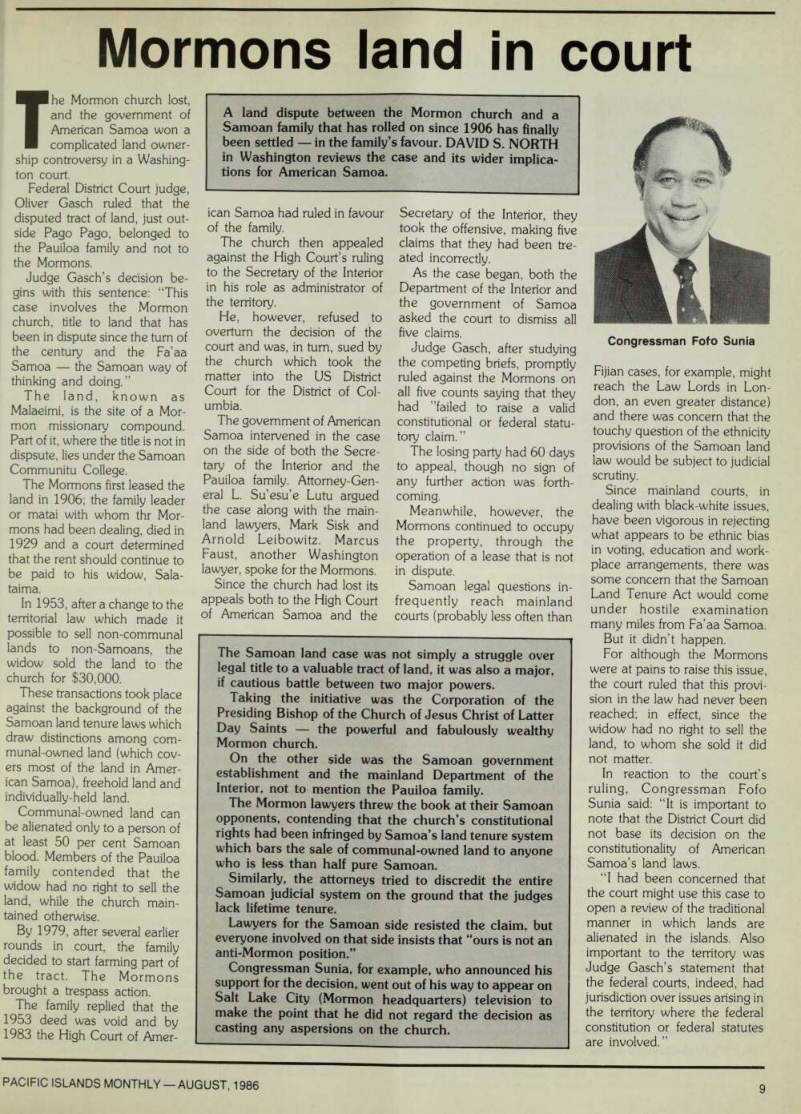
In reaction to the court’s ruling, Congressman Fofo Sunia said: “It is important to note that the District Court did not base its decision on the constitutionality of American Samoa’s land laws.
“I had been concerned that the court might use this case to open a review of the traditional manner in which lands are alienated in the islands. Also important to the territory was Judge Gasch’s statement that the federal courts, indeed, had jurisdiction over issues arising in the territory where the federal constitution or federal statutes are involved.”
Congressman Fofo Sunia