pacific report
pp. 7-8 · Read in the full issue
Special Border
Zone Planned
Papua New Guinea will consider setting up a 60-kilometre special development zone alomg its border with Indonesia.
The development along the border corri dor would include plans for roads, improved health facilities and village markets. The national government would take over responsibility for the zone from the two provincial governments, a spokesman for prime minister, Mr Paias Wingti, said. Indonesia is already under taking major development on its side of the border, including resettlement sites for transmigration immigrants and the trans-Irian highway.
Aid For Fruit
Juice Exporter
The Fiji government is to provide $370,000 for the country’s largest fruit juice manufacturer to help the company stay afloat. The parliament-approved sum came in response to a request from Fiji Citrus Products for $1.5 million. The Fiji Development Bank holds shares in the company which processes pine apples and oranges grown at its Vanua Levu orchards for the domestic market and for New Zealand. The company hopes to expand into Australia and other overseas markets.
Pacific Investment
Company Folds
A Malaysian investment agency, specialising in the South Pacific region, is being dissolved because of mounting debts. The Malaysian Overseas Invest ment Corporation MOIC owes banks and other creditors more than $2O million and all employees have received dismissal notices. The corporation was established four years ago with en couragement from Malaysian prime minister Dr Mahathir, as the first of five Malaysian companies seeking closer economic ties with the South Pacific nations. Apart from a hotel project in Suva, none of MOIC’s joint ventures in other South Pacific countries made any headway. The Fiji government is seeking new partners for the 200-room hotel on the seafront at Suva. Minister for econo mic development, Mr Peter Stinson said the failure of MOIC would not affect plans to build the hotel as the Malaysian company had not put in any money. The government, which was to have had a 30 per cent share in the hotel, had already received indications of interest from local and overseas parties.
Aviation Growth
Creates Problems
An aviation industry expert said the rapid growth of civil aviation in the Asia-Pacific region was posing challenges in provid ing suitable airports, tourism deve lopment and building the right kinds of aircraft for the region. The Managing Director of Singapore Airlines, Mr Cheong Choong Kong, told a seminar for industry executives that the In ternational Civil Aviation Organisation was predicting an annual growth rate of 10 per cent for passengers and 11 per cent for freight in the six years to 1992.
By that time, he said, the ICAO expected airlines in the region to be carrying 33 per cent of the world’s passengers and 37 per cent of international freight, surpassing Europe. Mr Cheong said airports were being built or expanded to meet future needs in many countries in the region including Australia, New Zea land and Tonga. He said United States manufacturers were beginning to design aircraft to meet the long-range needs of the region and that tourism was making a major contribution to expansion.
Breath Tests
For Drivers
The Fiji parliament passed a Bill to allow the introduction of breathalyser tests.
The Bill will empower the police to test drivers at random and enter property without warrants to carry out these tests.
Offenders face fines of up to $l5OO, disqualification and imprisonment. In troducing the Bill, the minister for trans port, Mr Tora, said breathalyser testing would help reduce the number of alco hol-related accidents on Fiji’s roads. The deputy speaker, Mr Vijay Paramanadam, however, accused the government of eroding the rights of citizens and said the Bill could be a forerunner to laws which could turn the country into a police state.
Sex And The
Secretive Society
The Papua New Guinea government plans to ban sex education in the country’s schools. Education minister, Mr Arum Matiabe, said PNG was a secretive society and sexual matters were not discussed openly by any age group. He said high school students were aroused by sex education lessons and many had been practising what they had learned of human reproduction. Mr Matiabe said statistics which show an increasing incidence of venereal dis ease among high school students sup ported his planned measure. He also planned to remove all pictures of human reproductive organs from school scien ce texts.
Indonesia Rejects
Irian Jayans
Indonesia refused to take back nine Irian Jayans who fled their home province for Australia last August. The Indonesian foreign minister, Dr Mochtar, said had informed his Australian counterpart, Mr Hayden, that the nine should not be returned. He said he also told Mr Hayden, during talks in Manila, that Indonesia would not object if Australia wanted more people from Irian Jaya.
Last August 11 Indonesians from the border province arrived by canoe in northern Australia. The Australian gov ernment has since granted two of them refugee status and has promised to find a third country in which they can settle.
Australia had suggested that the other nine be returned.
Cash Boost For
Sea Bed Mining
A search for sea bed mineral deposits in the South Pacific has been aided by a $3 million grant from the United Nations Development Program. The grant, to be spent over the next five years, was announced in Suva following a meeting of the Committee for Co-ordinating Offshore Prospecting in the South Paci fic (CCOP/SOPAC). The money is to help member states hire expert help to seek out manganese, phosphates and other minerals on the sea bed as well as on land. The members of CCOP/SOPAC are: Cook Islands, Fiji, Guam, Kiribati, New Zealand, Papua New Guinea, Solo mon Islands, Tonga, Tuvalu and Western Samoa. Australia is likely to seek membership at the group’s annual meet ing next month.
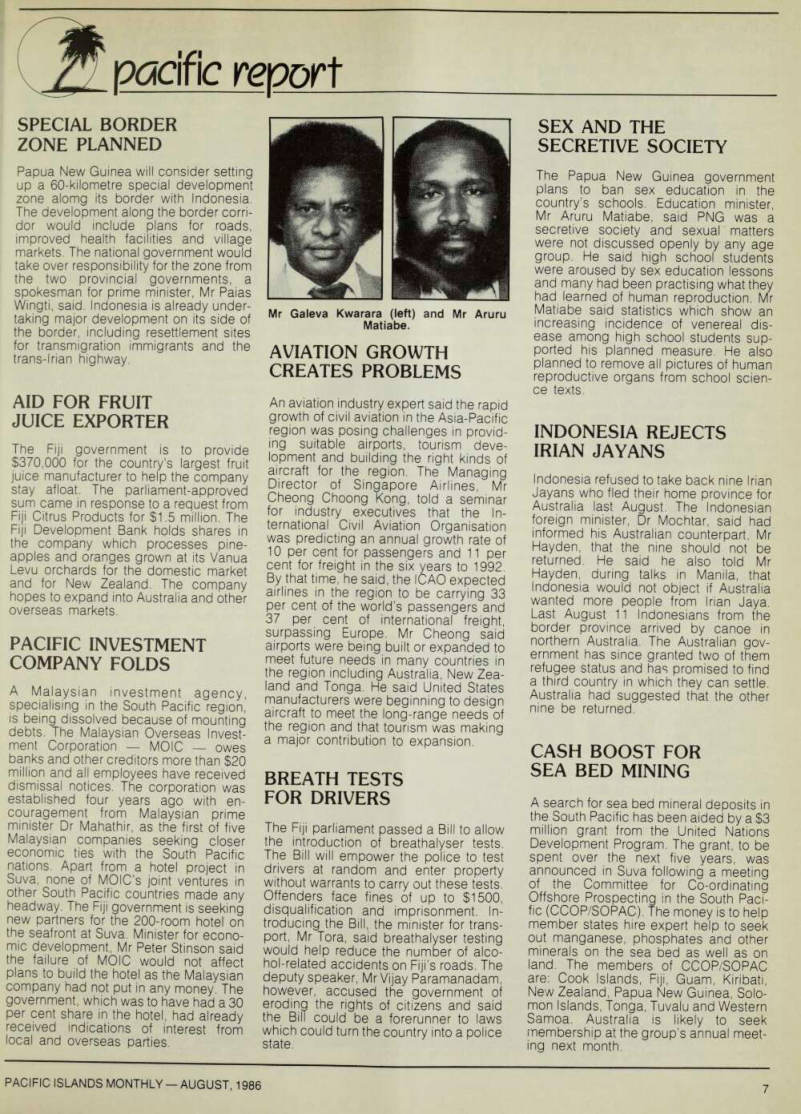
Mr Galeva Kwarara (left) and Mr Aruru Matiabe.
Tonga Slashes
Income Tax
Tonga has sharply reduced income and company taxes in a bid to stimulate investment. The new tax measures in clude a wide ranging sales tax and a reduction of most income tax from 40 per cent to 10 per cent. Company tax is reduced from 32.5 per cent to a maxi mum rate of 30 per cent. The five per cent sales tax will apply to all goods except home-building materials, agricultural and fish products and domestic airfares. Efforts in the past to diversify the kingdom’s agricultural ex ports have been relatively unsuccessful and Tonga continued to rely heavily on exports of coconut products and bana nas as main exports. Other foreign exchange comes from tourism and re mittances from overseas. Also, the Asia Development Bank announced a loan of $3 million to Tonga for technical assist ance. The bank said $2 million of the loan was intended for the establishment of small industries centres on Vava’u and Tongatapu as well as road and harbour improvements. Telecommunication faci lities on 'Eua island will also be im proved, while the remaining $1 million will go to the Tonga Development Bank to bolster its foreign exchange re sources.
Violent Films. Books
May Be Banned
The Papua New Guinea government is to introduce legislation to ban all films and books which portray violence and crime.
The minister for police, Mr Avusi Tanao, said crime in books and in films moti vated people, particularly the young unemployed, to commit crimes them selves. He said movie theatres were breeding grounds for criminals and that many of the worst felons in the country had learned their trades through films or comic books. And in Fiji, police commis sioner, Mr Premesh Raman, said a local crime wave was partly due to the influence of foreign films and video tapes. Mr Raman was launching a crime-prevention campaign last month.
He said the wave of crime which hit Fiji earlier in the year was something new and Fiji criminals were now better organ ised and were adopting sophisticated practices from overseas, although they were not being organised from abroad.
Mr Raman said their methods had been learned from video tapes and films.
No Request To
Join Asean
PNG has made no formal move to seek membership of the Association of South East Asian Nations (ASEAN), said acting minister for foreign affairs, Mr Galeva Kwarara. He was commenting on reports that foreign minister Mr Legu Vagi had applied for membership at the ASEAN foreign ministers meeting in Manila. “At
no stage was the matter ever put formally to ASEAN,” said Mr Kwarara. He said Mr Vagi had been asked by the government to seek information on the requirements for PNG to become a party to the treaty of amity and co-operation in South East Asia. “Unfortunately, there has been a deliberate media misrepre sentation linking partnership to this trea ty and membership in ASEAN,” he claimed. “The government treats both separately.” He said no decision had been made on PNG's status regarding ASEAN. “It would be true to say that Minister Vagi obtained some important information from ASEAN ministers in Manila. While assessment of this is being made, a decision on Papua New Guinea’s membership of ASEAN is much further down the tracks.” He said PNG was first and foremost a Pacific nation and the country’s association with ASEAN, where PNG has observer status, did not reflect any shift in emphasis. Mr
Kwarara pointed out that Mr Vagi’s first official visits had been to the Solomon Islands, Fiji and Vanuatu. Earlier, Opposition foreign affairs spokesman Mr John Giheno said the government was treating the members of the South Pacific Forum with contempt through its lack of caution in its approach to ASEAN.
The deputy Opposition leader, Fr John Momis, said ASEAN membership could compromise PNG if, in the future, it wished to support the independence movement in Irian Jaya against what he described as Indonesian occupation forces. Earlier, the Indonesian foreign minister Dr Mochtar Kusumatmadja said Indonesia would not oppose a PNG application for ASEAN membership, although any proposal would have to be approved by the five other member nations. Mr Kwarara said the PNG government welcomed the views of Mr Giheno and Fr Momis as a healthy sign in stimulating discussion.
Patrol Boats
Accepted
The Fiji government has decided to accept Australian-made patrol boats for surveillance purposes. Fiji originally de clined the Australian offer as the boats were thought to be too expensive to operate. Australian prime minister Mr Bob Hawke made the offer to Fiji and other island nations during the South Pacific Forum meeting in 1983. The boats will now be given to Fiji under a special aid program. Similar arrange ments were likely to be made for Papua New Guinea and Solomon Islands.
Bikini Islanders
Claim Compensation
The former inhabitants of Bikini atoll, forced to leave their homeland to make way for US nuclear weapons testing 40 years ago, have taken their battle for compensation into the US courts. They say that existing compensation arrange ments (PIM, April Page 19) are inadequ ate and have lodged a claim for US$525 million. The Bikinians, who numbered around 160 when they were evacuated in 1946, are now some 1300 strong and are scattered among neighbouring is lands. About half live on Kili, 640 kilometres from Bikini, where, says Biki nian Mr Tomaki Juda in Washington to press the compensation claim, the fishing grounds are infertile and the islanders depend on food supplies from the United States. Bikini site of 23 nuclear tests lies in the Marshall Islands which has concluded a compact of free association with the United States, making them largely self-gov erning with defence matters in the hands of the US. The compact grants the Bikinians US$75 million in compensation spread over 15 years but the Biki nians say the compact, which bars lawsuits and future claims, has deprived them of their rights.
Euro Mps In
Call To Free Ching
A group of left wing deputies from the European parliament has called on the authorities in French Polynesia to release separatist leader Charlie Ching, who was arrested in March last year during a protest against the Moruroa nuclear testing program. The group also claimed that Ching was being held in inhumane conditions. A resolution signed by 66 deputies condemned what it descibed as French colonial justice and drew a comparison between the jailing of Ching and French government attempts to negotiate an early release for the two Rainbow Warrior saboteurs in prison in New Zealand. Ching was convicted of organising an aunauthorised demonstra tion and was jailed for three and a half years. The deputies claimed he has served his sentence, so far, in a cramped cell usually reserved for spe cial punishment.
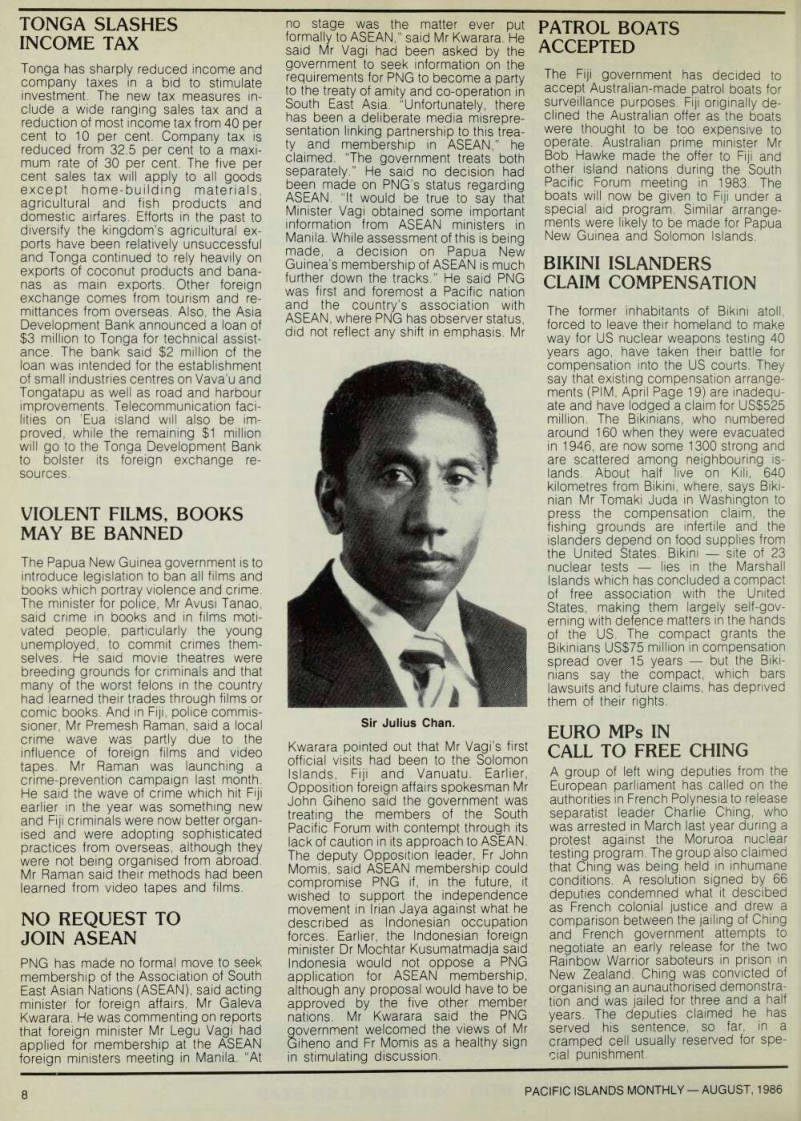
Sir Julius Chan.