Joyful journey
pp. 45-47 · Read in the full issue

books
Joyful journey without conclusions
Pacific Odyssey By Gwenda Cornell Adlard Coles, 218 pp,
Isbn 0 229 11758 9
“We had been made to feel part of the all-embracing Pacific family. Along with these small nations of our brothers and sisters, we looked warily at the threatening giants around the rim of their ocean.
“We shared their worries about the pollution of their waters, the nuclear intrusion into their peaceful existence, and the poaching of their fish by foreign fleets.
“I wondered if the influence
of the rest of the world would eventually destroy this peaceful Pacific or whether they would overcome it, adapt it and absorb it into their own culture and traditions.”
Thus Gwenda Cornell at the end of her story. There is, through much of the book, a sense of optimism and it is maintained, with due caution, to its closing paragraphs. I won der if she would feel able to maintain that optimism today. It is unlikely.
Not that her book is a de tailed political treatise on the future of the Pacific. It is far
from that and more power to Mrs Cornell; there are any number of learned academic works being published about the Pacific and they have one thing in common most will be unread. There’s a much better chance that Pacific Odys sey will have an audience.
And it deserves to have one.
For three years, the author who is English, her husband Jimmy who is Rumanian and their two children, Doina and Ivan, sailed the Pacific from Easter Island in the East to Papua New Guinea in the West.
They were extremely cau
tious sailors. They retired to New Zealand, for example, when the hurricane season ar rived and Ms Cornell details, with no pleasure, the fate of other, more foolhardy yachts men. Similarly, they preferred to wait in deep water rather than risk a late afternoon entr ance to a lagoon over a reef that might look safe but which might equally have them aground in seconds.
That same caution is re flected in the author’s approach to her subject. For the most part, she is content simply to tell what she saw and to be wary
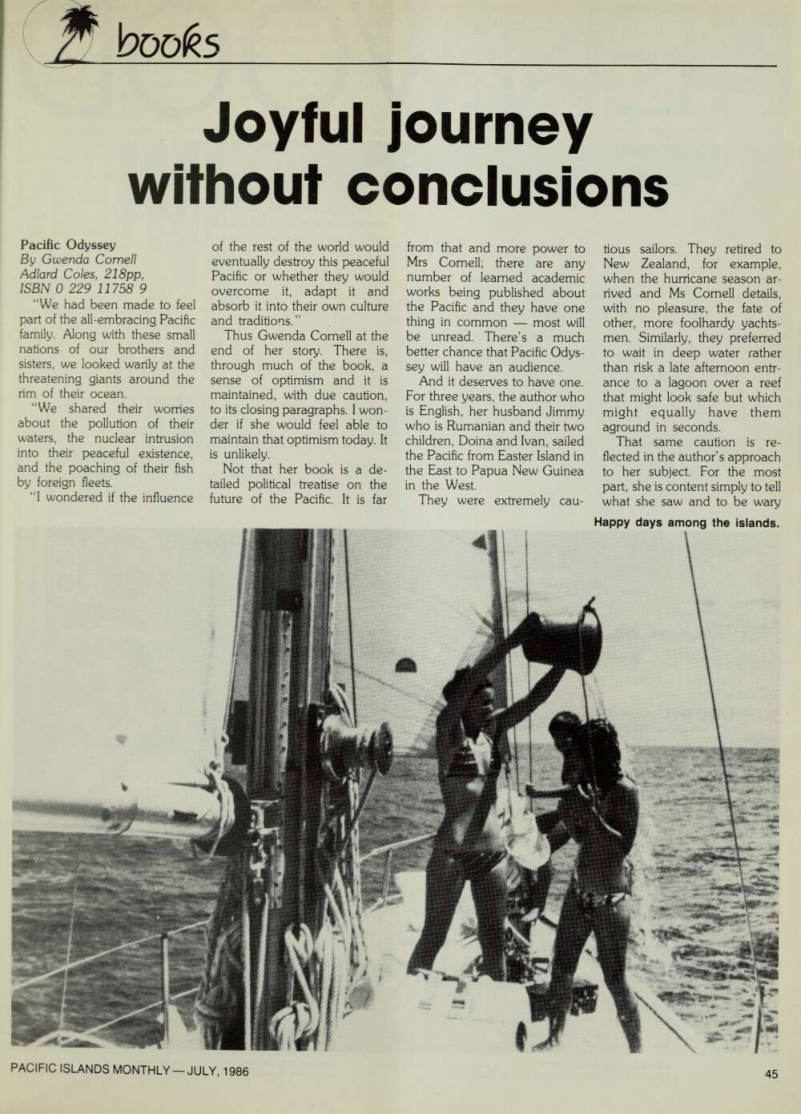
Happy days among the islands.
about drawing too many con clusions. That seems wise enough if Margaret Mead got it comprehensively wrong, an observer totally new to a string of different societies would do well not to push her luck.
It could be argued, of course, that a slim paperback of the this-is-where-I-went, this-is what-I-saw-and-this-is-what-itmeans variety is really rather unnecessary in this day and age. According to that argu ment, travel books are a pub lishing dinosaur. Sales figures in the bookshops of the world give the lie to that theory.
Avid readers of PIM will not discover many new places in Pacific Odyssey would they really expect to? But there are some surprises in store for them. An early chapter deals with the island of Mangareva in the Gambier Islands near Mururoa Atoll. It is a place whose contacts with the outside world have been overwhel mingly to its disadvantage. Last century, Catholic zealots im posed a harsh regime that led to the decimation of the island’s population.
More recently, Mangareva was among the islands which benefited most from French nuclear testing: that financial gain vanished when atmos pheric testing ended. Now it must struggle with a school curriculum dictated from Paris and quite alien to the islanders’ real needs.
Our travellers were wel
comed into the life of the island as anyone with a passing acquaintance with the Pacific would expect. They are also involved in a fracas involving alcohol and that won’t surprise any old hand either. . .1 wished these people had just been left alone on their beautiful island with their coco nut toddy instead of beer and wondered how paradise lost could ever be paradise re gained,” Ms Cornell writes.
I think she knew the answer even as she posed the question.
And if she didn’t then she knows it now. There never was any real chance of the major Pacific communities retaining the bulk of those many, good things from their traditional ex perience. I think there once was a possibility that some of the lonelier communities might be able to pick and choose from civilisation’s various “benefits” medicine and transport for example. That was the dream.
Sometimes, the dream com es true. For Ms Cornell it did so at Dregerhafen in Papua New Guinea where she found a high school, host to boarders from all over the province in classes all the way to university.
“The teachers came from many countries in the English speaking world as well as from all over New Guinea, which created a stimulating atmos phere. In the mornings, the more academic subjects were pursued, the school being well equipped with science labor-
atories, while in the afternoon there were sporting activities in the more practical subjects.”
But it’s not always like that and Ms Cornell reports on communities where the “no
ble” savage was always a joke and the beneficial influences of Western society have made no headway. Then there are what one might call the macro deve lopments in the Pacific.
Long term, bloody skir mishing is all but inevitable in New Caledonia, Vanuatu is establishing diplomatic relations with Libya and Kiribati has signed a fishing agreement with the Soviet Union. The West, despite years of warnings from writers in and editors of this esteemed journal, seems to have missed the boat, despite a burst of eleventh-hour fence mending.
It doesn’t do, of course, to be too morose about the future of the Pacific, nor should one take the easy way out of sinking into a morass of despair. What we can do is remember that Ms Cornell did the sailing on which her book is based just several years ago and there has already been immense change. That pace of that change is quite
unlikely to alter.
lan Hicks.