Pacific stamp box
p. 44 · Read in the full issue
Big news in the Pacific is America’s Bth International Stamp Exhibition called
Ameripex ’B6.
Held in Chicago’s O’Hara Exposition Centre from May 22 to June 1. The exhibition promised to be the finest ever in the USA with some of the world’s best philatelic collections.
The event also coincided with the centenaries of the prestigious American Philatelic Society and Smithsonian In stitute philatelic collection. Several Paci fic countries issued stamps in honor of the event. These include: Fiji, Mic ronesia, Papua New Guinea, Solomon Islands and Vanuatu.
While dealing with exhibitions, a reminder that the Stampex ’B6 will be held from August 4-10 in Adelaide.
Pacific countries will be represented.
Now that all the “excitement” of the Halley’s Comet visit has settled, several Pacific countries are still issuing souve nir stamps. One interesting advertise ment 1 saw was advertising com memorative first day covers of Austra lia’s 33c Halley’s stamp housing a Halley’s medal.
The company stated that given an annual inflation rate of 10.5 per cent the cost of a standard 33c stamp would have risen to $651 when the comet returns in 2062.
Not so many columns ago I said that the fuss caused by Australia Post’s sale of archive material had quietly settled.
However, Australia Post has now re vealed that much of the archival material which will be sold publicly consists of decimal stamps.
In fact most of the material for sale is identical to material already on the market. Stamp dealers are hopping mad as they rightly see such sales as damaging to the market.
It is the old story of supply and demand. Increasing supply decreases demand and prices. Many dealers are encouraging collectors to campaign vigorously to stop the sales.
Australia Post, in the meantime is standing fast and has, in fact, taken out advertisements in stamp magazines seeking to justify its actions, trying to explain that they will not damage the stamp collecting industry. As I said, however, any unloading of stock on to the market in quantity must upset the market.
Further, such actions must also create
an atmosphere of uncertainty in Austra lian stamps as one cannot be sure what stock Australia Post is likely to dump on the market next.
Complaints abound over the service given by Australia Post’s philatelic bureaus, and the enormous amount of philatelic material produced. With a good clean up of Australia Post such sales are not necessary and the needed philatelic material can be purchased for archives with the money raised with increased efficiency.
Finally, if in doubt about the wisdom of such sales look at what occurred in Britain a short time ago when the British Post Office unloaded material on to the
market and prices fell.
There’s an interesting story behind one of the unofficial cachets used by Pitcairn Island concerning postal mar kings. A Mrs Violet McCoy lived on the island but died in July 1973. The Governor of Pitcairn had to return letters sent to the deceased. Letters returned had the strange stamp “De ceased Return to Sender”.
The Governor explained that the message was made from a child’s rubber stamp set. It had only four letter e’s, and so the word “sender” could not be spelt fully as all the e’s were used up.
The Governor considered using the message “Dead Return to Sender” but he felt that lacked dignity. He couldn’t run down to the local store and buy another rubber stamp set and so left us with an interesting postal story.
A dispute has flared between Japan and Palau over the printing of an image of Japan’s Emperor Hirohito on a set of stamps commemorating the 60th anniversary of the Emperor’s reign.
The Japanese Government asked Palau to intervene immediately and have the printing stopped. It appears Palau’s National Development Bank has contracted a Tokyo stamp agent to release the set of stamps in Japan as a souvenir of the occasion and stands to make money from the venture.
The Japanese Government is upset because no official permission has been given for the use of the Emperor’s image. Meanwhile the President of Palau is denying his Government has any knowledge of the matter.
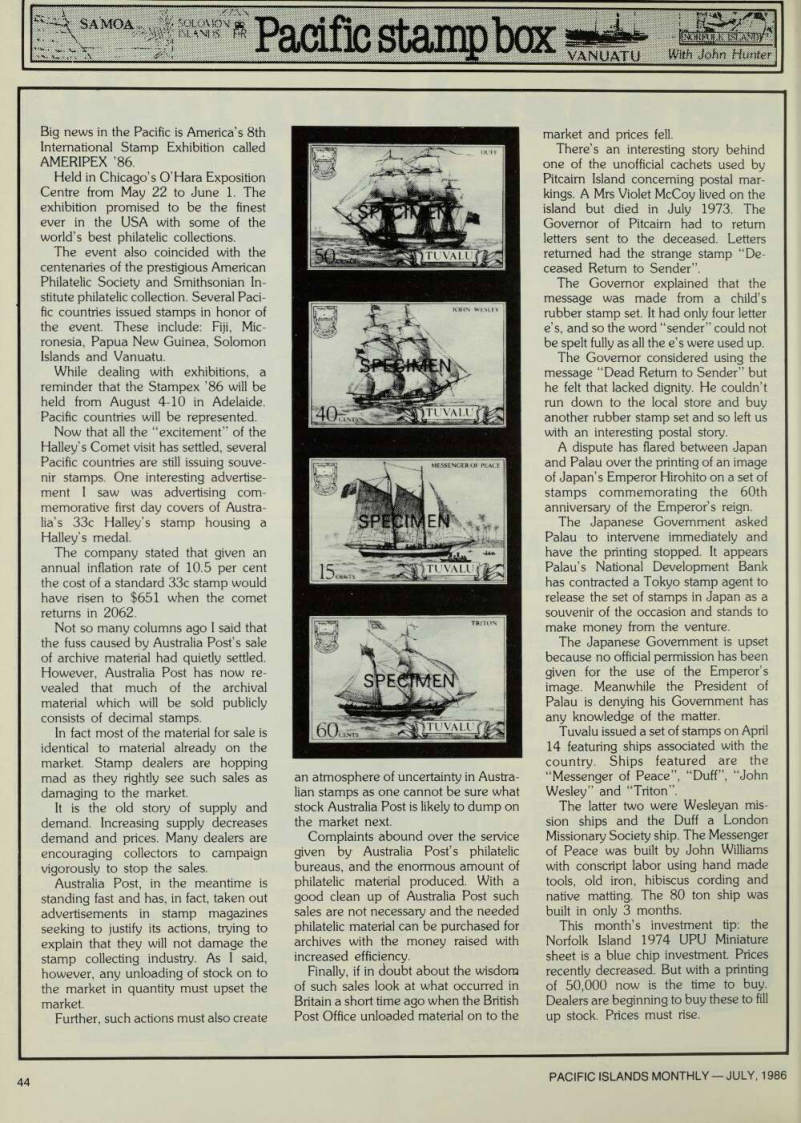
Tuvalu issued a set of stamps on April 14 featuring ships associated with the country. Ships featured are the “Messenger of Peace”, “Duff”, “John Wesley” and “Triton”.
The latter two were Wesleyan mis sion ships and the Duff a London Missionary Society ship. The Messenger of Peace was built by John Williams with conscript labor using hand made tools, old iron, hibiscus cording and native matting. The 80 ton ship was built in only 3 months.
This month’s investment tip: the Norfolk Island 1974 UPU Miniature sheet is a blue chip investment. Prices recently decreased. But with a printing of 50,000 now is the time to buy.
Dealers are beginning to buy these to fill up stock. Prices must rise.