conservationist fire
pp. 33-34 · Read in the full issue
The Gold Rush 2
Mining revival draws conservationist fire
Gold mining on a huge scale is poised for revival in New Zealand after a break of over three decades.
The new mines, led by the Waihi consortium, on North Island are the direct result of the application of new geological theory to vulcanogenic related occurences throughout the
So if aci^c - .
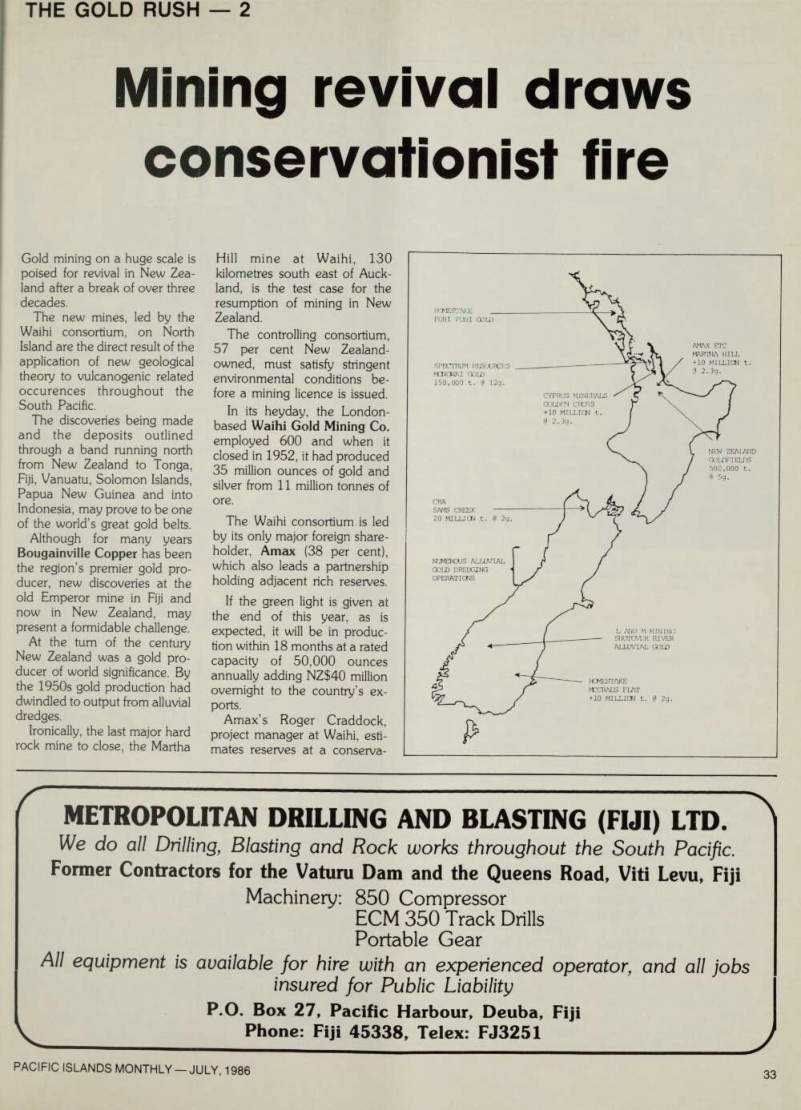
The discoveries being made and the deposits outlined through a band running north from Mew Zea Land to Tonga, Fiji, Vanuatu. Solomon Islands, Papua New Guinea and into Indonesia, may prove to be one of the world’s great gold belts.
Although for many years Bougainville Copper has been the region’s premier gold producer, new discoveries at the old Emperor mine in Fiji and now in New Zealand, may present a formidable challenge.
At the turn of the century New Zealand was a gold producer of world significance. By the 1950 s gold production had dwindled to output from alluvial dredges.
Ironically, the last major hard rock mine to close, the Martha
Hill mine at Waihi, 130 kilometres south east of Auck land, is the test case for the resumption of mining in New Zealand.
The controlling consortium, 57 per cent New Zealand owned, must satisfy stringent environmental conditions be fore a mining licence is issued.
In its heyday, the London based Waihi Gold Mining Co. employed 600 and when it closed in 1952, it had produced 35 million ounces of gold and silver from 11 million tonnes of ore.
The Waihi consortium is led by its only major foreign share holder, Amax (38 per cent), which also leads a partnership holding adjacent rich reserves.
If the green light is given at the end of this year, as is expected, it will be in produc tion within 18 months at a rated capacity of 50,000 ounces annually adding NZ$4O million overnight to the country’s ex ports.
Amax’s Roger Craddock, project manager at Waihi, esti mates reserves at a conserve-
tive 14 million tonnes, averag ing 3 grams per tonne.
An open cut pit reaching 200 metres deep is planned on the site of the old underground workings which extended to over 350 metres deep.
Waihi’s projected output compares to the capacity of 180,000 ounces annually from North Queensland’s Kidston Gold Mine, Australia’s largest.
New Zealand energy minister Bob Tizard has described the Waihi gold project as of na tional importance. This drew an immediate broadside from con servationists who claimed he was pre-judging the outcome of the New Zealand Planning Tribunal which is still to hear objections to the mine.
Conservationist sentiments are also focussing on Waihi as a test case because it opens up the whole question of mining on the romantic Coromandel peninsula.
The Coromandel, which en closes the Firth of the Thames
from the east, was the centre of gold mining in the last century.
“Foirty-niners” on their way across the Pacific to the gold fields of Australia, made the first authenticated gold discovery in New Zealand in 1852.
The major mining centre be came the Thames, where the first find was located in 1867 in a stream bed.
This became a mine known as the Shotover which pro duced in excess of 100,000 ounces of bullion. The Thames mines became world famous for so-called bonanza lodes.
The Manukau mine on a reef averaging 4 oz tonne dipped into the Golden Crown mine leases where the first crushings averaged 54 oz tonne. This rich vein led to the boundary of yet another mine, the Caledonian, where two tonnes of “speci men” ore yielded 25,000 ounces of gold a figure not known to have been surpassed by any of the other mines.
Geologists are convinced there is more where that came from.
But the conservationists say that the extra NZ$l5 billion in gold that the miners say may still be there is not worth distur bing the peninsula for.
The Coromandel is now the playground of potters, alterna tive lifestyle communities and weekenders.
They have formed a group called Coromandel Peninsula Watchdog and have taken up an active campaign against the miners.
Watchdog’s leading spokes man Mark Tygendhaft argues that the significance of the proposal’s economic benefit to New Zealand and the commer cial viability of the project, should be the subject of an independent study rather than relying on figures prepared by the mining partners.
There seems no doubt there will be a bitter fight to the last over the resumption of mining in New Zealand. But with one of the Lange government’s most senior ministers throwing his weight behind the project, it may well be just a matter of
time.
Denis Reinhardt.
Waihi’s Bob Drury ... back to the good old days photo Shar Adams.