Your guide to the gold rush
p. 32 · Read in the full issue
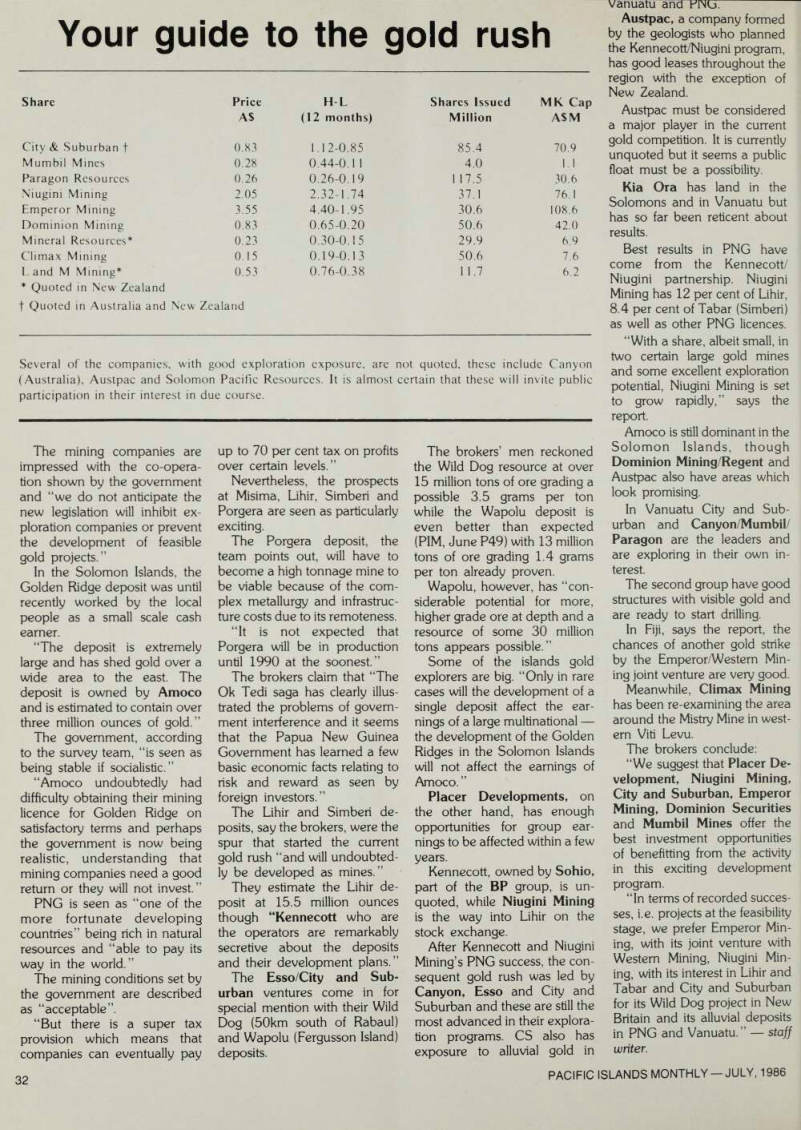
Several of the companies, with good exploration exposure, are not quoted, these include Canyon (Australia), Austpac and Solomon Pacific Resources. It is almost certain that these will invite public participation in their interest in due course.
The mining companies are impressed with the co-opera tion shown by the government and “we do not anticipate the new legislation will inhibit ex ploration companies or prevent the development of feasible gold projects.”
In the Solomon Islands, the Golden Ridge deposit was until recently worked by the local people as a small scale cash earner.
“The deposit is extremely large and has shed gold over a wide area to the east. The deposit is owned by Amoco and is estimated to contain over three million ounces of gold.”
The government, according to the survey team, “is seen as being stable if socialistic.”
“Amoco undoubtedly had difficulty obtaining their mining licence for Golden Ridge on satisfactory terms and perhaps the government is now being realistic, understanding that mining companies need a good return or they will not invest.”
PNG is seen as “one of the more fortunate developing countries” being rich in natural resources and “able to pay its way in the world.”
The mining conditions set by the government are described as “acceptable”.
“But there is a super tax provision which means that companies can eventually pay
up to 70 per cent tax on profits over certain levels.”
Nevertheless, the prospects at Misima, Lihir, Simberi and Porgera are seen as particularly exciting.
The Porgera deposit, the team points out, will have to become a high tonnage mine to be viable because of the com plex metallurgy and infrastruc ture costs due to its remoteness.
“It is not expected that Porgera will be in production until 1990 at the soonest.”
The brokers claim that “The Ok Tedi saga has clearly illus trated the problems of govern ment interference and it seems that the Papua New Guinea Government has learned a few basic economic facts relating to risk and reward as seen by foreign investors.”
The Lihir and Simberi de posits, say the brokers, were the spur that started the current gold rush “and will undoubted ly be developed as mines.”
They estimate the Lihir de posit at 15.5 million ounces though “Kennecott who are the operators are remarkably secretive about the deposits and their development plans.”
The Esso/City and Sub urban ventures come in for special mention with their Wild Dog (50km south of Rabaul) and Wapolu (Fergusson Island) deposits.
The brokers’ men reckoned the Wild Dog resource at over 15 million tons of ore grading a possible 3.5 grams per ton while the Wapolu deposit is even better than expected (PIM, June P 49) with 13 million tons of ore grading 1.4 grams per ton already proven.
Wapolu, however, has “con siderable potential for more, higher grade ore at depth and a resource of some 30 million tons appears possible.”
Some of the islands gold explorers are big. “Only in rare cases will the development of a single deposit affect the ear nings of a large multinational the development of the Golden Ridges in the Solomon Islands will not affect the earnings of Amoco.”
Placer Developments, on the other hand, has enough opportunities for group ear nings to be affected within a few years.
Kennecott, owned by Sohio, part of the BP group, is un quoted, while Niugini Mining is the way into Lihir on the stock exchange.
After Kennecott and Niugini Mining’s PNG success, the con sequent gold rush was led by Canyon, Esso and City and Suburban and these are still the most advanced in their explora tion programs. CS also has exposure to alluvial gold in
Vanuatu and Austpac, a company formed by the geologists who planned the Kennecott/Niugini program, has good leases throughout the region with the exception of New Zealand.
Austpac must be considered a major player in the current gold competition. It is currently unquoted but it seems a public float must be a possibility.
Kia Ora has land in the Solomons and in Vanuatu but has so far been reticent about results.
Best results in PNG have come from the Kennecott/ Niugini partnership. Niugini Mining has 12 per cent of Lihir, 8.4 per cent of Tabar (Simberi) as well as other PNG licences.
“With a share, albeit small, in two certain large gold mines and some excellent exploration potential, Niugini Mining is set to grow rapidly,” says the report.
Amoco is still dominant in the Solomon Islands, though Dominion Mining/Regent and Austpac also have areas which look promising.
In Vanuatu City and Sub urban and Canyon/Mumbil/ Paragon are the leaders and are exploring in their own in terest.
The second group have good structures with visible gold and are ready to start drilling.
In Fiji, says the report, the chances of another gold strike by the Emperor/Western Min ing joint venture are very good.
Meanwhile, Climax Mining has been re-examining the area around the Mistry Mine in west ern Viti Levu.
The brokers conclude; “We suggest that Placer De velopment, Niugini Mining, City and Suburban, Emperor Mining, Dominion Securities and Mumbil Mines offer the best investment opportunities of benefitting from the activity in this exciting development program.
“In terms of recorded succes ses, i.e. projects at the feasibility stage, we prefer Emperor Min ing, with its joint venture with Western Mining, Niugini Min ing, with its interest in Lihir and Tabar and City and Suburban for its Wild Dog project in New Britain and its alluvial deposits in PNG and Vanuatu.” staff writer.
Share Price H L Shares Issued MK Cap A$ (12 months) Million A$M City & Suburban f 0.83 1.12-0.85 85.4 70.9 Mumbil Mines 0.28 0.44-0.1 1 4.0 l.l Paragon Resources 0.26 0.26-0.19 1 17.5 30.6 Niugini Mining 2,05 2.32-1.74 37.1 76.1 Emperor Mining 3.55 4.40-1.95 30.6 108.6 Dominion Mining 0.83 0.65-0.20 50.6 42.0 Mineral Resources* 0.23 0.30-0.15 29.9 6.9 Climax Mining 0.15 0.19-0.13 50.6 7.6 L and M Mining* 0.53 0.76-0.38 11.7 6.2 * Quoted in New Zealand t Quoted in Australia and New Zealand