Solidarity with Ghaddafi
pp. 8-9 · Read in the full issue
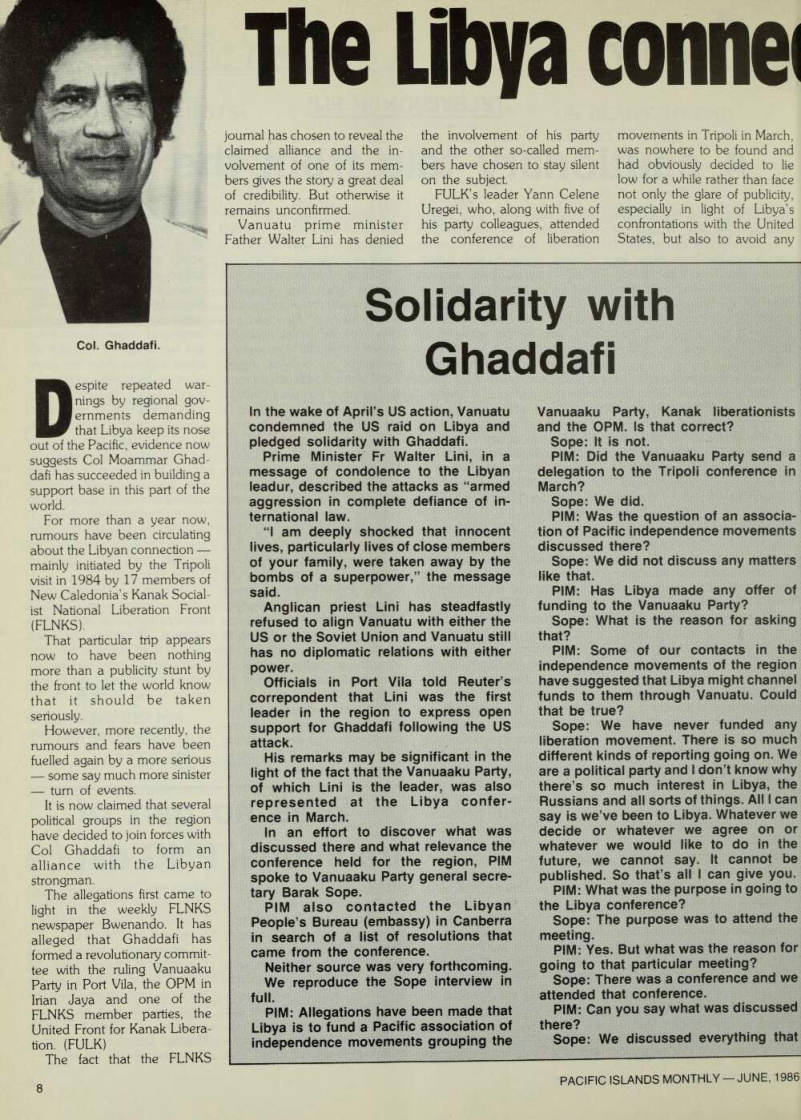
Ghaddafi
In the wake of April’s US action, Vanuatu condemned the US raid on Libya and pledged solidarity with Ghaddafi.
Prime Minister Fr Walter Lini, in a message of condolence to the Libyan leadur, described the attacks as “armed aggression in complete defiance of in ternational law.
“I am deeply shocked that innocent lives, particularly lives of close members of your family, were taken away by the bombs of a superpower,” the message said.
Anglican priest Lini has steadfastly refused to align Vanuatu with either the US or the Soviet Union and Vanuatu still has no diplomatic relations with either power.
Officials in Port Vila told Reuter’s correpondent that Lini was the first leader in the region to express open support for Ghaddafi following the US attack.
His remarks may be significant in the light of the fact that the Vanuaaku Party, of which Lini is the leader, was also represented at the Libya confer ence in March.
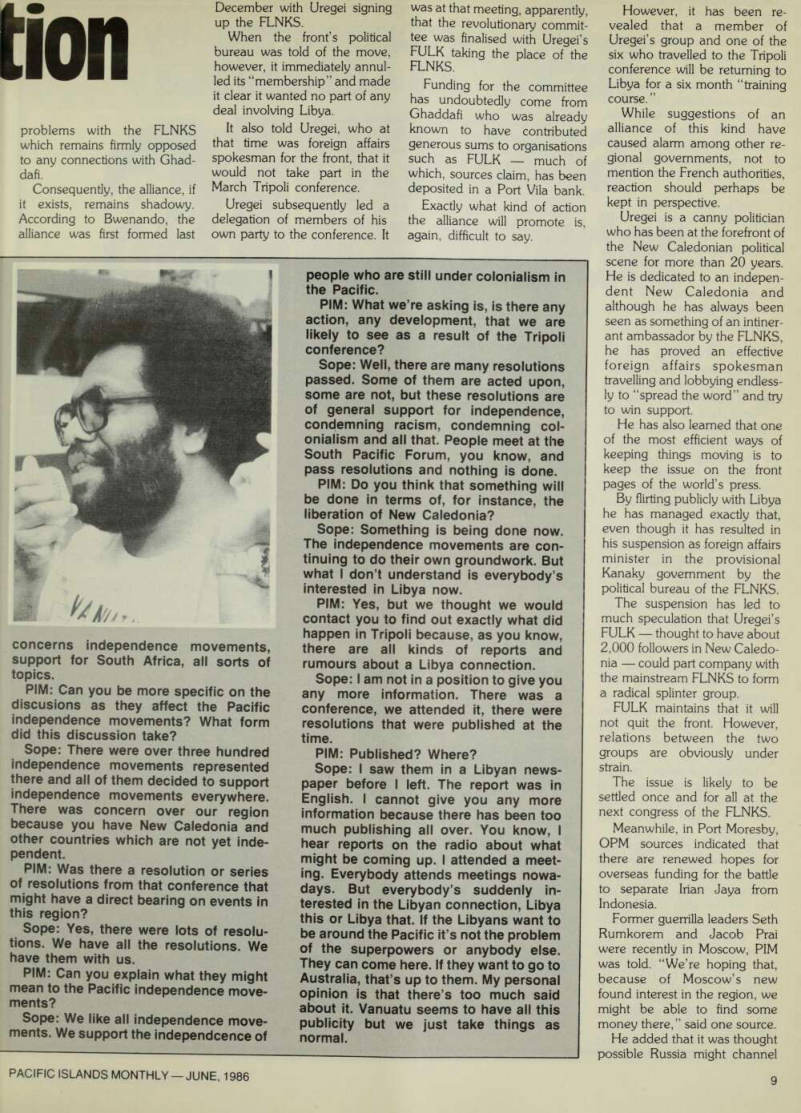
In an effort to discover what was discussed there and what relevance the conference held for the region, PIM spoke to Vanuaaku Party general secre tary Barak Sope.
PIM also contacted the Libyan People’s Bureau (embassy) in Canberra in search of a list of resolutions that came from the conference.
Neither source was very forthcoming.
We reproduce the Sope interview in full.
PIM: Allegations have been made that Libya is to fund a Pacific association of independence movements grouping the
Vanuaaku Party, Kanak liberationists and the OPM. Is that correct?
Sope: It is not.
PIM: Did the Vanuaaku Party send a delegation to the Tripoli conference in March?
Sope: We did.
PIM: Was the question of an associa tion of Pacific independence movements discussed there?
Sope: We did not discuss any matters like that.
PIM: Has Libya made any offer of funding to the Vanuaaku Party?
Sope: What is the reason for asking that?
PIM: Some of our contacts in the independence movements of the region have suggested that Libya might channel funds to them through Vanuatu. Could that be true?
Sope: We have never funded any liberation movement. There is so much different kinds of reporting going on. We are a political party and I don’t know why there’s so much interest in Libya, the Russians and all sorts of things. All I can say is we’ve been to Libya. Whatever we decide or whatever we agree on or whatever we would like to do in the future, we cannot say. It cannot be published. So that’s all I can give you.
PIM: What was the purpose in going to the Libya conference?
Sope: The purpose was to attend the meeting.
PIM: Yes. But what was the reason for going to that particular meeting?
Sope: There was a conference and we attended that conference.
PIM: Can you say what was discussed there?
Sope: We discussed everything that
concerns independence movements, support for South Africa, all sorts of topics.
PIM: Can you be more specific on the discusions as they affect the Pacific independence movements? What form did this discussion take?
Sope: There were over three hundred independence movements represented there and all of them decided to support independence movements everywhere.
There was concern over our region because you have New Caledonia and other countries which are not yet inde pendent.
PIM: Was there a resolution or series of resolutions from that conference that might have a direct bearing on events in this region?
Sope: Yes, there were lots of resolu tions. We have all the resolutions. We have them with us.
PIM: Can you explain what they might mean to the Pacific independence move ments?
Sope: We like ail independence move ments. We support the independcence of
people who are still under colonialism in the Pacific.
PIM: What we’re asking is, is there any action, any development, that we are likely to see as a result of the Tripoli conference?
Sope; Well, there are many resolutions passed. Some of them are acted upon, some are not, but these resolutions are of general support for independence, condemning racism, condemning col onialism and all that. People meet at the South Pacific Forum, you know, and pass resolutions and nothing is done.
PIM: Do you think that something will be done in terms of, for instance, the liberation of New Caledonia?
Sope: Something is being done now.
The independence movements are con tinuing to do their own groundwork. But what I don’t understand is everybody’s interested in Libya now.
PIM: Yes, but we thought we would contact you to find out exactly what did happen in Tripoli because, as you know, there are all kinds of reports and rumours about a Libya connection.
Sope: I am not in a position to give you any more information. There was a conference, we attended it, there were resolutions that were published at the time.
PIM: Published? Where?
Sope: I saw them in a Libyan news paper before I left. The report was in English. I cannot give you any more information because there has been too much publishing all over. You know, I hear reports on the radio about what might be coming up. I attended a meet ing. Everybody attends meetings nowa days. But everybody’s suddenly in terested in the Libyan connection, Libya this or Libya that. If the Libyans want to be around the Pacific it’s not the problem of the superpowers or anybody else.
They can come here. If they want to go to Australia, that’s up to them. My personal opinion is that there’s too much said about it. Vanuatu seems to have ail this publicity but we just take things as normal.