The Libya conne[?]
pp. 8-10 · Read in the full issue
Despite repeated war nings by regional gov ernments demanding that Libya keep its nose out of the Pacific, evidence now suggests Col Moammar Ghad dafi has succeeded in building a support base in this part of the world.
For more than a year now, rumours have been circulating about the Libyan connection mainly initiated by the Tripoli visit in 1984 by 17 members of New Caledonia’s Kanak Social ist National Liberation Front
(Flnks).
That particular trip appears now to have been nothing more than a publicity stunt by the front to let the world know that it should be taken seriously.
However, more recently, the rumours and fears have been fuelled again by a more serious some say much more sinister turn of events.
It is now claimed that several political groups in the region have decided to join forces with Col Ghaddafi to form an alliance with the Libyan strongman.
The allegations first came to light in the weekly FLNKS newspaper Bwenando. It has alleged that Ghaddafi has formed a revolutionary commit tee with the ruling Vanuaaku Party in Port Vila, the OPM in Irian Jaya and one of the FLNKS member parties, the United Front for Kanak Libera tion. (FULK) The fact that the FLNKS
journal has chosen to reveal the claimed alliance and the in volvement of one of its mem bers gives the story a great deal of credibility. But otherwise it remains unconfirmed.
Vanuatu prime minister Father Walter Lini has denied
the involvement of his party and the other so-called mem bers have chosen to stay silent on the subject.
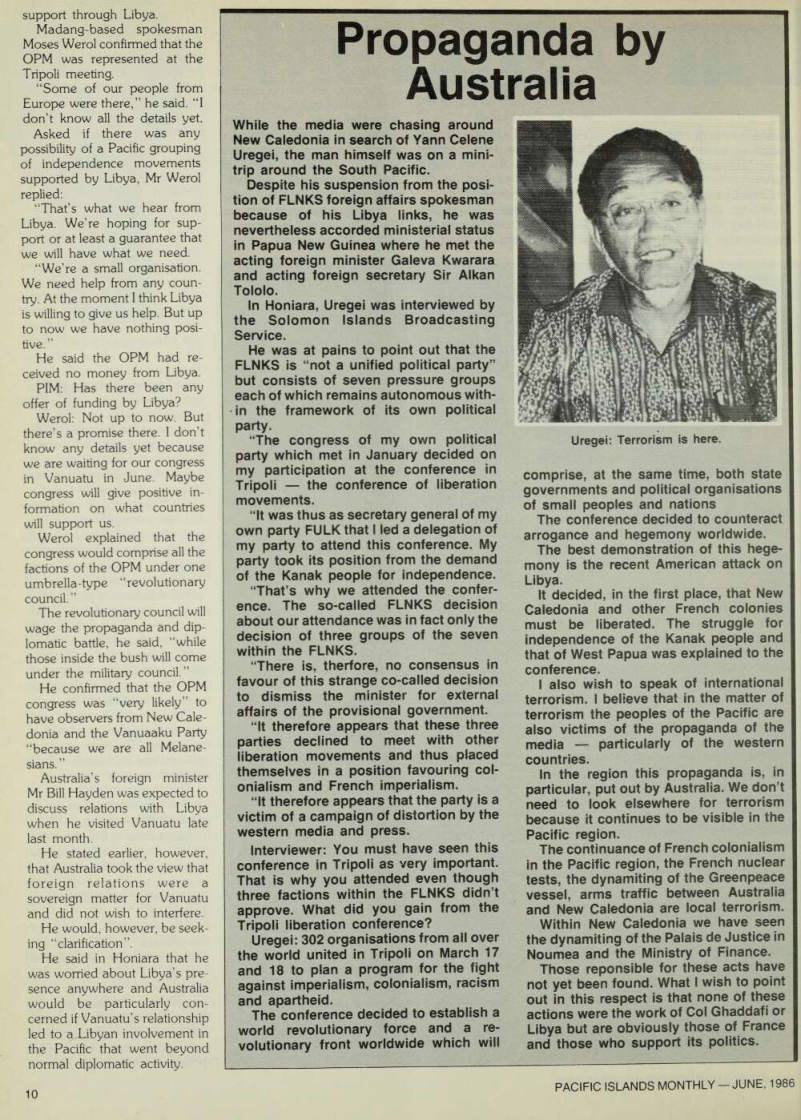
FULK’s leader Yann Celene Uregei, who, along with five of his party colleagues, attended the conference of liberation
movements in Tripoli in March, was nowhere to be found and had obviously decided to lie low for a while rather than face not only the glare of publicity, especially in light of Libya’s confrontations with the United States, but also to avoid any
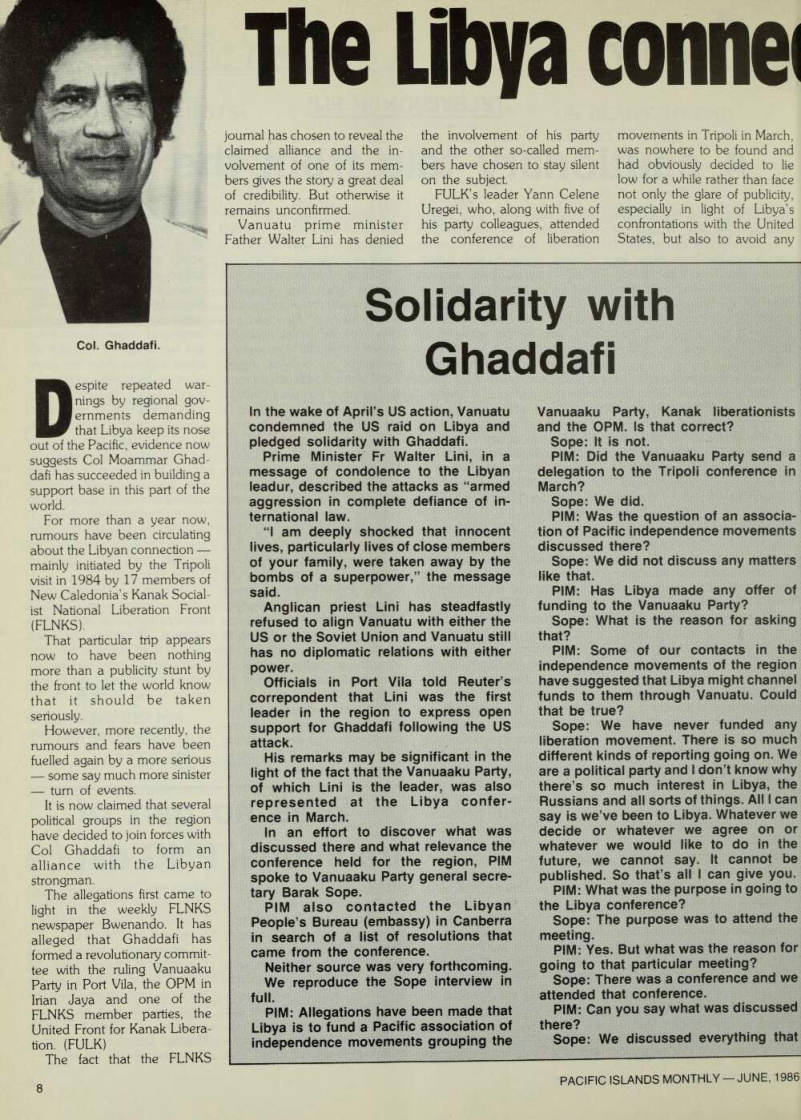
Col. Ghaddafi.
problems with the FLNKS which remains firmly opposed to any connections with Ghad dafi.
Consequently, the alliance, if it exists, remains shadowy.
According to Bwenando, the alliance was first formed last
December with Uregei signing up the FLNKS.
When the front’s political bureau was told of the move, however, it immediately annul led its “membership” and made it clear it wanted no part of any deal involving Libya.
It also told Uregei, who at that time was foreign affairs spokesman for the front, that it would not take part in the March Tripoli conference.
Uregei subsequently led a delegation of members of his own party to the conference. It
was at that meeting, apparently, that the revolutionary commit tee was finalised with Uregei’s FULK taking the place of the
Flnks.
Funding for the committee has undoubtedly come from Ghaddafi who was already known to have contributed generous sums to organisations such as FULK much of which, sources claim, has been deposited in a Port Vila bank.
Exactly what kind of action the alliance will promote is, again, difficult to say.
However, it has been re vealed that a member of Uregei’s group and one of the six who travelled to the Tripoli conference will be returning to Libya for a six month “training course. ”
While suggestions of an alliance of this kind have caused alarm among other re gional governments, not to mention the French authorities, reaction should perhaps be kept in perspective.
Uregei is a canny politician who has been at the forefront of the New Caledonian political scene for more than 20 years.
He is dedicated to an indepen dent New Caledonia and although he has always been seen as something of an intiner ant ambassador by the FLNKS, he has proved an effective foreign affairs spokesman travelling and lobbying endless ly to “spread the word” and try to win support.
He has also learned that one of the most efficient ways of keeping things moving is to keep the issue on the front pages of the world’s press.
By flirting publicly with Libya he has managed exactly that, even though it has resulted in his suspension as foreign affairs minister in the provisional Kanaky government by the political bureau of the FLNKS.
The suspension has led to much speculation that Uregei’s FULK thought to have about 2,000 followers in New Caledo nia could part company with the mainstream FLNKS to form a radical splinter group.
FULK maintains that it will not quit the front. However, relations between the two groups are obviously under strain.
The issue is likely to be settled once and for all at the next congress of the FLNKS.
Meanwhile, in Port Moresby, OPM sources indicated that there are renewed hopes for overseas funding for the battle to separate Irian Jaya from Indonesia.
Former guerrilla leaders Seth Rumkorem and Jacob Prai were recently in Moscow, PIM was told. “We’re hoping that, because of Moscow’s new found interest in the region, we might be able to find some money there,” said one source.
He added that it was thought possible Russia might channel
support through Libya.
Madang-based spokesman Moses Werol confirmed that the OPM was represented at the Tripoli meeting.
“Some of our people from Europe were there,” he said. “I don’t know all the details yet.
Asked if there was any possibility of a Pacific grouping of independence movements supported by Libya, Mr Werol replied: “That’s what we hear from Libya. We’re hoping for sup port or at least a guarantee that we will have what we need.
“We’re a small organisation.
We need help from any coun try. At the moment I think Libya is willing to give us help. But up to now we have nothing posi tive. ”
He said the OPM had re ceived no money from Libya.
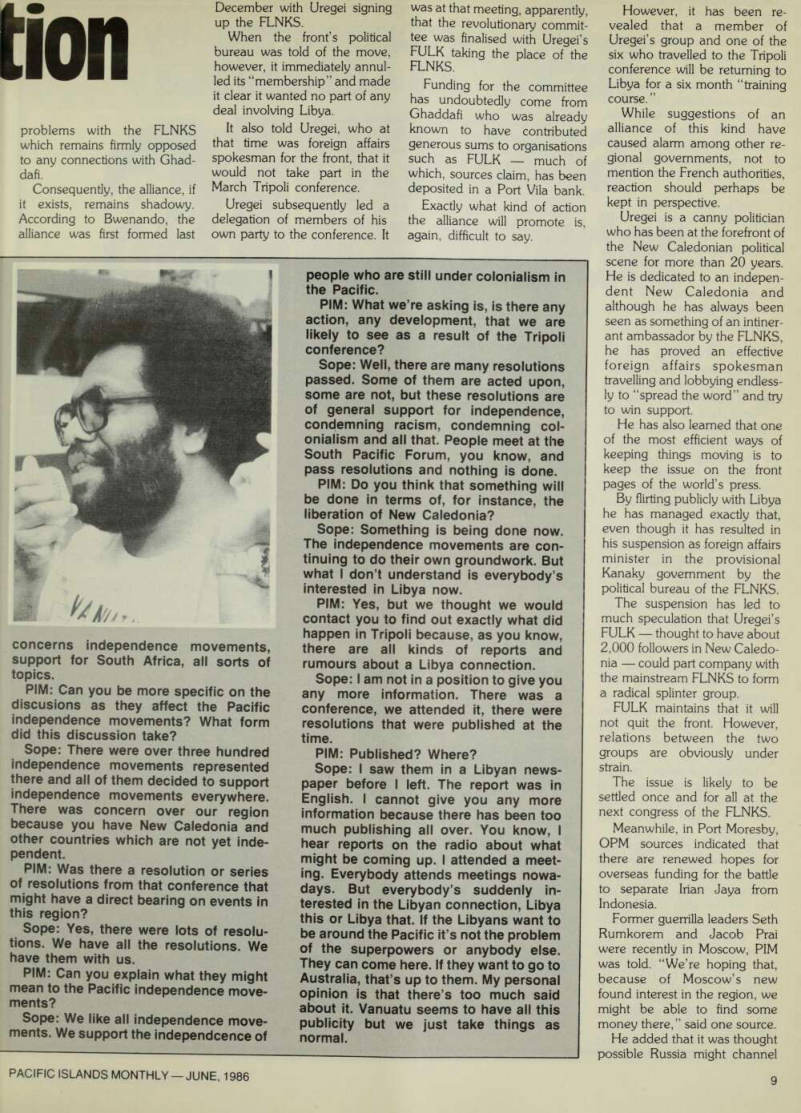
PIM: Has there been any offer of funding by Libya?
Werol; Not up to now. But there’s a promise there. I don’t know any details yet because we are waiting for our congress in Vanuatu in June. Maybe congress will give positive in formation on what countries will support us.
Werol explained that the congress would comprise all the factions of the OPM under one umbrella-type “revolutionary council.”
The revolutionary council will wage the propaganda and dip lomatic battle, he said, “while those inside the bush will come under the military council.”
He confirmed that the OPM congress was “very likely” to have observers from New Cale donia and the Vanuaaku Party “because we are all Melane sians. ”
Australia’s foreign minister Mr Bill Hayden was expected to discuss relations with Libya when he visited Vanuatu late last month.
He stated earlier, however, that Australia took the view that foreign relations were a sovereign matter for Vanuatu and did not wish to interfere.
He would, however, be seek ing “clarification”.
He said in Honiara that he was worried about Libya’s pre sence anywhere and Australia would be particularly con cerned if Vanuatu’s relationship led to aJJbyan involvement in the Pacific that went beyond normal diplomatic activity.