who helped make Fiji
pp. 44-45 · Read in the full issue
books
A motley crew of Australians who helped make Fiji
Adventurous Spirits: Austra lian Migrant Society in pre cession Fiji. By John Young.
Published 1985 by University of Queensland Press. ISBN 0 70221704 2. Price SA4O.
The second half of the 19th century was just as exciting a period in Fiji as it was in other more publicised parts of the world such as India, the Amer ican West and the Australian goldfields. Probably because there were no major battles, this period in the islands has largely escaped the attention of novel ists and historians.
Professor John Young pro vides a great deal of informa tion in his Adventurous Spirits both on the development of Fiji and the early history of some of Fiji’s most prominent families.
The author disagrees with the popular historical concept that the rise of the chieftancy of Bau was due to the influence of white beachcombers and their muskets. Otherwise he reflects the views of others in greater detail.
Professor Young includes settlers from all walks of life, from ex-convicts like Paddy Connell, sandalwood traders,
beche-de-mer traders and all those seamen who missed their ships and were left in Fiji. Later, as the tale unfolds, the reader learns of those who came to Fiji with the intention of settling down. Generally speaking those families that acquired land, either by purchase or by performing some service for one of the chiefs, are those that stayed, with many of their descendants still living in Fiji today.
Just over 100 years later, history is repeating itself on the matter of land acquisition.
Young writes of the sale of
islands in Northern Lau, sold off by the Tui Cakau after the landowners had assisted Waini qolo in an attempted attack on Taveuni. Those islands have, since that time, produced steady crops of cotton, then become some of the major copra-producing estates. Now the descendants of those earh, families have sold off those same islands for purposes other than agricultural production, Some have been bought rich owners, who visit then occasionally, others like Naitauba house religiou; groups. The latest reports indi
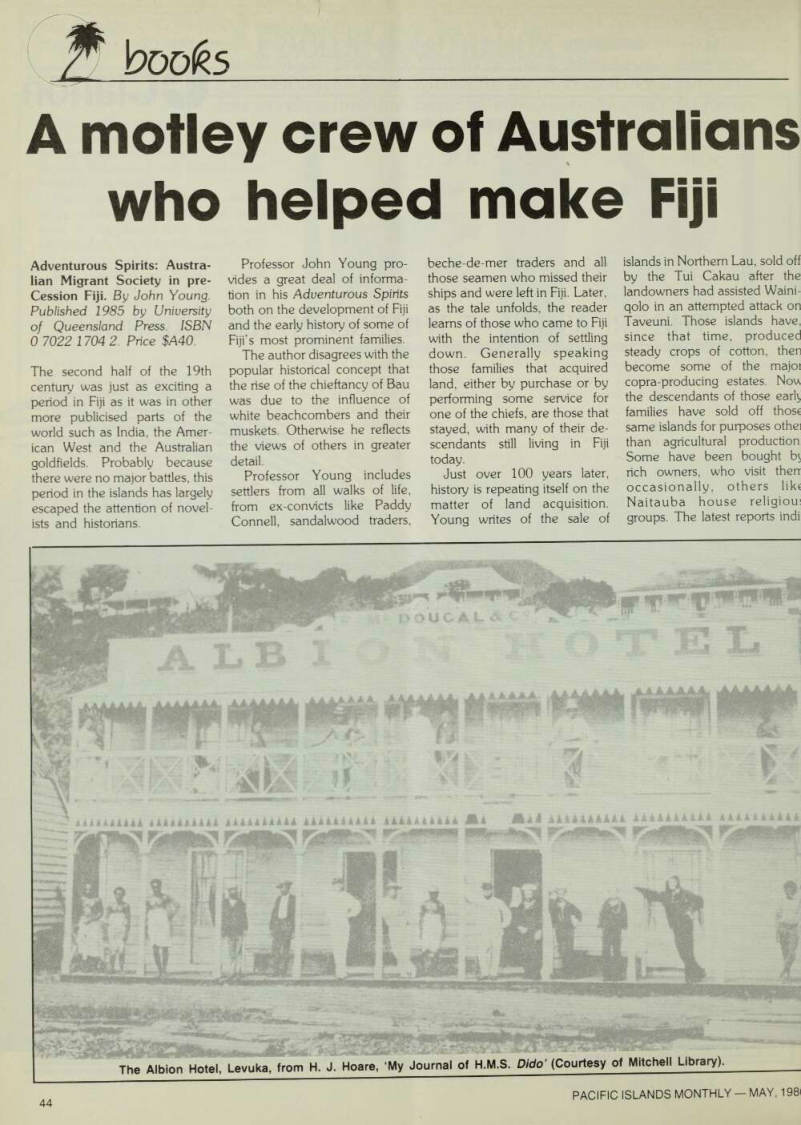
The Albion Hotel, Levuka, from H. J. Hoare, My Journal of H.M.S. Dido’ (Courtesy of Mitchell Library).
cate that Kanacea may be bought to accommodate the Gum Rajneesh, recently de ported from the U.S.A.
Similarly, as settlers came from both New Zealand and Australia to take up and deve lop agricultural land in those days, entrepreneurs are still arriving from the same places to buy land for development for the tourist industry.
A great deal of the deve lopment of Fiji, and this is a fact which places it in a unique position among the island countries, was begun in the homes and on the estates of those early pioneers.
Like many other works on Fiji, the tale of the adventurous spirits ends with the Cession of Fiji to the British Crown.
A gap in our knowledge of the country is the period 1874- 1924, in which I am sure the sons and grandsons of those early adventurers would figure strongly.
Another matter requiring the same diligent approach to re search displayed by this author, is the subject of Indian migra tion and settlement which have contributed so much to Fiji.
I commend this book, with its considerable amount of factual information, to any student of Fiji history. The binding is attractive, but the double spaced offset printing of the text detracts somewhat from the quality of the publication.
Nevertheless, Adventurous
Spirits should be on the shelves of all those who wish to have a knowledge of Fiji’s early deve lopment in pre-colonial times, and a must for those families A/ho wish to keep authentic 'ecords of the early days of their ancestors. Stanley B. 3rown.