commercial break?
pp. 33-35 · Read in the full issue
Can TV make the commercial break?
THE advertising industry in the islands is already switched on to television.
The agencies are eagerly looking forward to the in creased markets that they are sure TV will deliver. Commer cial TV, for them, is to be welcomed with open bank accounts.
Others in the media industry, however, are not so sure.
The current advertising “cake” in PNG, for instance, currently stands at about SUS 7 million annually, though that includes point of sale and Yel low Pages advertising, says HRD’s Phil Sawyer.
Sawyer is convinced, how ever, that TV will expand the advertising dollar.
“There are a lot of com panies, from what I can see, who will expand their budgets to encompass TV,” he said.
But, he agreed, somebody is bound to suffer. “I think the companies will divert from radio and cinema advertising more than from the news papers,” said Sawyer.
“I think the kind of advertis ing that will go to TV will be product specific, and I would suggest that the majority of product advertising is done by the multi-nationals.”
Companies such as Reckitt and Coleman, Colgate-Palmo live and Johnson and Johnson, said Sawyer, are well used to TV advertising elsewhere in the world and would find it a natural development in the South Pacific.
“Their problem at the mo ment is in getting awareness of their products out beyond the urban centres,” he said.
“As far as I am aware, the two proposals currently in place will provide greater coverage outside the urban centres than any existing media.”
The distance travelled by the government-owned FM radio, he said, was too short and the government’s countrywide AM service does not carry advertising.
“And even if television doesn’t have a wide reach in its initial stages, a lot of companies will still want to be there to establish themselves,” he said.
But will TV really reach the villages where some 86 per cent of the population still live?
Sawyer thinks so.
“If you look at what has happened with video, you’ll usually find at least one en trepreneurial person in each village who establishes a video set and charges a small fee for those who want to watch. TV would be a logical next step and I think that before too long
you’ll find a TV set in most villages.”
The recent budget (PIM last issue) slashed the import duty
Continued on page 35
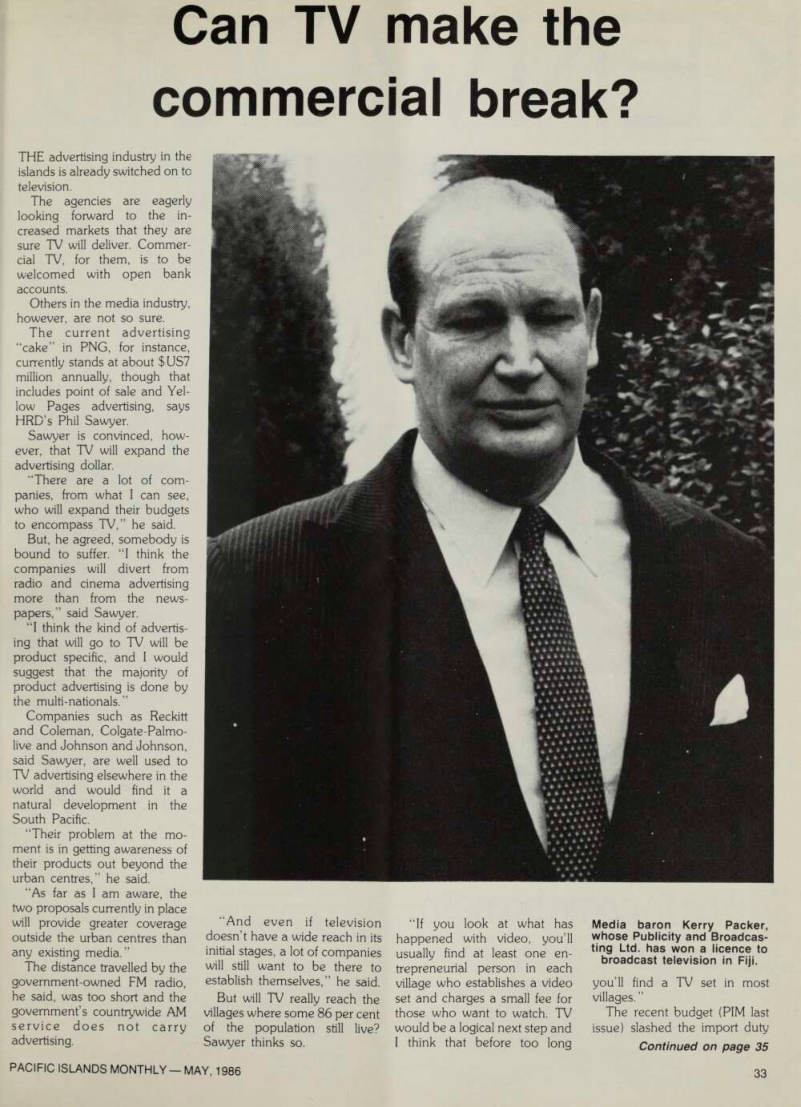
Media baron Kerry Packer, whose Publicity and Broadcas ting Ltd. has won a licence to broadcast television in Fiji.
Continued from page 33 on luxury goods from up to 85 per cent to 50 per cent. This, says Sawyer, will have the effect of reducing TV prices in the stores by about 25 per cent, TV’s impact on the local media scene is harder to prediet. The country is currently served by two daily English language newspapers, an upmarket weekly and a pidgin weekly.
The market is dominated by the PNG Post-Courier with a daily sale of 30,000-plus.
General manager Don Kennedy is less than convinced that TV is going to be a such a wonderful thing.
It s all very well to talk about expanding the market, but it seems to me that we have a certain market here, a certain and limited number of people who advertise,” he said.
If we have TV, it’s going to have to compete in an already fiercely competitive situation.
One result would be fewer newspapers.”
Kennedy also questions the ability of the TV companies to
produce local programming other than news bulletins. He worries that canned overseas material with, to say the least, limited relevance to PNG would become the order of the day.
“I know the TV companies will have done their home work,” he said. “But I wonder just how much they are aware of the market conditions here. I don’t see TV becoming corn mercially viable for quite some time to come.”
With most companies strap ped by high interest rates, he said, advertising budgets are often the first to feel the pinch.
Another competitor would make things uncomfortable for all concerned including the TV companies, he said, “They are talking about a large capital investment,” he said, “and I personally doubt the capacity of the market to give them a return.”
Even if TV did achieve its proposed market penetration, said Kennedy, the kind of pro ducts advertised may not appeal or be available to village dwellers.
Ross Addison of Fiji’s Wilson- Addison, however, is convinced TV “will bring Fiji into the 21st century. ”
“From my experience in the advertising industry and in tele vision in Australia, I think that television, apart from taking some of the revenue from the other media, will also generate its own revenue through marketing opportunities like direct response marketing which television can offer,” he said.
Addison believes, also, that TV will bring Fiji’s small businesses, who “do their own thing” in advertising, into the agency fold. “Most of them don’t retain the services of an ad agency, but with television they will have to because they don’t have the level of sophistication to go it alone.”
He says the current advertis ing spending in Fiji is about SUS 6 million which could ex pand to SUS 9 million within 18 months of television’s launch.
“The debate rages on here within the various factions about what’s good and bad
about it, but I think it ? s going to bring us into the 21st century and into touch with the outside world,” he said.
“It’s just a fact of life that it has to be commercial televi sion. ”
He accepts the fact that Fiji’s newspapers, already locked in a fierce competition for advertis ing revenue, are going to be affected.
“It’s going to make them become more sophisticated and give us more input, more de mographics that we’ve been asking for and haven’t got. It’s going to bring more sophistica tion to the media industry in general.”
Fiji currently supports two English language dailies and their Sunday sisters, two Fijian weeklies and a Hindi weekly.
The Fiji Times is the market leader and general manager Rex Gardner, while accepting the fact that the existing media are going to feel the pinch from TV, is not yet convinced that the profits are there for the television operators.
“Initially the newspapers will feel the pinch. It seems that some of the larger corporations here will divide their budget to accommodate TV.
“Some of the local businesses will be curious for a while and will probably divert some of their advertising to TV.”
The newspapers’ share of the advertising market will dimin ish, he said, with the market eventually expanding as TV becomes accepted.
“But the print media’s traditional markets will remain.
For instance, there’s pretty keen competition between the supermarkets here, and the print media can offer them the kind of service that television cannot,” he said.
He puts the market at around SUSS million which he sees expaning by some 20 per cent over a three to four year period.
“I wouldn’t expect any TV station to make roaring profits here initially. In fact I wouldn’t expect it to make any profits at all for the first few years,” he said.
“But I don’t see television as a major blow for us in the longer term.”