Executives volunteer
p. 32 · Read in the full issue
their skills
Since its inception in 1981 the Australian Executive Service Overseas Program (AESOP) has established operations in the South West Pacific, Papua New Guinea, ASEAN and China.
The program aims to assist businesses and institutions by upgrading their skills.
The joint venture between the Confederation of Australian Industry and the Australian De velopment Assistance Bureau was recently established as a limited liability company in Canberra.
AESOP maintains a list of available volunteers with their particular skills.
The company also provides airfares for its volunteers as well as medical and accident insur ance. The client is expected to provide accommodation and living expenses.
AESOP general manager Rod Cheatley said the com pany depends on being able to quickly locate a suitable qual ified person for each project.
When a request for assist ance is received the AESOP register is searched to identify a suitable volunteer whose curri culum vitae, if available, is sent to the client for acceptance.
The volunteer is then briefed
on the project and the host country.
He or she also prepares a final report covering results and recommendations. The client is also required to produce a report on the volunteer’s con tribution.
AESOP had 281 volunteers on the register at the end of last year and had approved 109 projects ranging from 40 in Western Samoa, 24 in PNG, 11 in Fiji to one in China.
Cheatley said that enterprises created by businessmen often have the potential to be successful but fail through lack of basic management skills.
“This is not unique to deve loping countries,” he said.
“Statistics on small business failures in Australia and other developed countries demons trate that small business everywhere is vulnerable.”
However, he said that small business failures in developing nations resulted in continuing dependence on imported capi tal with its attendant drain on national resources.
Expertise is expensive, said Cheatley, with the cost of hiring expatriate management re maining high all over the world.
“In some countries, localisa tion policies demand the
appointment of nationals whose experience and training are inadequate,” he said.
There were many providers of capital but fewer suppliers of expertise and training with few countries placing significant emphasis on business manage ment training.
“AESOP can fill this need,” he said. “The AESOP philoso phy is centred on training en trepreneurs and managers in skills to more effectively handle their own affairs.
“By providing volunteers with high levels of skills and expertise, AESOP ensures that, for a modest commitment of resources, a significant benefit will result.”
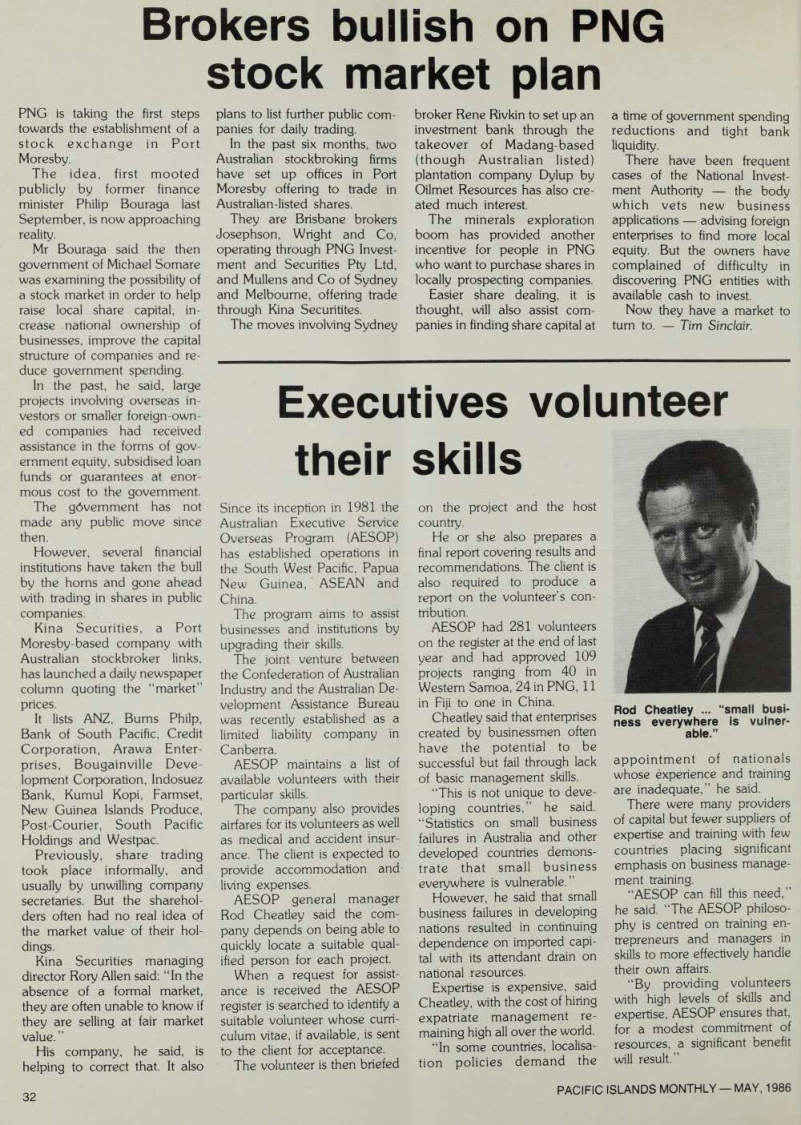
Rod Cheatley... “small busi ness everywhere is vulner able.”