Soviets
p. 13 · Read in the full issue
build up forces
Soviet combat forces in the Pacific area have grown by several hundred per cent in the past ten years, according to John Dorrance.
He lists known Russian regional power as 350 bombers, 1200 fighter/attack aircraft and 500 inter ceptors.
These are complemented by two aircraft carriers, 134 submarines, 85 capital surface ships and 589 auxiliary combat vessels.
The United States Pacific forces, however, can muster 200 ships and about 1900 aircraft of various types (2600 counting USMC planes).
The US also has access to 55 shore installations in the region. The US forces could be expected in wartime to be supported by Australian and possibly French regional sea and air power.
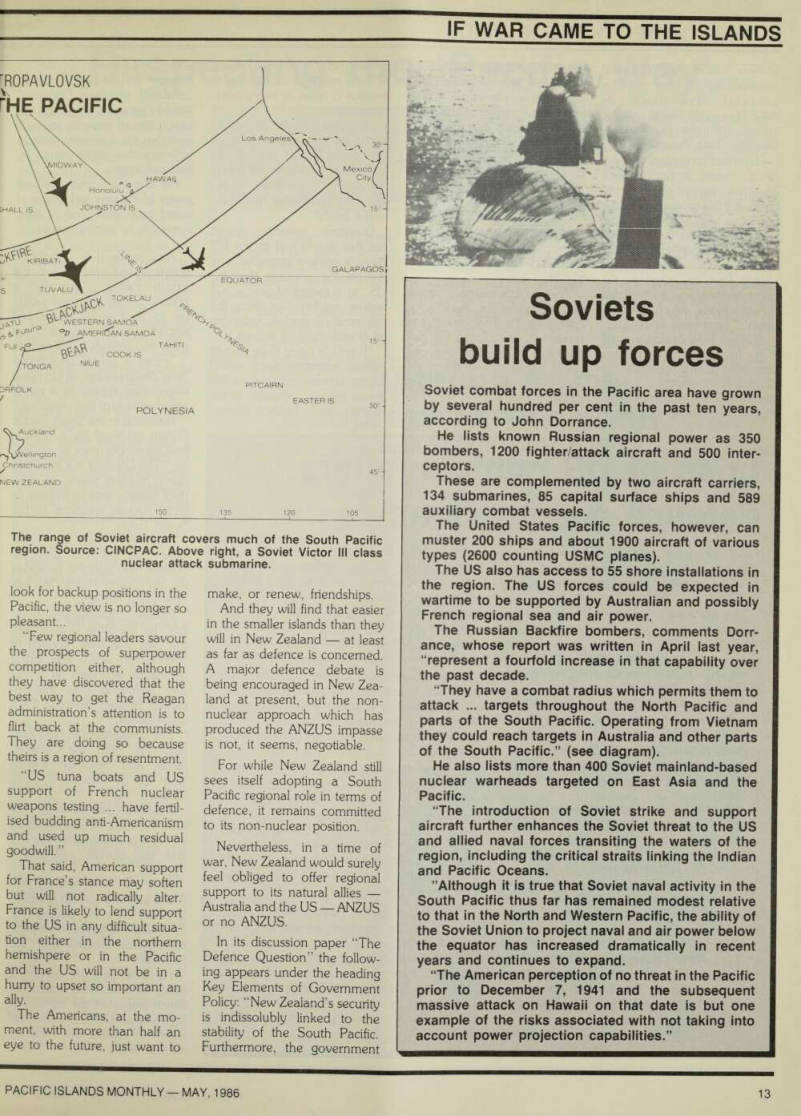
The Russian Backfire bombers, comments Dorr ance, whose report was written in April last year, “represent a fourfold increase in that capability over the past decade.
“They have a combat radius which permits them to attack ... targets throughout the North Pacific and parts of the South Pacific. Operating from Vietnam they could reach targets in Australia and other parts of the South Pacific.” (see diagram).
He also lists more than 400 Soviet mainland-based nuclear warheads targeted on East Asia and the Pacific.
“The introduction of Soviet strike and support aircraft further enhances the Soviet threat to the US and allied naval forces transiting the waters of the region, including the critical straits linking the Indian and Pacific Oceans. ’’Although it is true that Soviet naval activity in the South Pacific thus far has remained modest relative to that in the North and Western Pacific, the ability of the Soviet Union to project naval and air power below the equator has increased dramatically in recent years and continues to expand.
“The American perception of no threat in the Pacific prior to December 7, 1941 and the subsequent massive attack on Hawaii on that date is but one example of the risks associated with not taking into account power projection capabilities.”