the islands
pp. 11-14 · Read in the full issue
if war came to the islands
Defence, by its very na ture, is concerned with the future. So says the New Zealand government discussion paper which calls for public submis sions on the country’s defence posture.
The statement is one area, at least, where New Zealand and the US might find common ground in the regional defence debate.
Against the backdrop of the sudden increase in US interest in the region, the NZ statement does more than state the ob vious.
That is not to say that the new US interest is defence motivated. It isn’t. It stems from a number of stimuli, not least prolonged diplomatic urgings by Australia and New Zealand that the “watery continent” should not be taken for granted as a US sympathiser.
But there are other spurs to US interest. Years of Jolly Ro ger tactics by the American Tunaboat Association culmin ated in the Kiribati-Russian fishing deal and in J approaches by the Soviets to |-r other island states. Vanuatu. J according to prime minister "
Walter Lini (PIM last issue) will consider an expected Russian fishing proposal “on its com mercial merits.”
This has not altogether pleased the US. However, there is now an understanding in Washington of the islands’ problems and a tuna deal that gives island nations a fair return for the harvesting of their re- t source is the likely outcome of 1 continuing talks, now without an ATA presence on the Amer ican team.
Defence considerations prob ably come last as far as the US < is concerned. But they nevertheless exist. In the un- ’ likely event of major un- JJjj pleasantness involving the superpowers, the South J
Pacific could assume a higher strategic importance.
There are many ifs. But as defence is concerned with the future, they are ifs that have to be taken into account by the military planners.
Thus, if trouble erupted in the Southeast Asia region, a
Soviet (or other i, power) tactic Jk would certain
“ 7 ly be to deny
US and other shipping entry to the Indian Ocean via the South China Sea or the Malac ca Straits.
Lines of I communica tion be - 1 < tween the
United States mainland and islands and the Indian Ocean would then shift south either via the narrow Torres Strait between PNG and Australia, or, more likely, via the Tasman Sea and the Great Australian Bight.
In that event, the Pacific islanders would again find themselves bystanders in the midst of a potential war zone.
For while a direct superpow er threat to any of the islands can be disregarded, the thought of possibly nuclear ordnance hurtling around above on and below the ocean would be less than comforting.
The US interest extends to continuing to gain experience of Pacific navigation and condi tions. “State of readiness,” a common Pentagon catchphrase, would thereby be enhanced.
There is also the superpower game of watching each other watch each other. Most Russian fishing vessels are equipped with sophisticated electronic surveillance equipment. It is hard to expect the Kiribati fleet to be any different.
The Soviets have also shown much interest in oceanographic research. While much of that would be bona fide scientific interest, it is also true that knowledge of such items as seabed contours, ocean cur rents, water salinity and temperature are vital in the detection and tracking of sub marines.
The Americans would like to be in a position to know what the Russian fishing fleet is up to. i The Russian pre sence or potential presence is not confined to the fishing fleets (New Zealand also has a fishing agreement with the Soviets, as does the US).
I Since in-
heriting the abandoned US bases at Cam Ranh Bay and Da Nang in Vietnam, Russia can project sea and air power deep into the region. The Soviets, or their allies, in a time of conflict, would be able to threaten even the most southerly route from the Pacific to the Indian Ocean.
Aircraft from Cam Ranh can reach into the Pacific without the need for aerial refuelling.
They would, of course, run the gauntlet of US or allied inter ceptors alerted by listening posts in Australia and else where.
But in the even less likely event that such a conflict “went nuclear” it is a safe bet that the Australian installations would be early targets, thus reducing the warning times for the inter ceptors.
In a wide-ranging artiicle in Pacific Defence Forum, John C Dorrance, currently the US consul-general in Sydney and a former director of the Office of Australia and New Zealand Affairs in the State Department, states: “The importance of the northern Pacific islands is man ifest. Guam is a politically se cure and strategically located island under American sovereignty. From bases on Guam US air and sea power can support allies and friends in Asia and meet any Soviet thrust into the northern Pacific.”
Dorrance, an author of ex tensive Pacific island experi ence, goes on to note that the US has leased land in the Northern Marianas, mainly on Tinian, for possible military use.
However, he accords a fur
ther strategic significance to Guam and Micronesia: ”In any Pacific war scenario involving the Soviets, US lines of com munication would shift to the south and run through or near Micronesia; ships and aircraft would attempt to move beyond the range of Soviet attack air craft operating out of the Kuril islands and on the Soviet Asian mainland.
“For this reason, but also because of the threat that would be posed to Hawaii and to areas south of the equator, a primary US objective in the political status negotiations with the Micronesian governments has been an arrangement that assures no adversary of the United States or of its allies would have access to these islands for military purposes.”
In the event of the US losing access to its Subic Bay and Clark bases in the Philippines, Guam, the Northern Marianas
and Palau would assume an even greater importance.
But these are traditional areas of influence and involve ment for the US.
The South Pacific is currently seeing a series of State Depart ment heavyweights treading carefully through the region. As stated above, their presence is only partly defence-related.
Nevertheless, the visits can be seen as reflecting increased Soviet interest.
The Americans are aware of the goodwill towards them that exists in the islands as a result of their considerable presence here during the last unpleasant ness. The current interest aims to foster and develop that re lationship.
Most island governments will welcome US interest espe cially if it is followed up with aid and, more importantly, trade.
The US, for its part, would like to keep the islanders “on
side” not least because their friendship could be of enor mous value in time of conflict.
In the prestigious Wall Street Journal, James Sterba wrote last month; ”US military strategists, for one, are dis turbed by what they see (in the South Pacific). While the end of the presidential crisis in the Philippines would seem to im prove the odds of America’s holding on to its bases there, that cannot be considered cer tain, and when these strategists
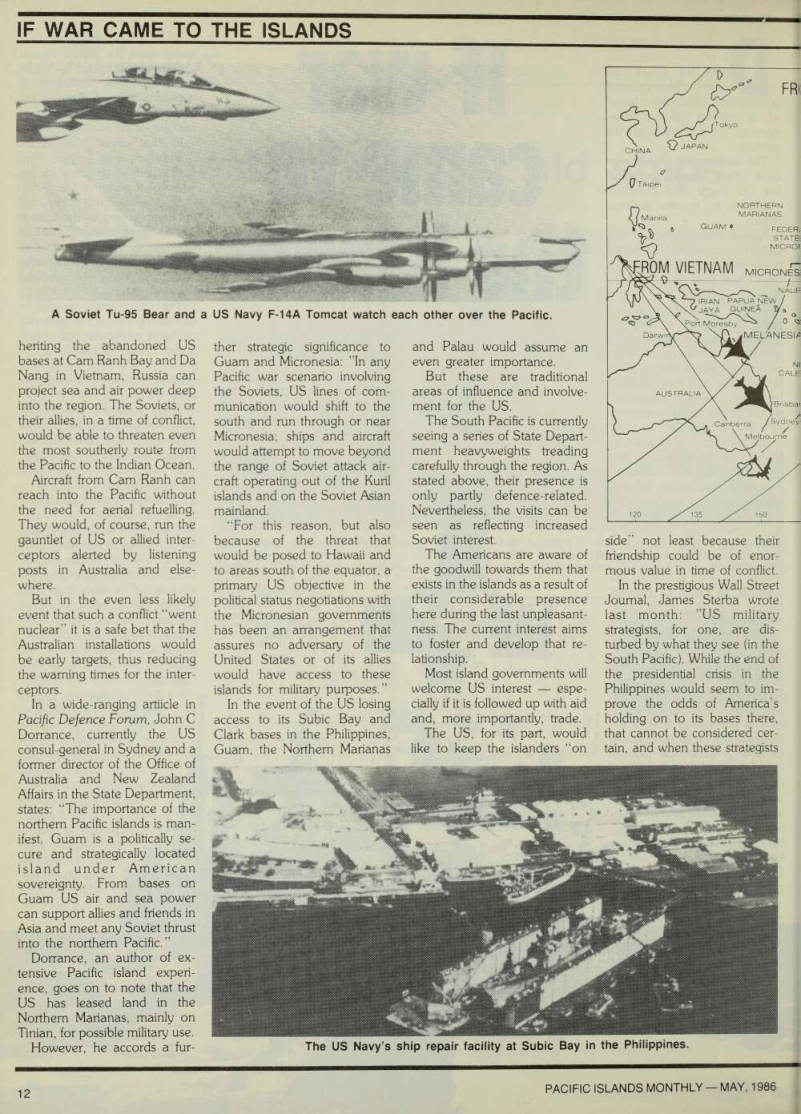
A Soviet Tu-95 Bear and a US Navy F-14A Tomcat watch each other over the Pacific.
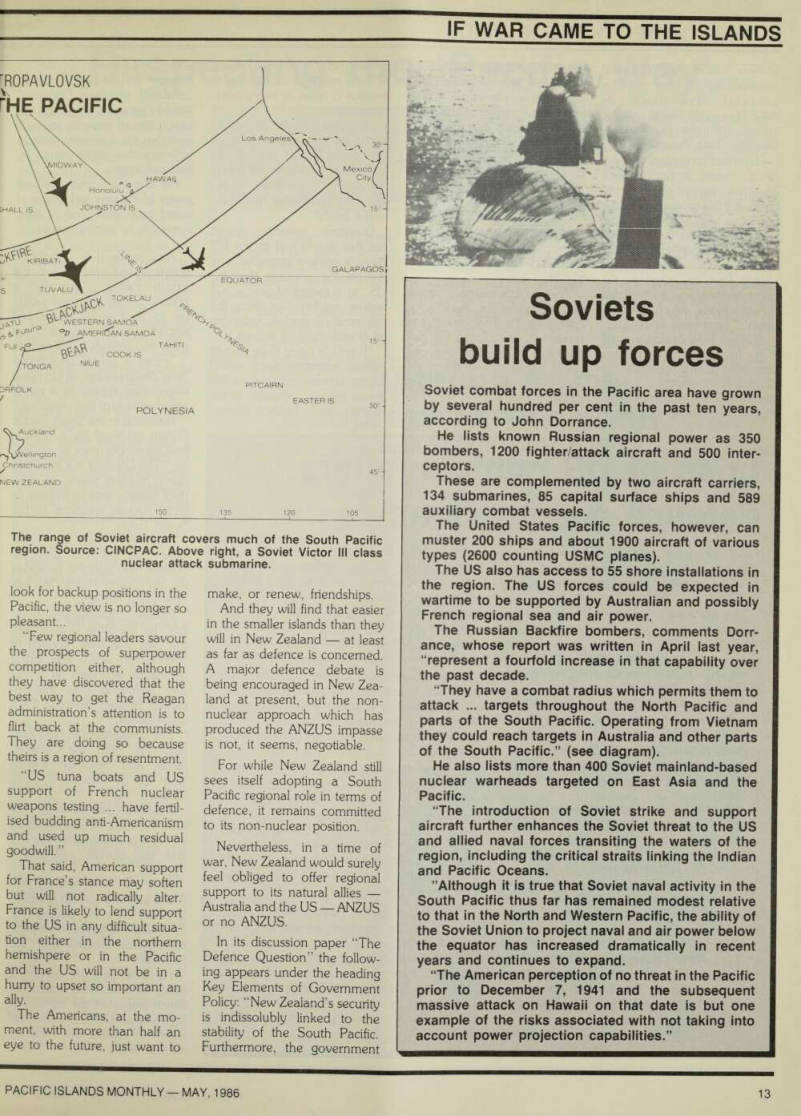
The US Navy’s ship repair facility at Subic Bay in the Philippines.
look for backup positions in the Pacific, the view is no longer so pleasant...
“Few regional leaders savour the prospects of superpower competition either, although they have discovered that the best way to get the Reagan administration’s attention is to flirt back at the communists.
They are doing so because theirs is a region of resentment.
“US tuna boats and US support of French nuclear weapons testing ... have fertil ised budding anti-Americanism and used up much residual goodwill. ”
That said, American support for France’s stance may soften but will not radically alter.
France is likely to lend support to the US in any difficult situa tion either in the northern hemishpere or in the Pacific and the US will not be in a hurry to upset so important an ally.
The Americans, at the mo ment, with more than half an eye to the future, just want to
make, or renew, friendships.
And they will find that easier in the smaller islands than they will in New Zealand at least as far as defence is concerned.
A major defence debate is being encouraged in New Zea land at present, but the non nuclear approach which has produced the ANZUS impasse is not, it seems, negotiable.
For while New Zealand still sees itself adopting a South Pacific regional role in terms of defence, it remains committed to its non-nuclear position.
Nevertheless, in a time of war, New Zealand would surely feel obliged to offer regional support to its natural allies Australia and the US ANZUS or no ANZUS.
In its discussion paper “The Defence Question” the follow ing appears under the heading Key Elements of Government Policy: “New Zealand’s security is indissolubly linked to the stability of the South Pacific.
Furthermore, the government
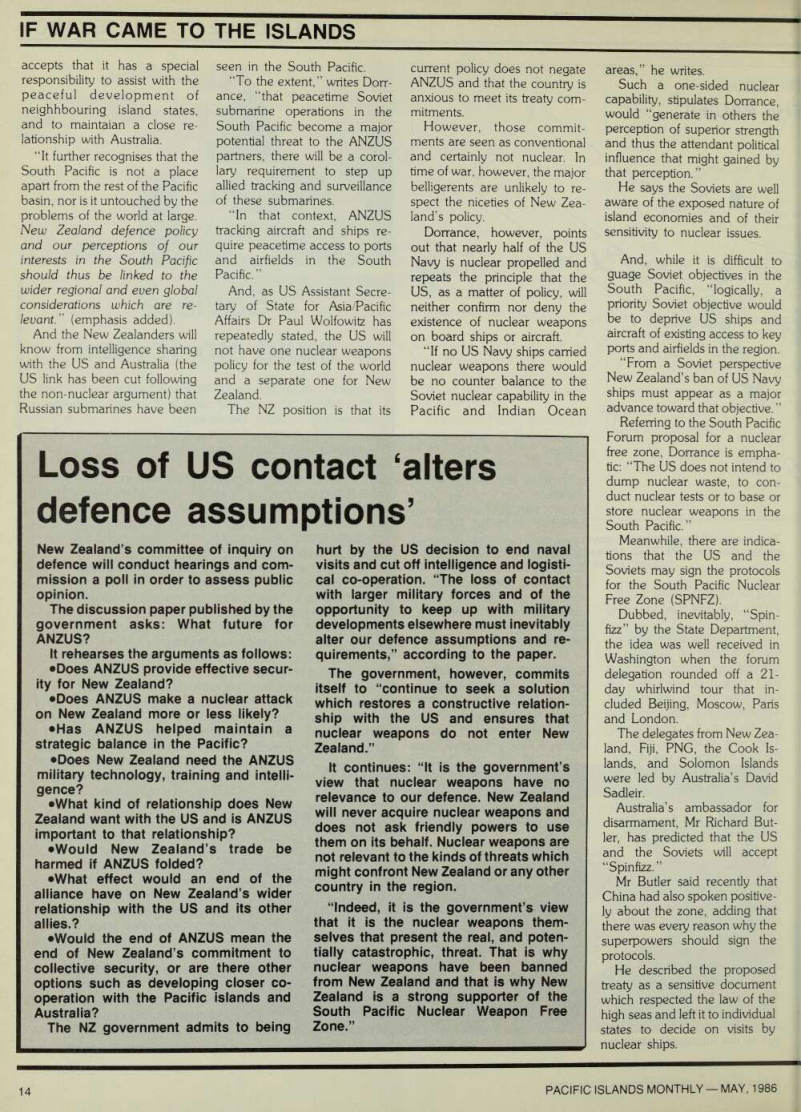
The range of Soviet aircraft covers much of the South Pacific region. Source: CINCPAC. Above right, a Soviet Victor III class nuclear attack submarine.
accepts that it has a special responsibility to assist with the peaceful development of neighhbouring island states, and to maintaian a close re lationship with Australia.
“It further recognises that the South Pacific is not a place apart from the rest of the Pacific basin, nor is it untouched by the problems of the world at large.
New Zealand defence policy and our perceptions of our interests in the South Pacific should thus be linked to the wider regional and even global considerations which are re levant. ” (emphasis added).
And the New Zealanders will know from intelligence sharing with the US and Australia (the US link has been cut following the non-nuclear argument) that Russian submarines have been
seen in the South Pacific.
“To the extent,” writes Dorr ance, “that peacetime Soviet submarine operations in the South Pacific become a major potential threat to the ANZUS partners, there will be a corol lary requirement to step up allied tracking and surveillance of these submarines.
“In that context, ANZUS tracking aircraft and ships re quire peacetime access to ports and airfields in the South Pacific.”
And, as US Assistant Secre tary of State for Asia/Pacific Affairs Dr Paul Wolfowitz has repeatedly stated, the US will not have one nuclear weapons policy for the test of the world and a separate one for New Zealand.
The NZ position is that its
current policy does not negate ANZUS and that the country is anxious to meet its treaty com mitments.
However, those commit ments are seen as conventional and certainly not nuclear. In time of war, however, the major belligerents are unlikely to re spect the niceties of New Zea land’s policy.
Dorrance, however, points out that nearly half of the US Navy is nuclear propelled and repeats the principle that the US, as a matter of policy, will neither confirm nor deny the existence of nuclear weapons on board ships or aircraft.
“If no US Navy ships carried nuclear weapons there would be no counter balance to the Soviet nuclear capability in the Pacific and Indian Ocean
areas,” he writes.
Such a one-sided nuclear capability, stipulates Dorrance, would “generate in others the perception of superior strength and thus the attendant political influence that might gained by that perception.”
He says the Soviets are well aware of the exposed nature of island economies and of their sensitivity to nuclear issues.
And, while it is difficult to guage Soviet objectives in the South Pacific, “logically, a priority Soviet objective would be to deprive US ships and aircraft of existing access to key ports and airfields in the region.
“From a Soviet perspective New Zealand’s ban of US Navy ships must appear as a major advance toward that objective. ”
Referring to the South Pacific Forum proposal for a nuclear free zone, Dorrance is empha tic: “The US does not intend to dump nuclear waste, to con duct nuclear tests or to base or store nuclear weapons in the South Pacific.”
Meanwhile, there are indica tions that the US and the Soviets may sign the protocols for the South Pacific Nuclear Free Zone (SPNFZ).
Dubbed, inevitably, “Spin fizz” by the State Department, the idea was well received in Washington when the forum delegation rounded off a 21day whirlwind tour that in cluded Beijing, Moscow, Paris and London.
The delegates from New Zea land, Fiji, PNG, the Cook Is lands, and Solomon Islands were led by Australia’s David Sadleir.
Australia’s ambassador for disarmament, Mr Richard But ler, has predicted that the US and the Soviets will accept “Spinfizz.”
Mr Butler said recently that China had also spoken positive ly about the zone, adding that there was every reason why the superpowers should sign the protocols.
He described the proposed treaty as a sensitive document which respected the law of the high seas and left it to individual states to decide on visits by nuclear ships.