Irian Jaya’s OPM: “Spent
pp. 37-39 · Read in the full issue
books
Irian Jaya’s OPM: “Spent force” or rising power?
Indonesia’s Secret War: The Guerrilla Struggle in Irian Jaya. By Robin Osborne. Pub lished by Alien & Unwin, 1985. 192 pp ISBN 0 86861 519 6 (pbk.). Price $A12.95.
Are the jungle fighters in Irian Jaya, as the 1984 assessment of General Sembiring, the Indone sian military commander of the province, put it “wild terrorist gangs,” and a “spent force”?
Or are the Melanesian freedom fighters engaged in a long and systematic guerrilla struggle against their internationally im posed Malay and Javenese rul ers? Osborne’s Secret War adopts the “revolutionary guer rilla” or “freedom fighter” thesis, and is the first serious study of the Melanesian guerril la (OPM) movement’s leader ship, conflicts, organisation, ideology and history.
As a movement for national independence in Indonesia’s westernmost province which borders on Papua New Guinea, the two-decade-old OPM is still in its infancy. Although its in ternational support network is thin, it stretches from Holland, through the United Nations and the World Congress of Indi genous Peoples, to Vanuatu. Its guerrilla messages are often in code, yet its communications system is by and large still rudimentary. Although organ ised along classic military lines by area and hierarchy, there have been debilitating leader ship splits. There have been numerous “surrenders” and “retirements” of OPM leaders after years of bush fighting, yet their ranks always seem to supply new leaders.
Secret War’s strength is the mass of detail Osborne accumulates to prove his “guer rilla movement” thesis. Its
weakness is the lack of an ultimate assessment of the OPM’s overall strength and prospects.
Osborne’s by-line, well known to Australian readers of The Australian or the National Times, consistently signals yet another investigative scoop (he
broke the story of the Indone sian murder of Melanesian anthropologist Arnold Ap in 1984, among others), or thoughtful analysis of Indone sian or PNG affairs. A former press secretary to both PNG’s former PM, Sir Julius Chan, and Deputy PM Paias Wingti in
a Somare government, Osborne brings the authority of an insider’s knowledge to this study.
Secret War fairly crackles with authenticity as Osborne marshals verbatim PNG inter cepts of OPM field communica tions, OPM-seized Indonesian
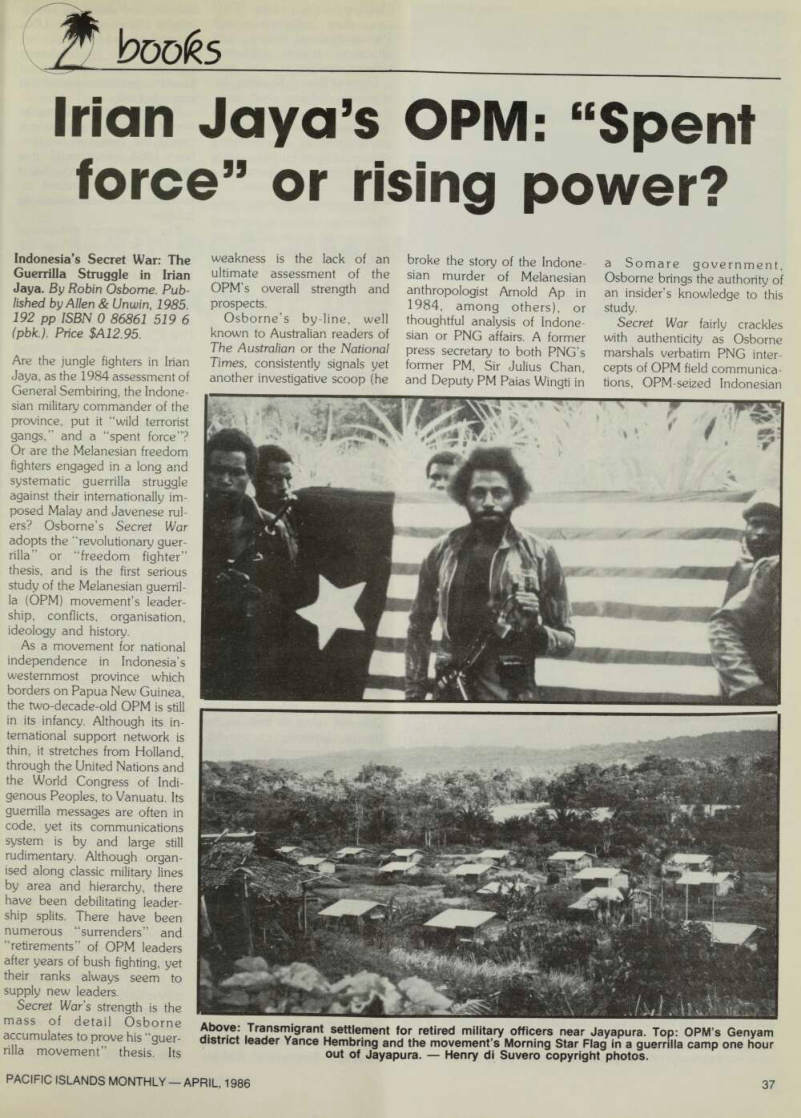
Above: Transmigrant settlement for retired military officers near Jayapura. Top: OPM’s Genyam district leader Yance Hembring and the movement’s Morning Star Flag in a guerrilla camp one hour out of Jayapura. Henry di Suvero copyright photos.
security assessments, diary en tries of Royal Australian Air Force personnel on mapping duty in Irian Jaya, and inter views with a wide variety of people, ranging from former Menzies Government Foreign Minister Sir Garfield Barwick, to an Australian solicitor who once flew helicopters for the Freeport Mining Company.
Mainstream journalism’s de scription of the OPM as ineffec tive “T-shirt guerrillas” has al ways represented Orwellian newspeak in service of the Indonesian military regime’s propaganda efforts to belittle the OPM. The catch phrase, like such other Indonesian de scriptions of the OPM as “wild terrorist gangs”, are one-di mensional terms invented to disparage the OPM and dis guise its strengths and wide spread support. Osborne’s con tribution is to impressively document the contrary view, detailing the two-decade history
of sustained Melanesian military resistance to Indonesian rule.
Whatever doubts there might have been about Indonesia’s harsh treatment of its Melane sian population have been laid to rest by “the great exodus” of 1984 when over 10,000 Melanesians of all walks of life crossed over into PNG to seek asylum. Almost the entire Melanesian border population crossed, either walking through the jungle or fleeing by ocean going canoe, all within six months.
It was a solid vote to choose the questionable freedom of the unknown in the form of a refugee’s life in PNG, over a life of continued fear and terror under Indonesian rule.
Whole villages, even tribes, crossed; military personnel de fected, academics, teachers and government bureaucrats fled.
In every camp the refugees raised the red, white and blue
Morning Star flag of the OPM, sang their Indonesia-banned Papuan national anthem, and almost to a person, stubbornly refused repatriation.
General Benny Murdani, In donesia’s military chief, con demned the refugees as “criminals”, and the Somare government, to its everlasting shame, obliged by prosecuting the first group of male refugees as “illegal border-crossers”.
Osborne explains the great Melanesian exodus as the result of massive reprisals by the Indonesian military after the OPM flag-raising and aborted uprising in Jayapura in mid- February, 1984. The politico military aim was to clear the border of the OPM, destroy all the villages in order to deny the guerrillas their widescale logisti cal support, and clear the re gion for subsequent repopula tion by ex-military Javanese transmigrants.
There had been earlier, smal ler, refugee flows over the years but none had been as massive as this. Someone had to be come the whipping boy, and, fearful of offending the obvious culprit, Indonesia, neither PNG nor Australia blamed the milit ary regime. Instead, the scapegoat became the OPM.
Out of the ashes of torched T-shirts, the previously inept and “spent” OPM were Phoenix-like resurrected and attributed with immense or ganisational finesse as they were blamed for instigating the massive migration.
In a finely woven tapestry, Osborne takes us through the bizarre responses of the So mare government as it strug gled to free itself from the Australian and Indonesian-im posed perspective that the great exodus was a “border prob lem” created by the OPM and susceptible to a bilateral dip lomatic solution where the 10,000 would voluntarily return to their Indonesian-destroyed gardens.
The truth was otherwise, and common Melanesian con sciousness quickly grew throughout PNG and stayed the government’s hand. So mare’s own daughter, as Osborne tells us, worked on the refugees’ behalf. Conflict deve loped within Somare’s cabinet.
Foreign Secretary Rabbie
Namaliu had dared to openly criticise Indonesia in the UN’s General Assembly and was re moved. His replacement embarked on a program of forced repatriation which was soon aborted.
The International Commis sion of Jurists’ delegation which toured the camps in Septem ber, 1984, determined that almost the entire population qualified under standard in ternational law definitions as refugees.
The announced determina tion of PNG’s new Wingti ad ministration to adhere to the UN Convention on Refugees (which all prior PNG adminis trations had resisted doing), and its open acceptance of UNHCR assistance to deter mine refugee status, probably ensures the vast bulk of re fugees will never return to Irian Jaya, but will instead be reset tled in PNG and elsewhere in the region.
One immovable object throughout the great exodus has been the refugees them selves. To break the refugees’ will and solidarity with the OPM, the Somare government shifted leadership from camp to camp, limited media access, brought prosecutions, and periodically threatened massive forced repatriation. Through it all the refugees continued to sing their anthem, hoist their flag and stone visiting Indone sian officials and newsmen. In the idiom of Black America’s civil rights anthem, they were saying to the world “We shall not be moved.’’
Osborne quotes Sir Garfield Barwick as describing Irian Jaya as “the new ‘Ulster’ in our part of the world.” There are other analogies that can be drawn: to Palestine, Vietnam, Cuba, New Caledonia, South Africa, the two Koreas and the two Ger manys. Each analogy is both imperfect and yet instructive.
Perhaps most immediately PNG could learn important na tion-building lessons from Israel’s positive approach of welcoming emigrating refugees fleeing from persecution.
Ulster or not, the 1984 flow of 10,000 refugees is probably only a taste of what is to follow.
Transmigration, the planned massive movement of mainly Javanese into Irian Jaya, as Osborne tells us, has just be
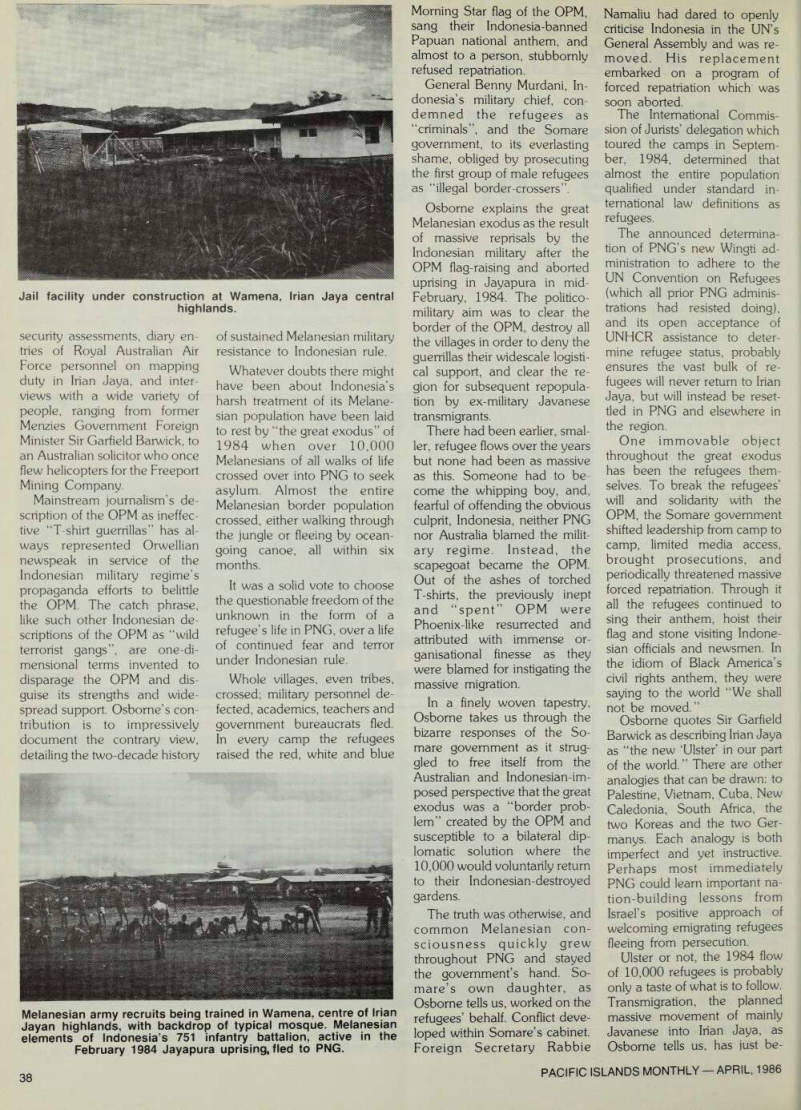
Jail facility under construction at Wamena, Irian Jaya central highlands.
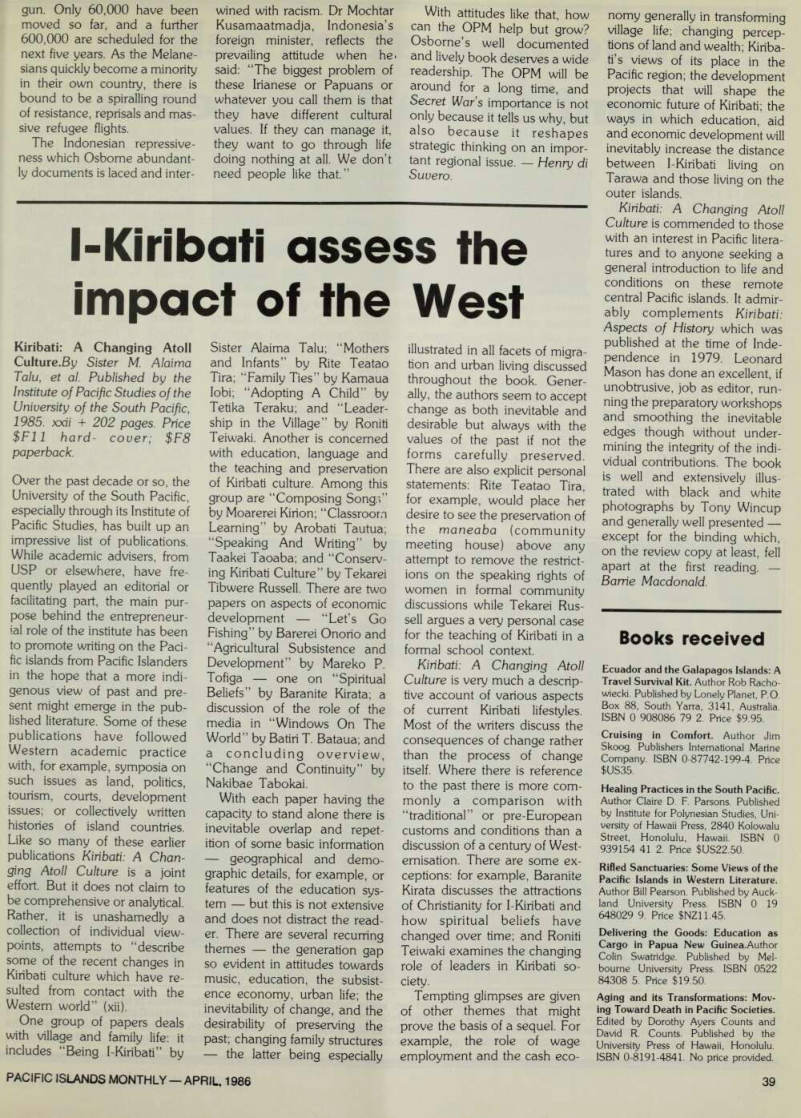
Melanesian army recruits being trained in Wamena, centre of Irian Jayan highlands, with backdrop of typical mosque. Melanesian elements of Indonesia’s 751 infantry battalion, active in the February 1984 Jayapura uprising, fled to PNG.
gun. Only 60,000 have been moved so far, and a further 600,000 are scheduled for the next five years. As the Melane sians quickly become a minority in their own country, there is bound to be a spiralling round of resistance, reprisals and mas sive refugee flights.
The Indonesian repressive ness which Osborne abundant ly documents is laced and inter
wined with racism. Dr Mochtar Kusamaatmadja, Indonesia’s foreign minister, reflects the prevailing attitude when he. said: “The biggest problem of these Irianese or Papuans or whatever you call them is that they have different cultural values. If they can manage it, they want to go through life doing nothing at all. We don’t need people like that.”
With attitudes like that, how can the OPM help but grow?
Osborne’s well documented and lively book deserves a wide readership. The OPM will be around for a long time, and Secret War’s importance is not only because it tells us why, but also because it reshapes strategic thinking on an impor
tant regional issue.
Henrv di
Suvero.