Niue: Is TV the answer, or has
pp. 35-36 · Read in the full issue
time already run out?
Often called “The Rock” be cause of its appearance from the sea, the tiny isolated nation of Niue 258 square kilometres has recently en joyed more media coverage than it has probably ever had before. There are two reasons for this: the island’s population dilemma, and the coming of television. Each springs from the same source the battle for national survival.
About 12,000 Niueans are living abroard, mainly in New Zealand where they have citi zenship and free access. On Niue itself, there are barely 2000. (This figure is at odds with the Niue Government’s claim, repeated regularly over the last three or four years, that there are 3000. The fact is that independent observers over the same period have recorded far more people leaving the island than returning.) Ironically, it was in the period immediately before and after Niue’s attainment of self-gov ernment in 1974 that emigra tion intensified as if fuelled by the young nation’s con stitutional freedom. The story has been the same ever since: the resources in manpower essential to economic growth have been enthusiastically self exported. So, for a number of years now, Niue’s economy has experienced “negative growth”.
Like their Pacific neighbors, the Niueans are descendants of ancient sea voyagers. The de sire to travel is in their make-up.
This may account in part for their casual attitude to packing up and leaving. Indeed, such a decision is not hard to make in view of the harsh realities of daily life on “The Rock”, parti cularly when it is visited by cyclones or drought. Today, the aeroplane makes everything so easy. But the loaded outward flights have been damaging not only to the government, but also to the futures of many disillusioned young people.
For the last few years the government has been trying vainly to revive its tiny “New
JACK SIONEHOLO, a Niuean graduate of Victoria University, Wellington, New Zealand, writes here on the problems facing his homeland in particular, the Niuean Government’s controversial proposal to introduce television.
Zealand-sponsored” economy in order to achieve at least population stability. Measures tried range from economic de velopment projects, small-scale business enterprises, and the direct funding of airfares for those wishing to return who are judged capable of making se rious contributions to local eco nomic growth. No success.
The latest attempt at a solu tion is television. It is hard to believe that it may actually be a
key to the survival of a nation, but Niue’s position is desperate, and it deserves some sympathy.
However, the questions must be asked. How can economic growth and self-sufficiency be possible when the basic ele ment for economic growth the population is over looked? What will the New Zealand Government’s reaction be especially since Deputy Prime Minister Geoffrey Palmer is on record as saying that his
government is reviewing its constitutional relationship with Niue with the aim of stabilising its population and eventually building it up? And how would New Zealand feel if a country with which it has a constitutio nal relationship turns around and invites a U.S. cable televi sion company to set up a service when New Zealand’s relations with the U.S. are at a very low ebb? Or how about the misappropriation and mis management of New Zealand aid funds to Niue by some top Niuean public servants which led to the setting-up of a public commission of inquiry late last year?
Over the last 11 years, New Zealand has poured more than SNZII million in aid into Niue.
The country has a lot of ques tions to answer, a lot of mis takes to be corrected, and a lot of thinking to do, before plun ging itself into the world of television where the ques tion of control is vital.
Papua New Guinea and Fiji are adopting a cautious attitude to television. Both are in a far better position in terms of eco nomic growth than is Niue. Yet neither regards television as a very high priority. In my view, Niue should follow along the same lines as these two coun tries, rather than adopting the attitude “Let’s have it and see how it goes.”
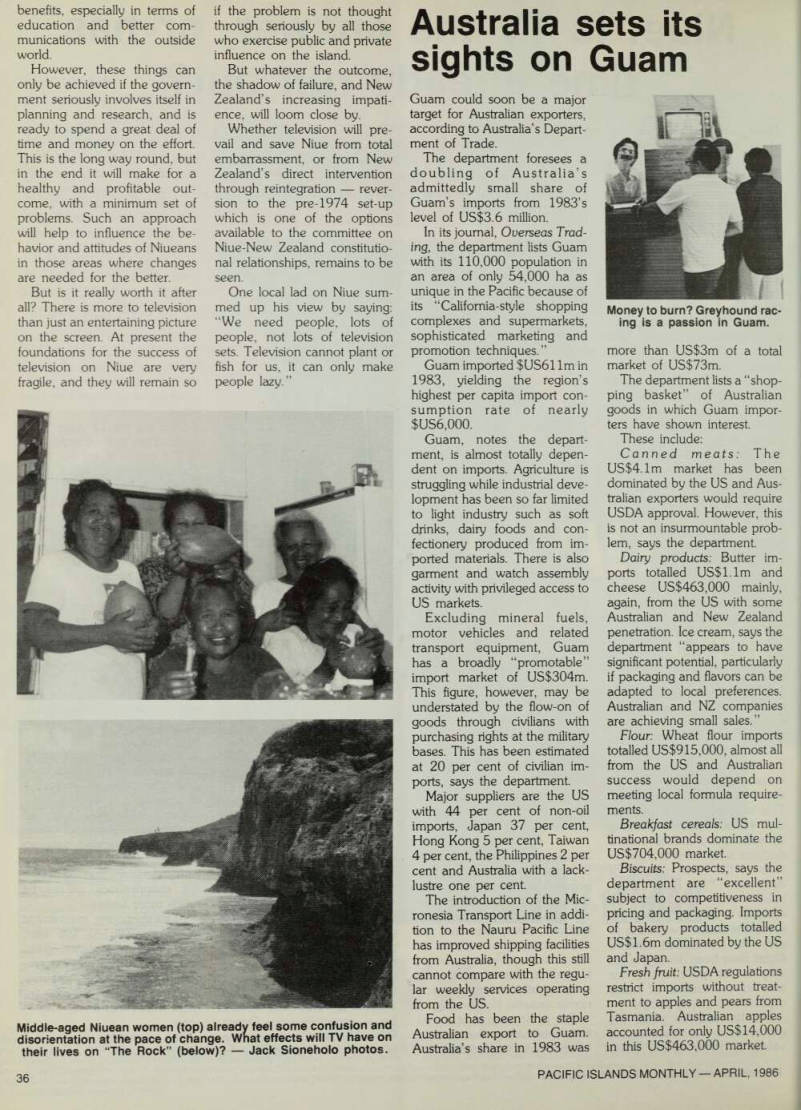
Already the social changes taking place on Niue have been more than the older generation of Niueans can accommodate without confusion and di sorientation. Many of them already feel trapped between the past and the future, and with television coming along this “culture shock” will only be much more severe.
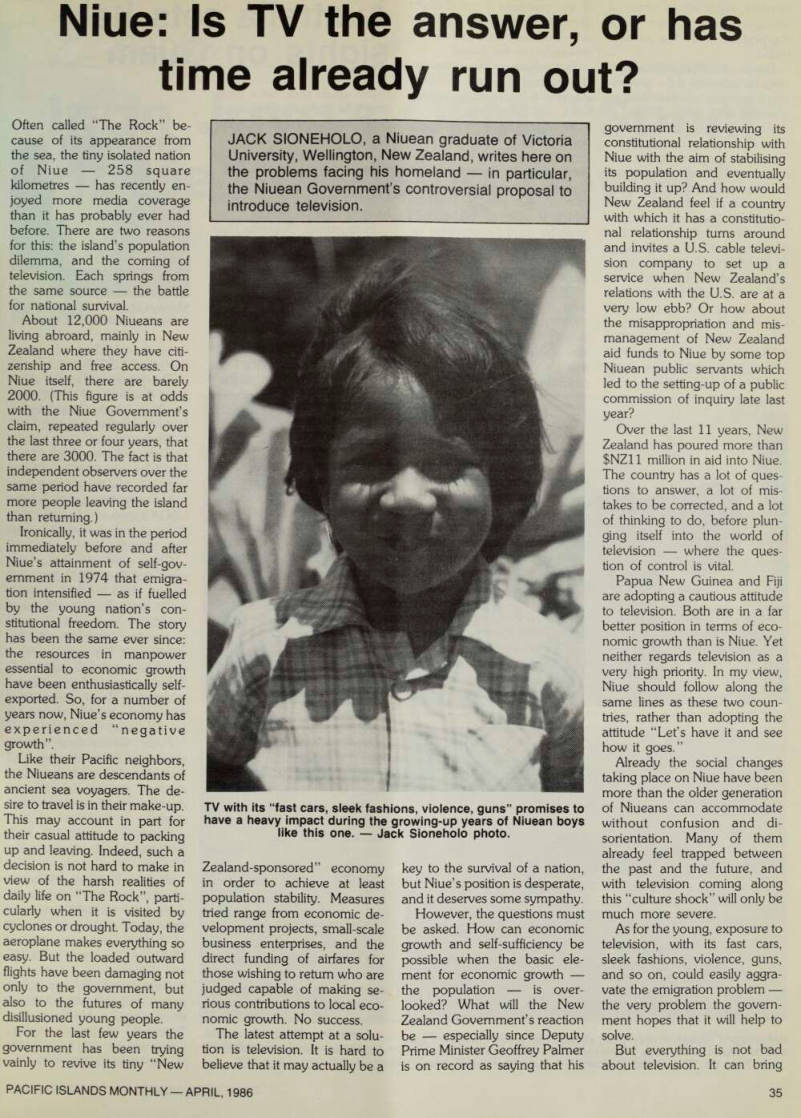
As for the young, exposure to television, with its fast cars, sleek fashions, violence, guns, and so on, could easily aggra vate the emigration problem the very problem the govern ment hopes that it will help to solve.
But everything is not bad about television. It can bring
TV with its “fast cars, sleek fashions, violence, guns” promises to have a heavy impact during the growing-up years of Niuean boys like this one. Jack Sioneholo photo.
benefits, especially in terms of education and better com munications with the outside world.
However, these things can only be achieved if the govern ment seriously involves itself in planning and research, and is ready to spend a great deal of time and money on the effort.
This is the long way round, but in the end it will make for a healthy and profitable out come, with a minimum set of problems. Such an approach will help to influence the be havior and attitudes of Niueans in those areas where changes are needed for the better.
But is it really worth it after all? There is more to television than just an entertaining picture on the screen. At present the foundations for the success of television on Niue are very fragile, and they will remain so
if the problem is not thought through seriously by all those who exercise public and private influence on the island.
But whatever the outcome, the shadow of failure, and New Zealand’s increasing impati ence, will loom close by.
Whether television will pre vail and save Niue from total embarrassment, or from New Zealand’s direct intervention through reintegration rever sion to the pre-1974 set-up which is one of the options available to the committee on Niue-New Zealand constitutio nal relationships, remains to be seen.
One local lad on Niue sum med up his view by saying: “We need people, lots of people, not lots of television sets. Television cannot plant or fish for us, it can only make people lazy.”
Australia sets its sights on Guam
Guam could soon be a major target for Australian exporters, according to Australia’s Depart ment of Trade.
The department foresees a doubling of Australia’s admittedly small share of Guam’s imports from 1983’s level of US$3.6 million.
In its journal, Overseas Trad ing, the department lists Guam with its 110,000 population in an area of only 54,000 ha as unique in the Pacific because of its “ Califomia-style shopping complexes and supermarkets, sophisticated marketing and promotion techniques.”
Guam imported SUS6IIm in 1983, yielding the region’s highest per capita import con sumption rate of nearly
Sus6,Ooo.
Guam, notes the depart ment, is almost totally depen dent on imports. Agriculture is struggling while industrial deve lopment has been so far limited to light industry such as soft drinks, dairy foods and con fectionery produced from im ported materials. There is also garment and watch assembly activity with privileged access to US markets.
Excluding mineral fuels, motor vehicles and related transport equipment, Guam has a broadly “promotable” import market of USs3o4m.
This figure, however, may be understated by the flow-on of goods through civilians with purchasing rights at the military bases. This has been estimated at 20 per cent of civilian im ports, says the department.
Major suppliers are the US with 44 per cent of non-oil imports, Japan 37 per cent, Hong Kong 5 per cent, Taiwan 4 per cent, the Philippines 2 per cent and Australia with a lack lustre one per cent.
The introduction of the Mic ronesia Transport Line in addi tion to the Nauru Pacific Line has improved shipping facilities from Australia, though this still cannot compare with the regu lar weekly services operating from the US.
Food has been the staple Australian export to Guam.
Australia’s share in 1983 was
more than USs3m of a total market of USs73m.
The department lists a “shop ping basket” of Australian goods in which Guam impor ters have shown interest.
These include: Canned meats: The USs4.lm market has been dominated by the US and Aus tralian exporters would require USDA approval. However, this is not an insurmountable prob lem, says the department.
Daily products: Butter im ports totalled USsl.lm and cheese U 55463,000 mainly, again, from the US with some Australian and New Zealand penetration. Ice cream, says the department “appears to have significant potential, particularly if packaging and flavors can be adapted to local preferences.
Australian and NZ companies are achieving small sales.”
Flour: Wheat flour imports totalled U 55915,000, almost all from the US and Australian success would depend on meeting local formula require ments.
Breakfast cereals: US mul tinational brands dominate the U 55704,000 market.
Biscuits: Prospects, says the department are “excellent” subject to competitiveness in pricing and packaging. Imports of bakery products totalled USsl.6m dominated by the US and Japan.
Fresh fruit: USDA regulations restrict imports without treat ment to apples and pears from Tasmania. Australian apples accounted for only US$l4,OOO in this U 55463,000 market.
Middle-aged Niuean women (top) already feel some confusion and disorientation at the pace of change. What effects will TV have on their lives on “The Rock” (below)? Jack Sioneholo photos.
Money to burn? Greyhound rac ing is a passion in Guam.