Tourism: Panacea
pp. 22-23 · Read in the full issue
or vicious circle?
Every year 3000 boys and girls in French Polynesia turn 18 that is, they attain all the rights of citizenship and start looking for jobs.
This simple fact haunts every government official and politi cian in the territory, and is the principal reason for their pre sent all-out efforts to develop tourism, which at present em ploys only about 4000 persons or 15 per cent of the labor force.
The local government last year spent CFP7OO million (SA4.B million) on tourist prom otion. Even more noteworthy is the fact that foreign investors in tourist projects are not only receiving substantial tax con cessions, and loans from the local banks on easy terms, but are also exempted from 50 per cent of the social security charges for their staff over the first three years of operation of their enterprise.
This great faith in tourism in
Tahiti as an economic panacea is quite surprising in view of its hitherto far from brilliant results.
Instead of the “500,000 tour ists by 1980” predicted, and almost guaranteed, 10 years ago by a well-known American marketing firm doing a survey on behalf of the local govern ment, the number of visitors in that year was only 89,000, and the annual intake since has hovered regularly about the 100,000 mark.
The reason advanced for this failure by local businessmen and politicians, beginning with government leader Gaston Flosse, is the over-centralised, bureaucratic rule of the French ministries in Paris. As soon as he came to power in 1982, Flosse began demanding wider powers for the local govern ment in the fields of foreign investment, commerce and in ternational air traffic. But the new constitution of September 1984 dashed all such hopes,
and the French airline UTA is still able to dictate international fares, and exclude all unwanted competition from foreign char ter companies.
Oddly enough, nobody in the territory seems ever to have challenged the basic assump tion of local businessmen and politicians (often the same people anyway) that tourism will automatically boom once “the skies are liberated”, which is their usual way of summing up their demands.
Even if it has not (to our knowledge) been asked before, we should like to pose this quite basic question: does Tahiti and the other islands of French Polynesia really have all the allurements needed to attract hordes of tourists?
In the absence of any reliable studies on tourist motivation, we would suggest, on the basis of our own observations, that the main reason a person is prepared to spend between
$2OOO and $3OOO on a holiday in Tahiti is that he or she expects to find a primitive Polynesian paradise. Our belief is reinforced by the fact that this is precisely what is promised by all travel posters, advertise ments and brochures. Unfortu nately, the fact is that this sort of unspoiled Arcadia simply does not exist anywhere in French Polynesia in Year 20 of the Bomb.
So American, Australian, New Zealand and Japanese tourists, who constitute the bulk of visitors from the Pacific, will probably continue to favor the more untouched islands in the Samoan, Tongan and Fiji groups.
Nor is this trend belied by the huge numbers more than four million of happy tourists who each year trek to Hawaii, the most civilised of all the island groups in Polynesia. For smart American promoters, with the experiences of Holly wood and Disneyland behind them, have managed to recre ate there whole villages, or “cultural centers”, in which highly professional natives climb coconut trees, make earth ovens, paddle canoes, and sing and dance.
On this scale of acculturation, French Polynesia sits uneasily in the middle between the two extreme forms of attractive tourist resorts: on the one hand, islands which retain a genuine folklore, and on the other those endowed with well-organised human zoos.
The only tourist promoter in our islands who has tried to any extent to imitate the Hawaiian model is the powerful Club Med and it is certainly no accident that its “Moorea Vil lage”, with its carefully calcu lated ambiance indigene, is in finitely more successful and profitable than the conventional hotels. Evidence enough of this is the fact that Club Med has recently spent vast sums on new buildings at its Moorea Village, increasing capacity to 720 rooms.
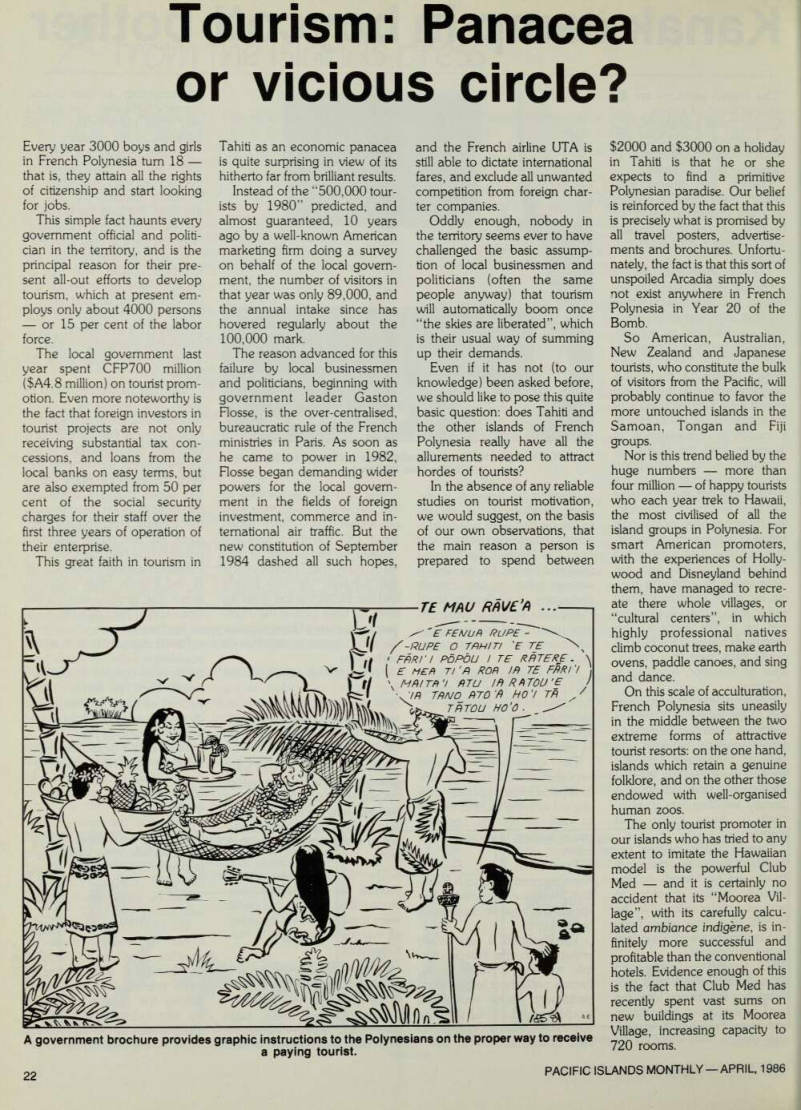
A government brochure provides graphic instructions to the Polynesians on the proper way to receive a paying tourist.
Another totally unproven basic assumption is that what is good for Club Med and the other hotel owners and tourist promoters is good for the Polynesians. It has for example just been announced with some pride that the 122,086 tourists who visited French Polynesia in 1985 spent a total of CFPI6 billion more in fact than was shelled out by the French milit ary personnel employed at the nuclear testing base.
Unfortunately the figure is not accompanied by detailed statistics identifying the fortun ate recipients of all this money.
However, there is no doubt in our minds that most were the French expatriates who own and run those restaurants and shops in Papeete not owned by local Chinese, with the Polyne sians as always way, way, down towards the end of the receiving line.
As we wrote back in 1979, when a special tourist confer ence was held in Papeete (PIM May ’79 p 25), it is time for those in power to pause and consider whether tourism in its present form, based almost en tirely on foreign investments, is really the best line of economic development for a free and fun-loving people whose traditional way of life was based mainly on fishing and farming.
Look for example at what is happening on the fabled island of Borabora.
With the building back in the
1960 s of the first-rate bunga
low-type Hotel Borabora, and Club Med’s more spartan com pound, and the more recent addition of another bungalow hotel built by the family of Dino di Laurentiis during the produc tion of the ill-fated movie The Hurricane, bringing the total room capacity up to 300, it seemed that this was all the island could take without losing its special charm and without causing more problems for the islanders, who have for some time been faced with serious shortages of water and land.
But yet another company, Climat de France, was allowed last year to build a 40-room hotel, and to create an artificial beach by dredging.
But all this is nothing to what is in store for the Boraborans in the near future when the Amer ican Hyatt corporation will open its giant tourist village on
the north shore facing the air port built by the Americans in 1943 on the reef ring. Con struction has been held up for a whole year due to bad manage ment, which has greatly in creased costs, but it is expected to open some time in 1986. It seems that the Hilton chain is also seriously considering buil ding a 300-room hotel.
All this is called “progress,” but there can be no doubt that, measured in human terms, it means that the whole Borabor an population of 1600 men and women will be rapidly trans formed into a small army of charwomen, barmaids, waiters, bellhops, porters, taxi drivers and entertainers which does not necessarily imply a great promotion. Nor must it be forgotten that the island will simultaneously be invaded by numerous expatriates come to fill the top jobs in the new hotels.
When the University of the South Pacific in 1980 published a book entitled Pacific Tourism as the Islanders See It, all contributors criticised the over whelmingly negative consequ ences of the large-scale tourism they had observed. The only voice absent from the chorus was that of French Polynesia because nobody here has ever bothered to ask the islanders for their opinions. (Incidentally, if such a survey were ever actual ly undertaken, most islanders would probably approve of tourism in enthusiastic terms, as a result of the daily indroctrina tion to which they have been exposed for years by the local politicians and mass media ...).
We believe that the only thing likely to slow down the development of tourism, here and elsewhere in the Pacific, is its self-defeating character. For the following chain reaction automatically sets in along the road to “progress”: comfortable hotels are built; tourists flock to them to watch the strange and primitive customs of the na tives; the natives go to work in the hotels to earn enough money to live in European style; the tourists are not in terested any more, and move to some other region, where there are still some genuine natives.
Whereupon, somewhere else, the whole process starts all over again. Marie-Therese and Bengt Danielsson.
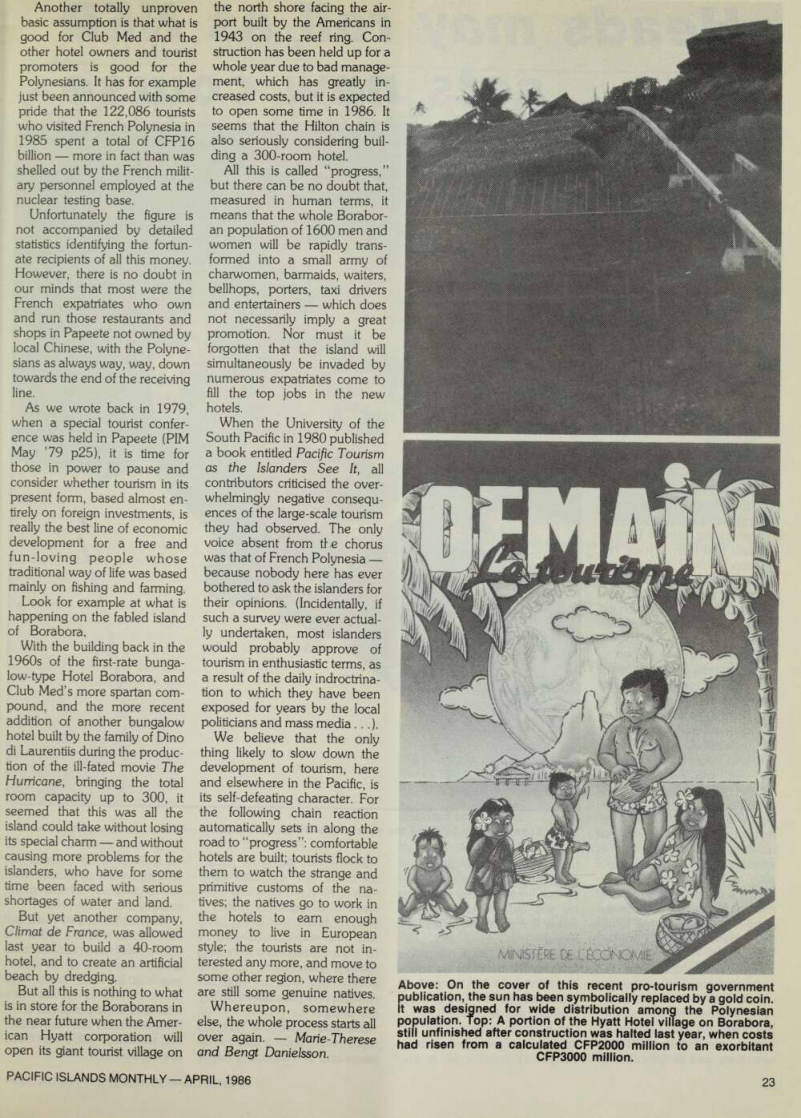
Above: On the cover of this recent pro-tourism government publication, the sun has been symbolically replaced by a gold coin.
It was designed for wide distribution among the Polynesian population. Top: A portion of the Hyatt Hotel village on Borabora, still unfinished after construction was halted last year, when costs had risen from a calculated CFP2000 million to an exorbitant CFP3000 million.