Kanak camp in boycott bother
p. 21 · Read in the full issue
“The French elections are the concern of France, not Kanaky. ” With that argument at the forefront the FLNKS de cided to boycott the March 16 legislative poll in France.
Despite the defiant tone though, there was also another far more important reason for backing the boycott: to prevent the movement from tearing it self apart.
The boycott decision was not a popular one. Union Caledo nienne, the biggest party within the front, had wanted to partici pate and had said so publicly, However, the more militant fac tions led by Yann Celene Uregei (leader of the FULK Party) believed that the FLNKS should have nothing to do with the elections. The issue came to a crunch at a convention of delegates from the FLNKS in February a convention which had been closed to the press to prevent the inevitable row from becoming too public.
Mr Uregei has been increasingly critical of the movement leader ship accusing it of moving too far to the right. He also has some scores to settle after hav ing his wrists publicly slapped earlier this year by the powers that be in the Front for his statements claiming the FLNKS would participate in a confer ence of liberation movements in Tripoli.
Consequently the conven tion at the village of Sarramea north of Noumea became a power struggle between the factions. Interestingly, FLNKS leader Jean-Marie Tjibaou stayed away from the meeting thereby avoiding any involve ment or threat to his own position.
Sources at the meeting say the FULK leader was grudging ly allowed his victory on the boycott question in order to prevent a major split within the FLNKS at a time when unity and credibility are all-important to the movement.
Mr Uregei is extremely pleased with himself and says he intends to continue lobbying hard to strengthen his position and keep the FLNKS on the right track.
Whether he succeeds is an other question. In the lead-up to the election there were wide spread mumblings of discontent from the Union Caledonienne rank and file for UC to have a representative in the French Parliament. (UC Deputy Roch Pidjot has decided to retire this time round) and know well the legitimacy such representation brings.
Union Caledonienne officials spent some time travelling throughout the territory ex plaining the boycott to disgrun tled members and urging them to observe it.
The explanations became necessary after two other pro independence parties not aligned with the FLNKS moved to cash in on the apparent cracks starting to appear in the Front.
The PFK (Parti Federal Kanaque) and the LKS (Libera tion Kanaque Socialiste) be lieved the boycott decision to be an error.
They argued it was vitally important to the independen tists to have a voice in the French parliament, especially a parliament whose sympathies would be likely to lie with the anti-independentist groups in New Caledonia.
The two parties decided to join forces and stand their own candidates. They also urged those UC members who felt cheated by the boycott to give them their vote. However the gulf between the two parties and the FLNKS is too great for them to have polled the num bers to win one of New Caledo nia’s two seats in the French parliament.
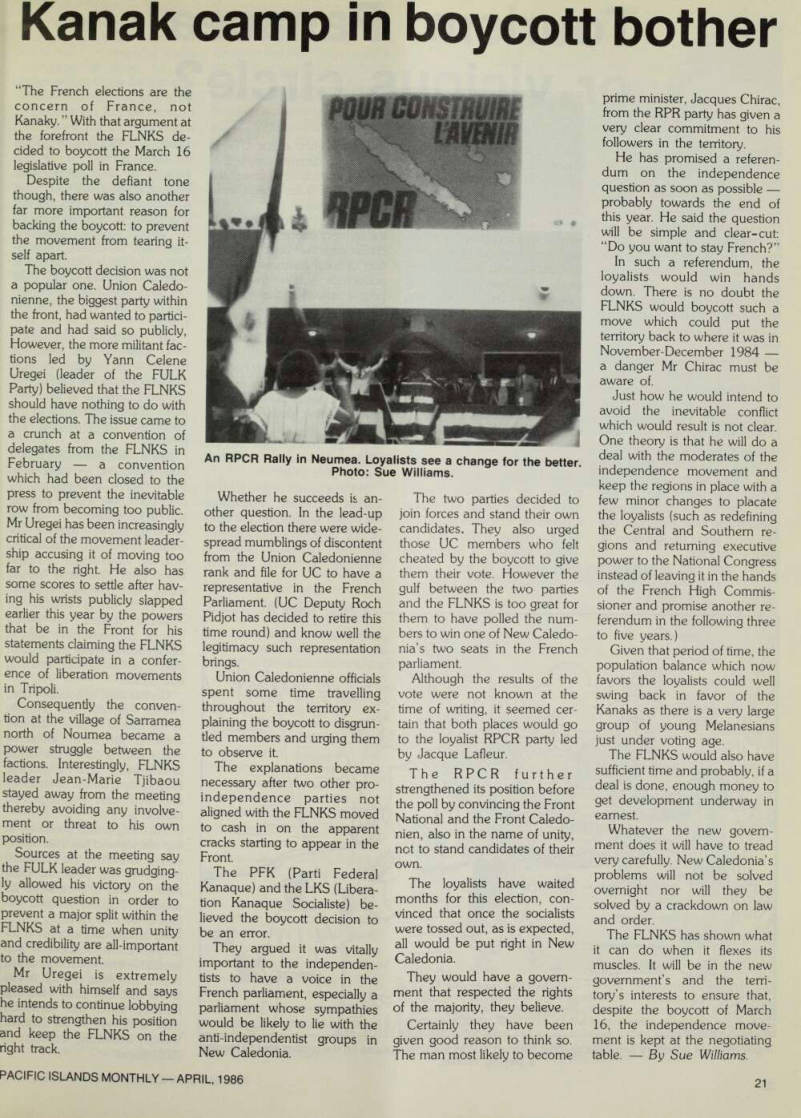
Although the results of the vote were not known at the time of writing, it seemed cer tain that both places would go to the loyalist RFCR party led by Jacque Lafleur.
The RFCR further strengthened its position before the poll by convincing the Front National and the Front Caledo nien, also in the name of unity, not to stand candidates of their own.
The loyalists have waited months for this election, con vinced that once the socialists were tossed out, as is expected, all would be put right in New Caledonia.
They would have a govern ment that respected the rights of the majority, they believe.
Certainly they have been given good reason to think so.
The man most likely to become
prime minister, Jacques Chirac, from the RPR party has given a very clear commitment to his followers in the territory.
He has promised a referen dum on the independence question as soon as possible probably towards the end of this year. He said the question will be simple and clear-cut: “Do you want to stay French?”
In such a referendum, the loyalists would win hands down. There is no doubt the FLNKS would boycott such a move which could put the territory back to where it was in November-December 1984 a danger Mr Chirac must be aware of.
Just how he would intend to avoid the inevitable conflict which would result is not clear.
One theory is that he will do a deal with the moderates of the independence movement and keep the regions in place with a few minor changes to placate the loyalists (such as redefining the Central and Southern re gions and returning executive power to the National Congress instead of leaving it in the hands of the French High Commis sioner and promise another re ferendum in the following three to five years.) Given that period of time, the population balance which now favors the loyalists could well swing back in favor of the Kanaks as there is a very large group of young Melanesians just under voting age.
The FLNKS would also have sufficient time and probably, if a deal is done, enough money to get development underway in earnest.
Whatever the new govern ment does it will have to tread very carefully. New Caledonia’s problems will not be solved overnight nor will they be solved by a crackdown on law and order.
The FLNKS has shown what it can do when it flexes its muscles. It will be in the new government’s and the terri tory’s interests to ensure that, despite the boycott of March 16, the independence move ment is kept at the negotiating
table.
By Sue Williams.
An RPCR Rally in Neumea. Loyalists see a change for the better.
Photo: Sue Williams.