"Citadel Noumea" win
pp. 45-46 · Read in the full issue
political currents
French Writer’S View
"Citadel Noumea" win be the anvil
Noumea, rather than the land issue, will be the main scene and principal stake in the developing battle for independence in New Caledonia.
This viewpoint is argued in a contentious article by French sociologist Loic J.D. Wacquant in a recent issue of the Paris monthly Le Monde diplo matique.
Headlined “An Extreme Concentration of Powers: Noumea, a Stronghold in a Desert,” Wacquant’s article argues that Noumea already holds such a massive demog raphic, economic and political predominance in the territory that there is really nothing else much worth controlling there.
Taking as his starting point the slogan, “Noumea: A White Town,” which appeared on walls in the town centre during anti-independence riots on January 11, 1985, Wacquant notes that this was nothing more than a crude expression of the “special status” of Noumea acknowledged by the French government in its recent division of the country into four regions. It was also the basis for the decision of the main anti independence party, the RPCR, at its April, 1985, con gress no longer to permit “any peaceful demonstrations by the FLNKS in Noumea” “a decision,” Wacquant writes ‘which was put into effect on B, 1985, resulting in 10 lours of street confrontations”.
“Leaving aside Australia and Mew Zealand, Noumea is the bird largest urban settlement in he South Pacific, after Port Moresby and Suva,” writes
Wacquant. “It is also the only one of the three to have a majority European population.
“Europeans account for 43,000 of the total of 85,000 people living in Noumea and its outskirts. Around this European core is concentrated a strong Wallisian and Tahitian minority (11,000 and 5000 people re spectively), and a sprinkling of other nationalities (4000 In donesians, 2200 Vietnamese, and 3500 ’others’).
“Although their numbers have doubled in the last 15 years, and they are being urba
nised little by little, Kanaks are still heavily under-represented in the town: only one in five Noumeans is of Melanesian stock.”
But, Wacquant says, the truly unique feature of Noumea in New Caledonia’s demography is its sheer weight in the popula tion as a whole: the urban perimeter running from Paita to Mont-Dore alone absorbs 58.2 per cent of New Caledonia’s population. It contains 80 per cent of the Europeans, 90 per cent of the Polynesians, and 85 per cent of the Asians living in
the territory.
“These figures show to what extent Noumea has become the redoubt of the territory’s non indigenous races...” Wacquant said.
While the population of New Caledonia as a whole rose by 22,000 (133,000 to 145,000, or nine per cent) between 1976 and 1983, that of Noumea and its outskirts rose by 25,000 or 20 per cent.
Over the same period the bush “urban centres” have sim ply stagnated: La Foa, Bourail, Koumac, Poindimie, would
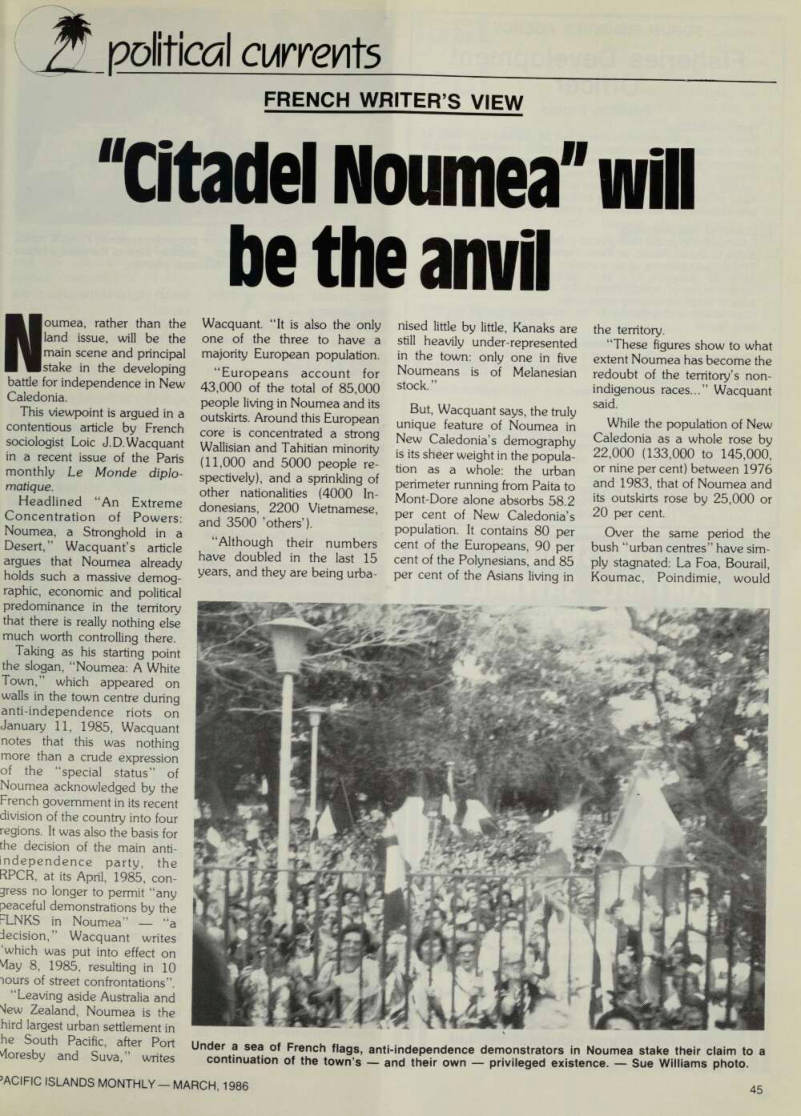
Under a sea of French flags, anti-independence demonstrators in Noumea stake their claim to a continuation of the town’s - and their own - privileged existence. - Sue Williams photo.
have trouble mustering 1000 souls apiece.
On the Grande Terre (main island) as a whole, population density is around four people per square kilometre, while for Noumea the figure is about 1500. New Caledonia’s “urban space” is thus concentrated in the Noumean peninsula, a total area of 100 sq km, in a territory of 20,000 sq km.
In the economic sphere, the disparities are even more glar ing. Mine sites aside, Noumea contains virtually all the terri tory’s industries, the major part of commercial activity,and all government services, both (metropolitan French) state and (New Caledonian) territorial.
All metallurgy, New Caledo nia’s modest main industry, is carried out at Noumea’s Doniambo-SLN works.
Greater Noumea in 1984 contained half the retail businesses, and 70 per cent of the retail trading space in the territory. The volume of self service facilities in the Noumea area (hypermarkets, super markets, and self-service areas in small mixed businesses) was 300 sq metres per 1000 inhabi tants, twice that for metropoli tan France (136 sq metres per 1000).
Wacquant asks; “How many provincial towns in France of the size of Noumea could boast one hypermarket and 13 super markets?”
Wacquant notes: “The idea of turning Koumac, and then Nepoui, into centres of indust rial attraction capable of if not competing with Noumea, at least of reducing its economic predominance, came to nothing.
“New Caledonia’s economic
desert begins at the gates of the capital. ”
What is true of population and the economy is also true of society and politics, with the French exercising a virtual monopoly of positions of authority in the higher profes sions (91 per cent, as against 4 per cent for Kanaks), and in business, with a handful of French families Lafleur, Bal lande, Pentecost, Barrau, Daly, de Rouvray controlling prac tically the entire import-export trade, and production and distribution of local industrial output. The same families dominate the Noumean politi cal scene.
Wacquant sees no way out of the impasse except through what he calls “a major social crisis.” He writes in conclusion: “The gradual access to social rights and secondary education conferred upon the Melane sians by Paris, the on-again-off again calls for labor for a mining industry totally dependent on the vagaries of the world nickel market, have slowly eroded the social economy of the Kanak reserves, whose preservation is crucial to the extended repro duction of the existing social order. Even gradual entry of Melanesians into the urban wage-earning system can only result in a major social crisis.
“The sole centre of cultural, economic and political activity in a territory which it cannot hope to ’develop’ without undermining its own position, Noumea is destined to become, much more than the land issue, the main scene and principal stake in the social struggles now under way in New Caledonia. ”
Staff Writer.
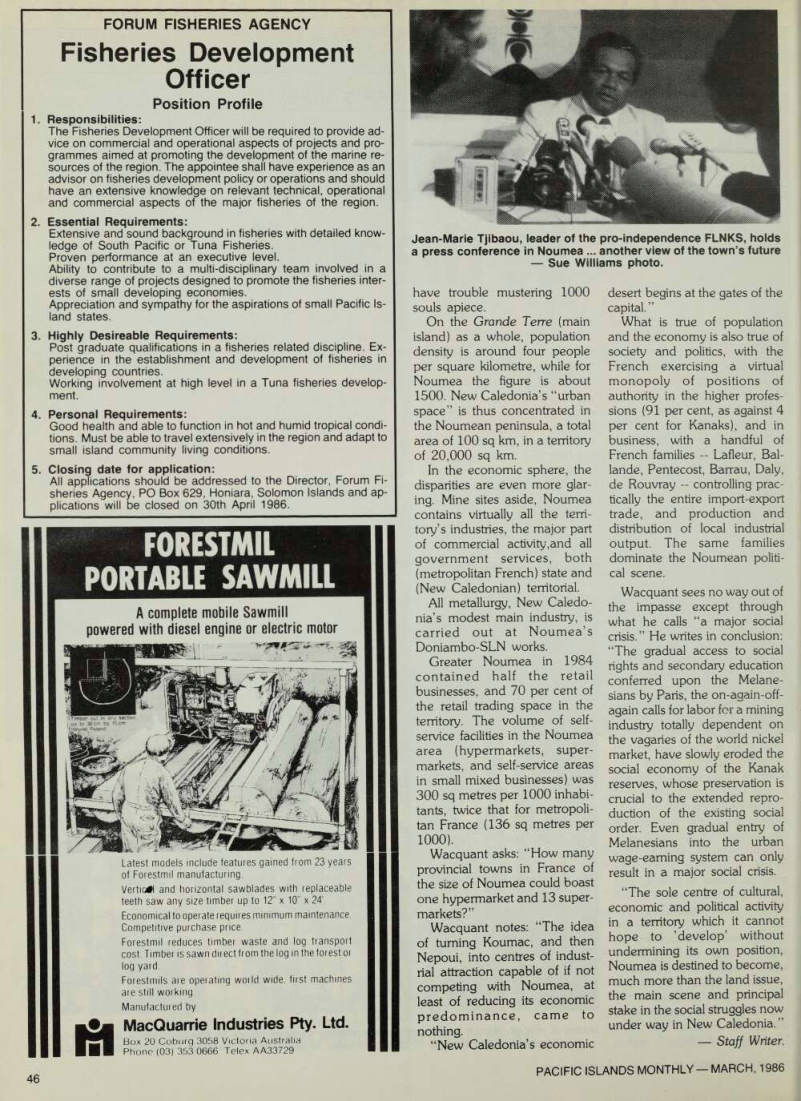
Jean-Marie Tjibaou, leader of the pro-independence FLNKS, holds a press conference in Noumea ... another view of the town’s future - Sue Williams photo.