early Pakeha days
pp. 42-43 · Read in the full issue
A restaurant recalls early Pakeha days
The history of the Wakefield brothers is virtually that of early European settlement in New Zealand. The eldest and most notorious, Edward Gibbon Wakefield, after two runaway marriages to heiresses (one, indeed, involving the physical abduction of a schoolgirl and her fraudulent persuasion into a Gretna Green ceremony), de veloped his colonial ideology in Newgate prison. After an early interest in Australia he per suaded his brother William (who also married after an elopement) to undertake a pre liminary expedition to New Zealand in 1839. “The Colonel” proceeded to acquire some eight million hectares of land, but his failure to establish an undisputed title led to the Wairau Massacre in 1843. He died in Wellington in 1848 of apoplexy!
Another brother Daniel left his wife and travelled to New Zealand under an assumed name to the NZ Com pany’s New Plymouth settle ment. Yet another Felix worked for a brief period as an engineer in Canterbury before taking off for the Crimea to build the Balaclava-Sebastopol railway.
The last brother Arthur was a bachelor to his untimely death at Wairau. He seems to have been the most balanced and able of the five, possessed of what the Nelson Examiner and New Zealand Chronicle described as “the very practical
businesslike turn which ever thing took with him”; and what his colleague Stephens called “a steady uprightness in all his actions”. It was Arthur Wake field who, after a successful career in the Royal Navy, or ganised and led the first of the New Zealand Company’s ex peditions to Nelson (the second to New Zealand). It comprised three ships (the Whitby , the Will Watch and the Arrow) of sur veyors, “improvers” (appren tices) and laborer immigrants, and arrived in Nelson by September 1841 having left London in April. There, the voyagers eagerly awaited their wives and children aboard the notorious Lloyds, which was expected to arrive in advance of the main settler ships.
Arthur Wakefield faced a multitude of immediate prob lems, which were scarcely di minished when the Lloyds did arr i ve late, with a disastrous ly incompetent doctor and under the captaincy of a former master of convict ships. The Lloyds reported 65 child deaths (out of 139 on board), and was described following a subse quent inquiry as a “floating bawdy house . . . the master at the head of it”. The crews of all three settler ships had deserted in Wellington, delaying the arri val of the passengers in Nelson, where they were greeted by a plague of aggressive native rats (quite unlike “civilised rats ’, according to one diarist), to replace the ship’s cockroaches
(which could “eat the edge of razors off”!).
Few of the early arrivals were in a state of health to undertake immediate manual labor. On the ships of the NZ Company, minimal rations (the Dietary) were prescribed for steerage passengers, but included no fresh meat, vegetables or fruit, and were dominated by “weevilly biscuit and preserved potato”. The quality owed much to the ships’ surgeons (who varied in abilities and conscientiousness) and to the cooks (who were male passen gers). The monetary allowance for cabin class, however, was eight times that of steerage, and good captains provided some memorable meals. One such passenger (John Bamicoat) re called . . soup and fresh fish every day, roast and boiled mutton, roast goose, giblet pie, mutton pies, salt fish, baked and boiled potatoes, apple tarts, plum puddings and des sert two or three times a week”.
Another (Alfred Fell) remem bered “a salmon preserved as fine as ever I tasted . . . cheese, bottled porter, champagne and sherry with dessert consisting of apples, nuts, almonds, raisins, etc . . .”. All ships carried live stock (for officers and cabin passengers only) but animals could not be eaten if they died naturally; sometimes, therefore, “a pig was killed to save its life”!
In the new settlement under Arthur Wakefield, a greater variety of food become avail
able for ordinary immigrants; there was abundant seafood (including oysters, shrimps, eels and whitebait); poultry (quail, pigeons, pukeko, kaka, duck); and wild pork. The settlers brought fruit, vegetables and domestic stock. There were some disease problems typhoid and tutu poisoning (described at an inquest as “death by the visitation of God”) and scab disease of sheep. The pestilential rabbit first became established in Nelson. But these were minor irritants compared with the problems associated with land tenure, absentee land purchases, lack of capital, ignorance of farming and the non existence o anyt mg approaching a market ecovolumes for * 6ield < S °f tonal ability as founder, JP, and de facto mentor of the new colony that, by his death on June 17, 1843 (at the age of only 44), this “gentle idealist”
looked after a scattered community of nearly 3000 European souls, having most of the essential elements of contemporary New Zealand society (including three breweries, 14 hostelries, five churches, a local newspaper, a cricket club, a race meeting and the remarkable Nelson Literary and Scientific Institute).
After Wakefield’s death (and the suspension of company operations in 1844) there began ver y arc j times in M e i son , eS neciallv for the landless laborre d ucec i in some cases to su u sistence on Than“ and fern roots was not untj| the next decade and the emergence of produce markets on the goldfie|ds of , he West Coast that promise of economic prosperity There are few memorials to Arthur Wakefield even the village which carries the family
name is not thought to have been called after him. Compensation for this apparent lack of respect, however, is provided by what is arguably the best (in terms of value) gourmet restaurant in New Zealnd Arthur Wakefield House, in the village of Richmond, near Nelson. And if a gourmet restaurant seems an inappropriate memorial to a P ioneer > perhaps it may be as partly redressing the c^ass distinctions which characterised the early days of c °l° n y ar >d which were reflected in food habits.
The house was built in 1894 what was a fairly typical middle-class colonial style. The restaurant openedin 1978 and, w ' t h °P en hearths in winter and an abundance of aged wood in its decor, presents an attractive returned. Victorian cosiness. But ambience is easy to create - a good cuisine is more difficult.
There are three notable features of the Arthur Wakefield
restaurant. Firstly, the chef Peter Banham is, quite sim ply, a very good cook indeed able and willing to adapt to changes in standard raw materials. Nowadays, for exam ple, New Zealand lamb is flash frozen very quickly; Peter has discovered that it needs to be thawed slowly (for three days, in water) before preparation for cooking. Pork, on the other hand because of the way pigs are now farmed needs alternate freezing and thawing; while most cuts of beef need ageing by hanging for two weeks in a vacuum pack.
Secondly, he is a rarity among New Zealand chefs in that he does not treat venison as a kind of beef, or offal as low-grade dog tucker. Venison he marinates in wine and fruit and serves with a plum and boysenberry sauce; it is moist, tender and delicious. Kidneys are presented “en croute”, chicken giblets, lamb sweet breads, hearts and the humble rabbit are paid the compliment of being cooked (“chasseur”) in a good wine or poached and served with cream.
Finally, the Arthur Wakefield offers a series of lowly priced specialities unique in New Zea land. There is a “ploughman’s lunch” comprising a range of breads, salad and coffee plus a selection of pates , smoked fish or thick piquant ham off the-bone (an item rapidly being replaced in New Zealand’s culinary repertoire by the boned, pressed and plasticised variety). There is a simple “businessman’s lunch” and there is a cheeseboard that should make New Zealand’s dairy industry hang its collective head in shame: it offers a selection of six cheeses from French Camembert to Norwe gian Jarlsberg all of them imported.
Devotees of natural foods do well to avoid New Zealand cheeses which are made from pasteurised milks and suffocated in clinging plastic to a bland, aseptic uniformity. The Arthur Wakefield restaurant in Richmond provides a reminder that good food is one of life’s richest pleasures. And, after all, improvement in quality of life is what Arthur Wakefield and his expedition sought in New Zea
land.
Dennis Richardson.
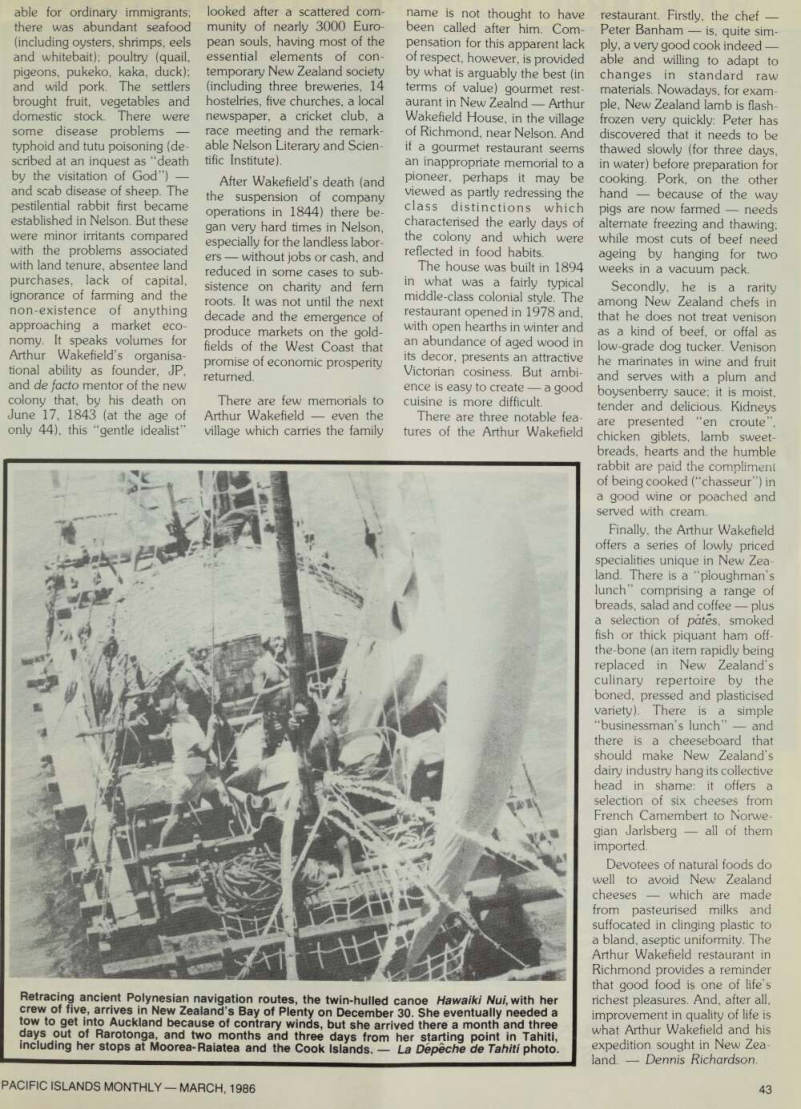
Retracing ancient Polynesian navigation routes, the twin-hulled canoe Hawaiki Nui, with her crew of five, arrives in New Zealand’s Bay of Plenty on December 30. She eventually needed a tow to get into Auckland because of contrary winds, but she arrived there a month and three days out of Rarotonga, and two months and three days from her starting point in Tahiti, including her stops at Moorea-Raiatea and the Cook Islands. - La Dépêche de Tahiti photo.