dealings bear their fruit
pp. 39-40 · Read in the full issue
The middle years: Canny land dealings bear their fruit
In 1873, Commodore Goode nough was guided into Apia harbor by “The Yankee consul, my friend, the pilot.” On November 9, Goodenough gave a party on board the H.M.S. Pearl and invited “all the English residents . . . and also the American consul... he told many stories, which were very good ... as to the value of mats (and other customs). He then gave us the sketch of a marriage, that is always by elopement, and that a girl mar ried as she liked; and that then her friends sent after her, and made a present of mats to swell their importance.” He spoke entertainingly of Samoan “borrowing” habits and methods of native warfare.
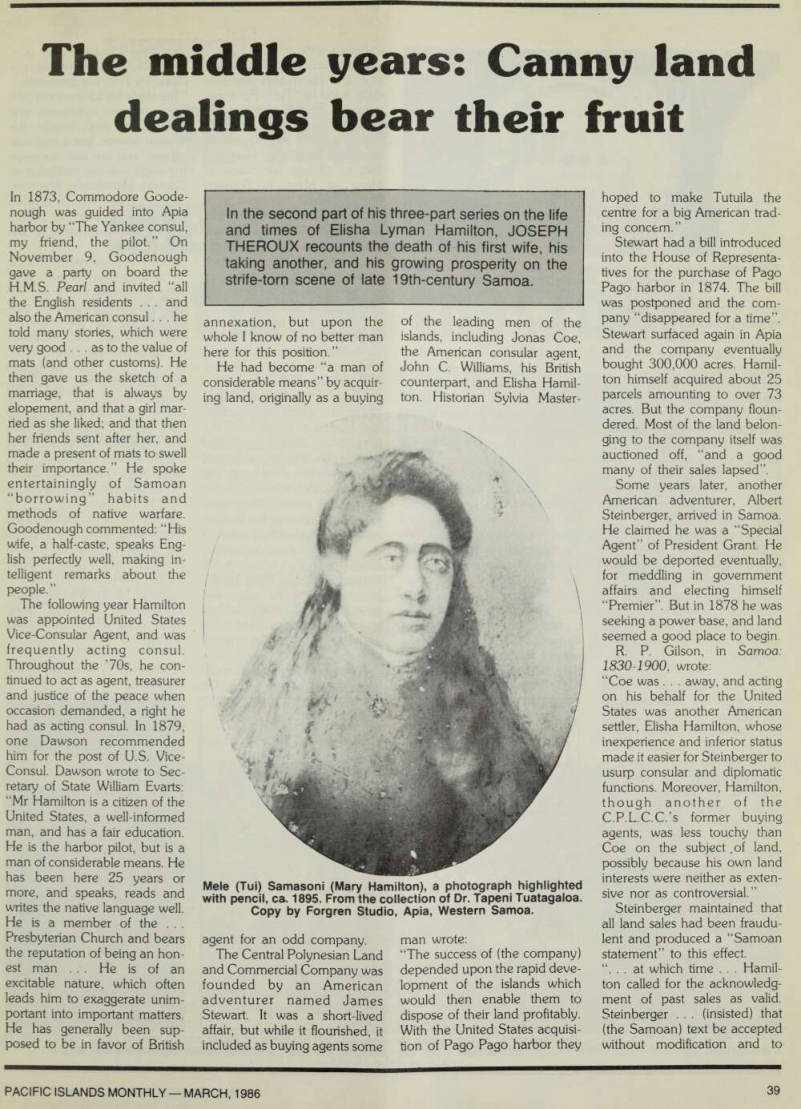
Goodenough commented: “His wife, a half-caste, speaks Eng lish perfectly well, making in telligent remarks about the people.”
The following year Hamilton was appointed United States Vice-Consular Agent, and was frequently acting consul.
Throughout the ’7os, he con tinued to act as agent, treasurer and justice of the peace when occasion demanded, a right he had as acting consul. In 1879, one Dawson recommended him for the post of U.S. Vice- Consul. Dawson wrote to Sec retary of State William Evarts; “Mr Hamilton is a citizen of the United States, a well-informed man, and has a fair education.
He is the harbor pilot, but is a man of considerable means. He has been here 25 years or more, and speaks, reads and writes the native language well.
He is a member of the ...
Presbyterian Church and bears the reputation of being an hon est man ... He is of an excitable nature, which often leads him to exaggerate unim portant into important matters.
He has generally been sup posed to be in favor of British
In the second part of his three-part series on the life and times of Elisha Lyman Hamilton, JOSEPH THEROUX recounts the death of his first wife, his taking another, and his growing prosperity on the strife-torn scene of late 19th-century Samoa.
annexation, but upon the whole I know of no better man here for this position.”
He had become “a man of considerable means” by acquir ing land, originally as a buying
of the leading men of the islands, including Jonas Coe, the American consular agent, John C. Williams, his British counterpart, and Elisha Hamil ton. Historian Sylvia Master-
agent for an odd company.
The Central Polynesian Land and Commercial Company was founded by an American adventurer named James Stewart. It was a short-lived affair, but while it flourished, it included as buying agents some
man wrote: “The success of (the company) depended upon the rapid deve lopment of the islands which would then enable them to dispose of their land profitably.
With the United States acquisi tion of Pago Pago harbor they
hoped to make Tutuila the centre for a big American trad ing concern.”
Stewart had a bill introduced into the House of Representa tives for the purchase of Pago Pago harbor in 1874. The bill was postponed and the com pany “disappeared for a time”.
Stewart surfaced again in Apia and the company eventually bought 300,000 acres. Hamil ton himself acquired about 25 parcels amounting to over 73 acres. But the company floun dered. Most of the land belon ging to the company itself was auctioned off, “and a good many of their sales lapsed”.
Some years later, another American adventurer, Albert Steinberger, arrived in Samoa.
He claimed he was a “Special Agent” of President Grant. He would be deported eventually, for meddling in government affairs and electing himself “Premier”. But in 1878 he was seeking a power base, and land seemed a good place to begin R. P. Gilson, in Samoa: 1830-1900, wrote; “Coe was . . . away, and acting on his behalf for the United States was another American settler, Elisha Hamilton, whose inexperience and inferior status made it easier for Steinberger to usurp consular and diplomatic functions. Moreover, Hamilton, though another of the C.P.L.C.C.’s former buying agents, was less touchy than Coe on the subject .of land, possibly because his own land interests were neither as exten sive nor as controversial.”
Steinberger maintained that all land sales had been fraudu lent and produced a “Samoan statement” to this effect.
“. . . at which time . . . Hamil ton called for the acknowledg ment of past sales as valid.
Steinberger . . . (insisted) that (the Samoan) text be accepted without modification and to
Mele (Tui) Samasoni (Mary Hamilton), a photograph highlighted with pencil, ca. 1895. From the collection of Dr. Tapeni Tuatagaloa.
Copy by Forgren Studio, Apia, Western Samoa.
scold Hamilton for having moved to amend it.” (Gilson.) Hamilton, however, held on to his property, which was in his own name and which even tually became known as the Hamilton Estates. As a good New Englander, he knew land was money, and he refused to give it up. His will lists the names of each of the land owners he bought from; evidently he was a good record keeper. When the International Land Commissions of the 1890 s investigated the claims of outlanders, much of the land was returned to the Samoans, as they had been duped or swindled into giving it up.
Hamilton’s property withstood the scrutiny of the Commission: each parcel had been gotten honestly. • • • Mary Ann Hamilton, 10 years older than her husband, died on February 3, 1882, aged 63.
She had borne no children, but he would speak tenderly of her in his will 10 years later. She was buried by the house at Matautu as Samoan custom dictated, beneath a massive tiered grave. But Hamilton, at 54. did not remain disconsolate long. On June 3, four months later, he married a full-blooded Samoan girl named Tui. The occasion was recorded by the U.S. Consul J.E.V. Alvord, though they were probably married in Apia Protestant Church. Tui was a relative of Lauli’i Willis, who, along with her husband Alex, wrote The Story of Lauli’i: Daughter of Samoa (1889). When the Wil lises returned from a trip, they were greeted by;
“Captain Hamilton ... an old pilot who had retired from the business . . . (and his wife) . . . soon came on board them selves and we were saluted in the true Samoan fashion (as the Captain prided himself upon being a Samoan in spirit and in truth), by rubbing noses, which with us takes the place of kissing ...”
Tui was a high-spirited girl who liked to flirt and twit missionaries. No doubt Hamil ton had his hands full. Two years later, on June 16. 1884.
Tui gave birth to John Williams Hamilton. He would be edu cated in California, and even tually settle there; the family would lose track of him. He was named for the John C. Williams of the C.P.L.C.C., who was the son of the first missionary to Samoa and, according to his torian Robson, “the first copra
trader to settle in Apia”.
Son John’s birth was the last time that his mother was offi cially listed as “Tui”. For some reason, Oedipal or otherwise, to honor his first wife, or out of convenience, as Westbrook suggested of others, Hamilton had to change her name to Mary, or Mele, in Samoan (though some rendered it as Meli). She was known as Mary for the rest of her life. But it may have been her idea: Samoans are notorious for changing their names at the drop of a mat, or for having several names to suit various circumstances.
But it was by her new, English, name that Robert Louis Stevenson refers to her in his book A Footnote to History: Eight Years of Trouble in Samoa. In describing the Battle of Matautu which raged around the Hamilton home and the pilot station during the district wars of the ’Bos, he mentioned a German-led attack on the Matautu Peninsula. Native forces, he wrote, “lay close along the shoreside bushes, expecting their arrival; when a silly lad, in mere lightness of heart, fired a shot in the air. My native friend, Mrs Mary Hamil ton, ran out of her house and gave the culprit a good shaking: an episode in the midst of battle as incongruous as the grazing cow. ”
It was the only light moment in a deadly serious war. On
December 21 of the same year (1888) a German warship, the Olga, fired on the peninsula.
“The shells fell for the most part innocuous; an eyewitness saw children at play beside the flaming houses; not a soul was injured; and the one notewor thy event was the mutilation of Captain Hamilton’s American flag . . . These rags of tattered bunting occasioned the display of a new sentiment in the United States.”
But who now remembers the insult, or indeed, the war itself? • • • Hamilton had resigned his post as vice-consul the previous year, though he remained municipal treasurer until Febru ary 20, 1889. Then he retired and planned a trip, possibly a delayed honeymoon, to Austra lia. He and Mele were gone for two months, visiting Sydney and the Blue Mountains of New South Wales. Several years later, Mele recalled the trip to Fanny Stevenson, and one inci dent in particular.
They had been discussing the loose-fitting island dress, called the Mother Hubbard, or in Hawaiian, the holaku. Fanny quoted Mary as saying that in Sydney “a crowd of boys” followed her shouting: “Hey, there goes a woman in her nightgown!”
Next month: The stories of old Samasone.
Tombstone of Mary Ann (Cawley) Hamilton, first wife of Elisha Lyman Hamilton. - Joseph Theroux photo.
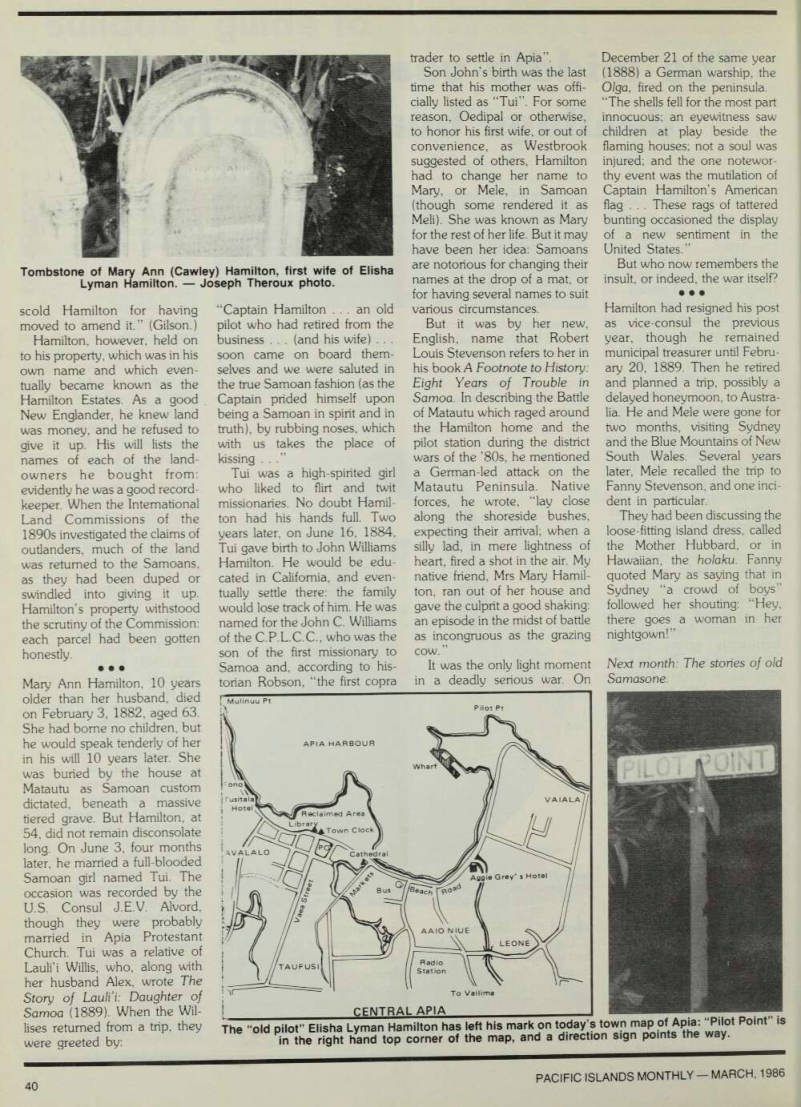
The “old pilot” Elisha Lyman Hamilton has left his mark on today's town map of Apia: “Pilot Point" is in the right hand top corner of the map, and a direction sign points the way.