Builders’ guide to
p. 38 · Read in the full issue
the Islands scene
Pacific Island construction and development. Published by Pacific Economics Pty. Ltd. , Sydney Economic growth can mean many things but this small book reminds us of an often over looked dimension, namely, the fact that economic growth is “construction-oriented”. Little development can take place physically without some input of design, construction and/or materials. This is true whether we are considering a large industrial economy, or a small developing unit as characteristic of the South Pacific Island world. Development implies a need for relatively large-scale construction works as well as for imported building products and materials. In relation to the South Pacific region, this opens up major opportunities for overseas-based contractors and suppliers.
This book is intended to serve the needs of major over seas construction contractors, principally in Australia and New Zealand, and to draw attention to existing opportunities and prospects for contract work. It does this by assembling a con siderable body of information bearing on the construction in dustry in the Pacific Basin coun tries information which is needed to “support significant business decisions” and from which “future market participa tion can be projected” (p. 3).
The survey covers 26 Eng lish-speaking countries, island states or overseas-owned terri tories located in the vast region from New Zealand in the south, northward to the State of Hawaii and from Papua New Guinea east to the Pitcairn Islands. New Zealand and the State of Hawaii are not in cluded in the survey but will be surveyed separately. Without the U.S.-administered John ston, Midway and Wake, the region is thus co-extensive with the English-speaking compo nent of the SPC region.
The information used in the study is drawn heavily from a variety of published sources.
principally the economic and statistical data published by re gional and international orlike ADB. ESCAP.
SPC and the World Bank. It also draws upon development plans and newspaper sources and the results of regular sur veys conducted by PACIFECON itself. On the whole, statistical materials from these sources are used uncri tically even though the accura cy of some estimates (e.g., on national income) can be ques tioned.
The book divides into three parts: overview, market profiles and evaluation. In the overview section, some well-known fea tures of Pacific Island econo mies are highlighted. These in clude a high rate of population growth especially in Melanesia, the large development potential in marine resources, extent of external aid support and cur rent trends in trade, national income and government ex penditure. inflation and tour ism. The material is presented in summary form and in several instances there is a heavy re liance on direct quotations from other sources (e.g., in the sec tion on official development assistance (pp. 22-26), direct quotes account for eight out of 10 paragraphs). Many distinc tive features and interesting pieces of information are noted in this section: for example, we are reminded of the fact that total government expenditure
in both Niue and Tokelau ex ceeds gross domestic product!
A source of weakness is the rather cursory treatment of employment in construction.
Here the only data given are the percentage proportion of the workforce in construction, and then for only 11 countries.
There is scope here for other employment issues to be raised, in particular, on levels of skills, availability of labor, wage levels and extent of union influence (if any).
The market profiles of indi vidual Pacific Island countries form the substantive section of the book and one of most interest for the hard-headed businessman-contractor. The salient features of the construc tion industry in each country are described, focusing on; im ports of building materials, re cord of building permits issued, major contracts awarded (with name of contractor), listing of construction authorities, pro jects currently under construc tion (with costs) by sectoral area (buildings, roads, power, air ports. etc.), and listing of local construction companies (with postal address). In some cases, capital projects listed in deve lopment plans are also outlined.
The coverage given to each country reflects economic size and construction potential.
Thus while the profiles for Papua New Guinea and Fiji each take up four to five pages, those for the 12 smallest coun tries and territories occupy no more than about half a page each. On the whole, however, the material is well selected and detailed enough for the pur pose.
The last section on evalua tion focuses on a number of topics that have a bearing on the building/construction mar ket potential in the countries concerned. These include pro curement possibilities associ ated with official aid flows into the region, certain factors favor ing growth in the region, im plications of the Micronesia compact, regional trade and aid agreements; export promotion programs available in Australia and New Zealand, and market ing aspects. All these provide valuable information bearing on economic prospects, espe cially for trade, investment and construction activity.
The analysis of procurement (pp.sB-60) is of particular in terest. “Confidential” data from the ADB (applying to Decem ber 31, 1982) concerning con tributions to ADB ordinary capi tal resources and procurements (goods, related services and civil works as well as consultan cies) are given, showing that Australia and New Zealand have both done pretty badly compared with Japan and one or two others. Funds contri buted by Australia, for exam ple, are more than seven times what is gained from procure ments. (This is offset in part by a more favorable outcome in relation to technical assistance.
Implicitly, the analysis suggests that much more can be done by both Australia and New Zea land to increase procurements.
However, it would be unfortun ate indeed if this were to be interpreted as an argument for a greater proportion of tied aid!) The book concludes on a note of exhortation; the Pacific Islands constitute an open mar ket worth hundreds of millions of dollars annually which can be tapped by contractors and suppliers of materials. But they need to do their homework, for such business will not be just “dumped in their lap". Much will depend on a continuing planned involvement, on or ganisation and imagination and not just luck. Nothing to dis agree with here!
The book is a most worth while exercise which succeeds in what it sets out to do. For the Pacific-wide contracting fra ternity, it will most certainly be seen as an essential acquisition
and resource material.
Te'o
I.J. Fairbairn.
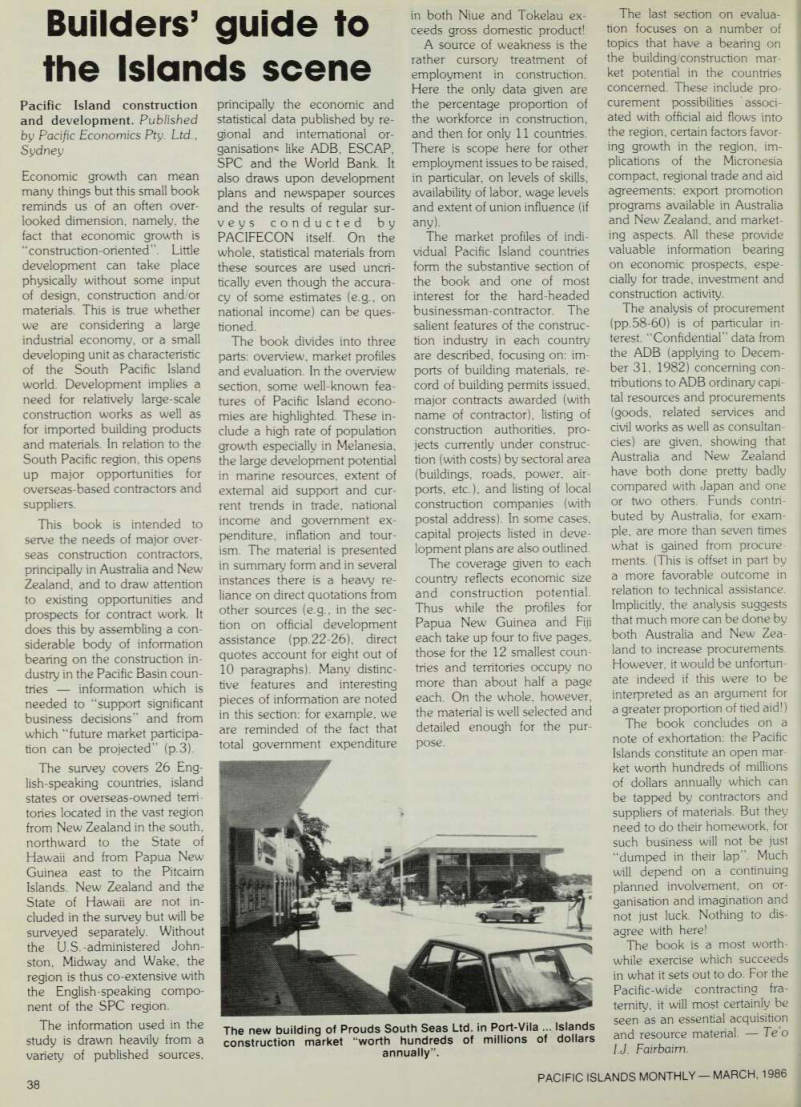
The new building of Prouds South Seas Ltd. in Port-Vila ... Islands construction market “worth hundreds of millions of dollars
annually”.