Pacific Island theses etc:
pp. 36-37 · Read in the full issue
Homage to much midnight oil
By W. G. Coppell and S.
Stratigos. Published by Re search School of Pacific Stu dies, Australian National Uni versity, in conjunction with The Institute for Polynesian Studies.
Brigham Young University Hawaii Campus. Copyright 1983. Distributed by University of Hawaii Press. ISBN 0 939154 33 1. $A24.95.
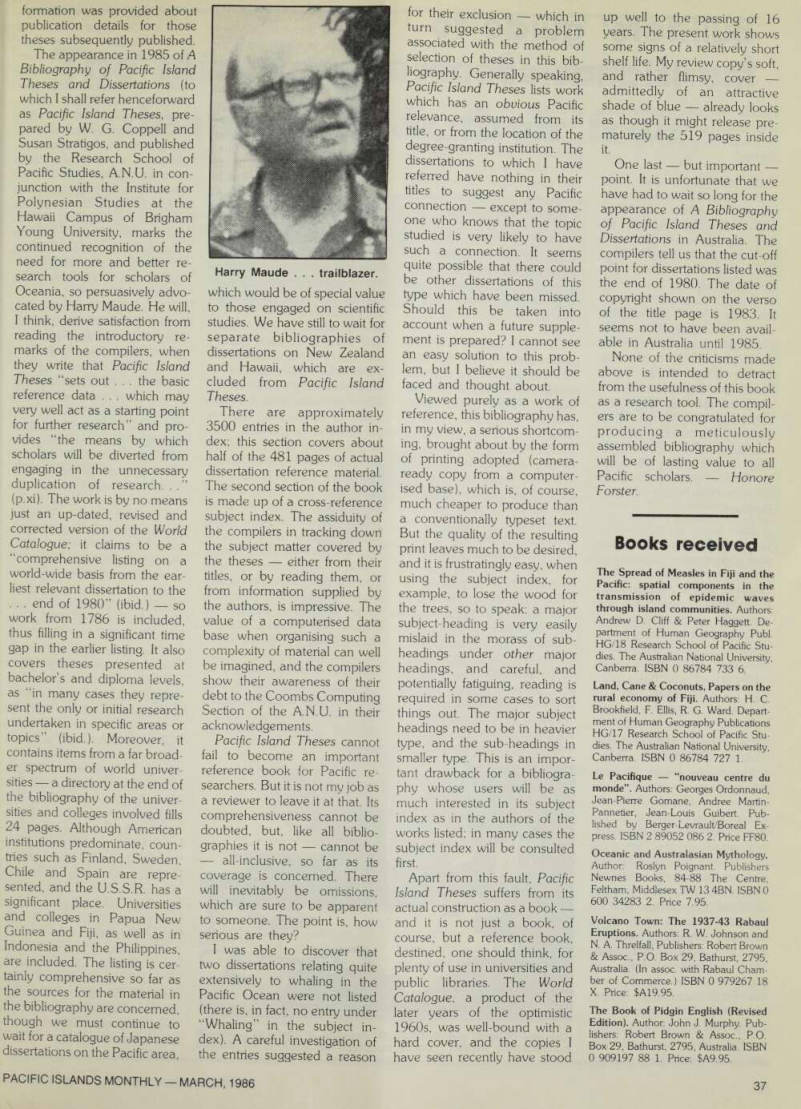
Sixteen years ago, the publication of the World Cata logue of Theses on the Pacific Islands, compiled by Diane Dickson and Carol Dossor. and published by the Australian Na tional University Press, brought to fruition an important bib liographical project undertaken with the encouragement and guidance of Professor Harry Maude. Professor Maude, who has been recognised as one of the major figures, along with the late Professor Jim David son, in the development of the study of Pacific Islands history in Australia, was then profes sorial fellow in the Department of Pacific History at the A.N.U.
He had long been an advo
cate of the need for more basic research tools for Pacific his torians, who, he believed, had been, and were continuing to be, seriously hampered by the dearth of bibliographies, serials indexes and manuscript cata logues in the newly-tapped mine of Islands’ history. It was under his direction that the South Pacific Commission had published in 1955 an Index of Social Science Theses on the South Pacific, as even then it was apparent that a regional catalogue of research theses was needed. By 1970 Oceania had become, as Harry Maude wrote in his preface to the World Catalogue, “a vast lab oratory for both the social and natural scientist” (p.v.) and the realisation of its potential in this regard and the concomitant necessity for research workers to know what was being done in their field in order to avoid duplication, led him to initiate work on an expanded, updated and revised catalogue of theses, covering “the whole range of scholarly inquiry” (ibid), to be comoiled bv members of the
research support staff of the Department of Pacific History.
Its basis was to be the microfilm library of theses on the Pacific Islands maintained by this de partment.
The result was an elegant, slim volume of some 1000 entries and 123 well printed and generously spaced pages, divided geographically under four headlings Oceania, Melanesia, Micronesia and Polynesia. Theses in the Oceania section were usefully listed according to six subject headings, such as “Natural Sci ences” and “Maritime Affairs”, but in only two instances in the island sub-groupings under New Guinea and Hawaii was it found necessary to have a further break-down by subject category because of the num ber of entries. The catalogue listed mainly doctoral and mas ters’ theses, with only a few university prize essays, and B.A. (Hons) and Dip. Ed. theses “considered to be significant contributions to knowledge' (p.vi), almost all of them written after 1900; where known, in
formation was provided about publication details for those theses subsequently published.
The appearance in 1985 of A Bibliography of Pacific Island Theses and Dissertations (to which I shall refer henceforward as Pacific Island Theses, pre pared by W. G. Coppell and Susan Stratigos, and published by the Research School of Pacific Studies, A.N.U. in con junction with the Institute for Polynesian Studies at the Hawaii Campus of Brigham Young University, marks the continued recognition of the need for more and better re search tools for scholars of Oceania, so persuasively advo cated by Harry Maude. He will, I think, derive satisfaction from reading the introductory re marks of the compilers, when they write that Pacific Island Theses “sets out . . . the basic reference data . . . which may very well act as a starting point for further research” and pro vides “the means by which scholars will be diverted from engaging in the unnecessary duplication of research. . .” (p.xi). The work is by no means just an up-dated, revised and corrected version of the World Catalogue; it claims to be a “comprehensive listing on a world-wide basis from the ear liest relevant dissertation to the . . . end of 1980” (ibid.) so work from 1786 is included, thus filling in a significant time gap in the earlier listing. It also covers theses presented at bachelor’s and diploma levels, as “in many cases they repre sent the only or initial research undertaken in specific areas or topics” (ibid.). Moreover, it contains items from a far broad er spectrum of world univer sities a directory at the end of the bibliography of the univer sities and colleges involved fills 24 pages. Although American institutions predominate, coun tries such as Finland, Sweden.
Chile and Spain are repre sented, and the U.S.S.R. has a significant place. Universities and colleges in Papua New Guinea and Fiji, as well as in Indonesia and the Philippines, are included. The listing is cer tainly comprehensive so far as the sources for the material in the bibliography are concerned, though we must continue to wait for a catalogue of Japanese dissertations on the Pacific area,
which would be of special value to those engaged on scientific studies. We have still to wait for separate bibliographies of dissertations on New Zealand and Hawaii, which are ex cluded from Pacific Island Theses.
There are approximately 3500 entries in the author in dex; this section covers about half of the 481 pages of actual dissertation reference material.
The second section of the book is made up of a cross-reference subject index. The assiduity of the compilers in tracking down the subject matter covered by the theses either from their titles, or by reading them, or from information supplied by the authors, is impressive. The value of a computerised data base when organising such a complexity of material can well be imagined, and the compilers show their awareness of their debt to the Coombs Computing Section of the A.N.U. in their acknowledgements.
Pacific Island Theses cannot fail to become an important reference book for Pacific re searchers. But it is not my job as a reviewer to leave it at that. Its comprehensiveness cannot be doubted, but, like all biblio graphies it is not cannot be all-inclusive, so far as its coverage is concerned. There will inevitably be omissions, which are sure to be apparent to someone. The point is, how serious are they?
I was able to discover that two dissertations relating quite extensively to whaling in the Pacific Ocean were not listed (there is, in fact, no entry under “Whaling” in the subject in dex). A careful investigation of the entries suggested a reason
for their exclusion which in turn suggested a problem associated with the method of selection of theses in this bib
liography. Generally speaking,
Pacific Island Theses lists work which has an obvious Pacific relevance, assumed from its title, or from the location of the degree-granting institution. The dissertations to which I have referred have nothing in their titles to suggest any Pacific connection except to some one who knows that the topic studied is very likely to have such a connection. It seems quite possible that there could be other dissertations of this type which have been missed.
Should this be taken into account when a future supple ment is prepared? I cannot see an easy solution to this prob lem, but I believe it should be faced and thought about.
Viewed purely as a work of reference, this bibliography has, in my view, a serious shortcom ing, brought about by the form of printing adopted (camera ready copy from a computer ised base), which is, of course, much cheaper to produce than a conventionally typeset text.
But the quality of the resulting print leaves much to be desired, and it is frustratingly easy, when using the subject index, for example, to lose the wood for the trees, so to speak; a major subject-heading is very easily mislaid in the morass of sub headings under other major headings, and careful, and potentially fatiguing, reading is required in some cases to sort things out. The major subject headings need to be in heavier type, and the sub-headings in smaller type. This is an impor tant drawback for a bibliogra phy whose users will be as much interested in its subject index as in the authors of the works listed; in many cases the subject index will be consulted first.
Apart from this fault, Pacific Island Theses suffers from its actual construction as a book and it is not just a book, of course, but a reference book, destined, one should think, for plenty of use in universities and public libraries. The World Catalogue , a product of the later years of the optimistic 19605, was well-bound with a hard cover, and the copies I have seen recently have stood
up well to the passing of 16 years. The present work shows some signs of a relatively short shelf life. My review copy’s soft, and rather flimsy, cover admittedly of an attractive shade of blue already looks as though it might release pre maturely the 519 pages inside it.
One last but important point. It is unfortunate that we have had to wait so long for the appearance of A Bibliography of Pacific Island Theses and Dissertations in Australia. The compilers tell us that the cut-off point for dissertations listed was the end of 1980. The date of copyright shown on the verso of the title page is 1983. It seems not to have been avail able in Australia until 1985.
None of the criticisms made above is intended to detract from the usefulness of this book as a research tool. The compil ers are to be congratulated for producing a meticulously assembled bibliography which will be of lasting value to all
Pacific scholars.
Honore
Forster.
Harry Maude . . . trailblazer.