books
pp. 35-36 · Read in the full issue
'Rainbow Warrior’: A thriller, even if you know whodunit
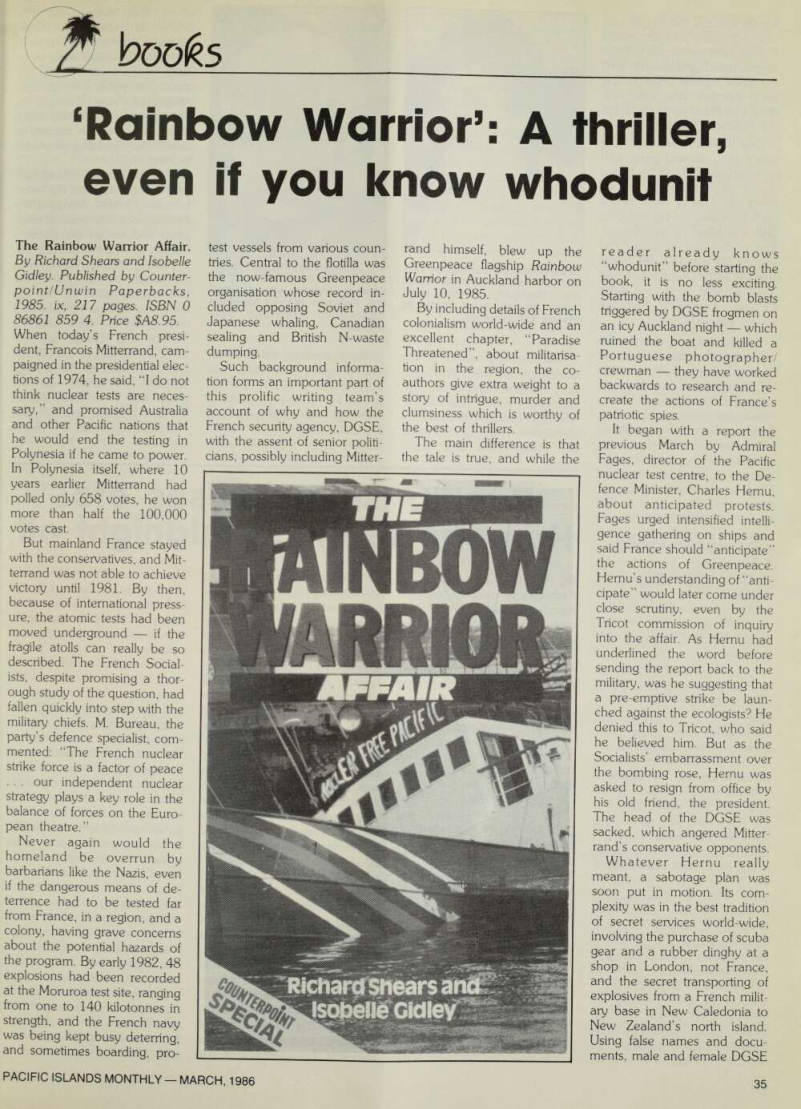
The Rainbow Warrior Affair.
By Richard Shears and Isobelle Gidley. Published by Counter point/Unwin Paperbacks, 1985. ix, 217 pages. ISBN 0 86861 859 4. Price $A8.95.
When today’s French presi dent, Francois Mitterrand, cam paigned in the presidential elec tions of 1974, he said, “I do not think nuclear tests are neces sary,” and promised Australia and other Pacific nations that he would end the testing in Polynesia if he came to power.
In Polynesia itself, where 10 years earlier Mitterrand had polled only 658 votes, he won more than half the 100,000 votes cast.
But mainland France stayed with the conservatives, and Mit terrand was not able to achieve victory until 1981. By then, because of international press ure, the atomic tests had been moved underground if the fragile atolls can really be so described. The French Social ists, despite promising a thor ough study of the question, had fallen quickly into step with the military chiefs. M. Bureau, the party’s defence specialist, com mented: “The French nuclear strike force is a factor of peace . . . our independent nuclear strategy plays a key role in the balance of forces on the Euro pean theatre.”
Never again would the homeland be overrun by barbarians like the Nazis, even if the dangerous means of de terrence had to be tested far from France, in a region, and a colony, having grave concerns about the potential hazards of the program. By early 1982, 48 explosions had been recorded at the Moruroa test site, ranging from one to 140 kilotonnes in strength, and the French navy was being kept busy deterring, and sometimes boarding, pro
test vessels from various coun tries. Central to the flotilla was the now-famous Greenpeace organisation whose record in cluded opposing Soviet and Japanese whaling, Canadian sealing and British N-waste dumping.
Such background informa tion forms an important part of this prolific writing team’s account of why and how the French security agency, DGSE, with the assent of senior politi cians, possibly including Mitter
rand himself, blew up the Greenpeace flagship Rainbow Warrior in Auckland harbor on July 10, 1985.
By including details of French colonialism world-wide and an excellent chapter, “Paradise Threatened”, about militarisa tion in the region, the co authors give extra weight to a story of intrigue, murder and clumsiness which is worthy of the best of thrillers.
The main difference is that the tale is true, and while the
reader already knows “whodunit” before starting the book, it is no less exciting.
Starting with the bomb blasts triggered by DGSE frogmen on an icy Auckland night which ruined the boat and killed a Portuguese photographer/ crewman they have worked backwards to research and re create the actions of France’s patriotic spies.
It began with a report the previous March by Admiral Pages, director of the Pacific nuclear test centre, to the De fence Minister, Charles Hernu, about anticipated protests.
Pages urged intensified intelli gence gathering on ships and said France should “anticipate” the actions of Greenpeace.
Hernu’s understanding of “anti cipate” would later come under close scrutiny, even by the Tricot commission of inquiry into the affair. As Hernu had underlined the word before sending the report back to the military, was he suggesting that a pre-emptive strike be laun ched against the ecologists? He denied this to Tricot, who said he believed him. But as the Socialists’ embarrassment over the bombing rose, Hernu was asked to resign from office by his old friend, the president.
The head of the DGSE was sacked, which angered Mitter rand’s conservative opponents.
Whatever Hernu really meant, a sabotage plan was soon put in motion. Its com plexity was in the best tradition of secret services world-wide, involving the purchase of scuba gear and a rubber dinghy at a shop in London, not France, and the secret transporting of explosives from a French milit ary base in New Caledonia to New Zealand’s north island.
Using false names and docu ments, male and female DGSE
agents entered NZ by air and sea (on the charter yacht Ouvea, later presumed to have been scuttled) and co-ordinated the strike against unsuspecting crew members who were hol ding a birthday party on board the Rainbow Warrior.
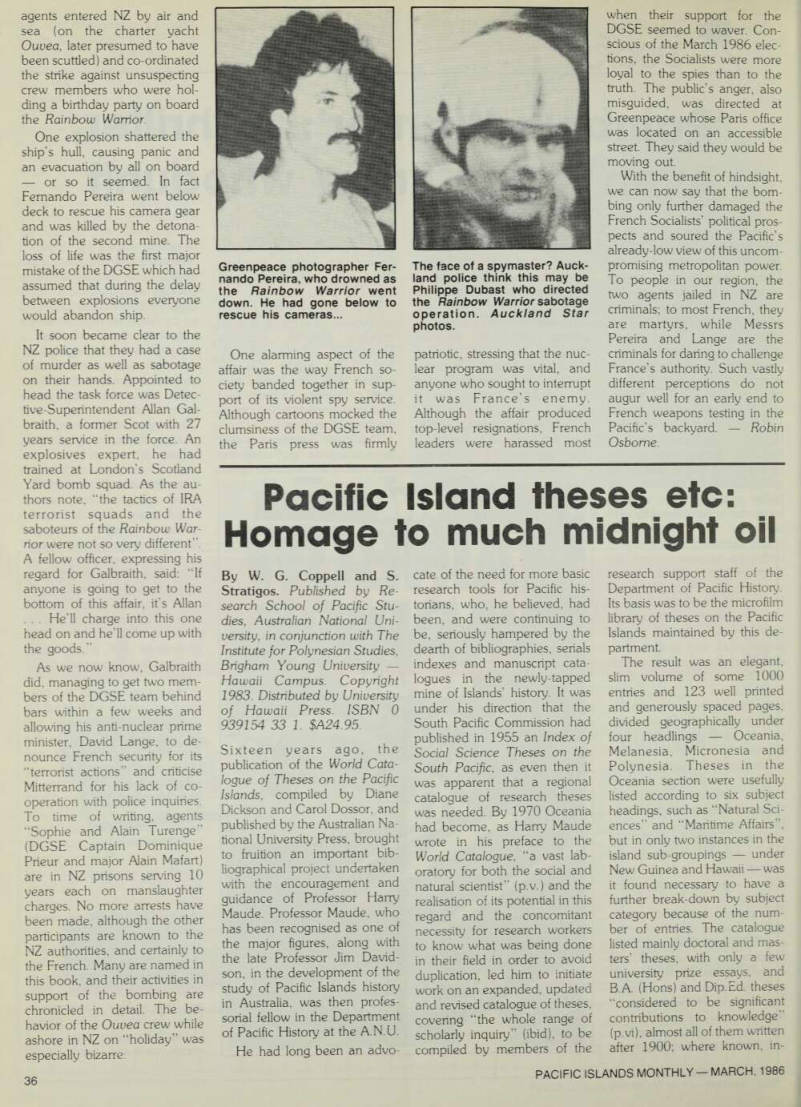
One explosion shattered the ship’s hull, causing panic and an evacuation by all on board or so it seemed. In fact Fernando Pereira went below deck to rescue his camera gear and was killed by the detona tion of the second mine. The loss of life was the first major mistake of the DGSE which had assumed that during the delay between explosions everyone would abandon ship.
It soon became clear to the NZ police that they had a case of murder as well as sabotage on their hands. Appointed to head the task force was Detec tive-Superintendent Allan Gal braith, a former Scot with 27 years service in the force. An explosives expert, he had trained at London’s Scotland Yard bomb squad. As the au thors note, “the tactics of IRA terrorist squads and the saboteurs of the Rainbow War rior were not so very different”.
A fellow officer, expressing his regard for Galbraith, said; “If anyone is going to get to the bottom of this affair, it’s Allan . . . He'll charge into this one head on and he’ll come up with the goods.”
As we now know, Galbraith did, managing to get two mem bers of the DGSE team behind bars within a few weeks and allowing his anti-nuclear prime minister, David Lange, to de nounce French security for its “terrorist actions” and criticise Mitterrand for his lack of co operation with police inquiries.
To time of writing, agents “Sophie and Alain Turenge” (DGSE Captain Dominique Prieur and major Alain Mafart) are in NZ prisons serving 10 years each on manslaughter charges. No more arrests have been made, although the other participants are known to the NZ authorities, and certainly to the French. Many are named in this book, and their activities in support of the bombing are chronicled in detail. The be havior of the Ouvea crew while ashore in NZ on “holiday” was especially bizarre.
One alarming aspect of the affair was the way French so ciety banded together in sup port of its violent spy service.
Although cartoons mocked the clumsiness of the DGSE team, the Paris press was firmly
patriotic, stressing that the nuc lear program was vital, and anyone who sought to interrupt it was France’s enemy.
Although the affair produced top-level resignations, French leaders were harassed most
when their support for the DGSE seemed to waver. Con scious of the March 1986 elec tions. the Socialists were more loyal to the spies than to the truth. The public’s anger, also misguided, was directed at Greenpeace whose Paris office was located on an accessible street. They said they would be moving out.
With the benefit of hindsight, we can now say that the bom bing only further damaged the French Socialists’ political pros pects and soured the Pacific’s already-low view of this uncom promising metropolitan power.
To people in our region, the two agents jailed in NZ are criminals; to most French, they are martyrs, while Messrs Pereira and Lange are the criminals for daring to challenge France’s authority. Such vastly different perceptions do not augur well for an early end to French weapons testing in the
Pacific’s backyard.
Robin
Osborne.
Greenpeace photographer Fer
nando Pereira, who drowned as the Rainbow Warrior went down. He had gone below to rescue his cameras...
The face of a spymaster? Auck land police think this may be Philippe Dubast who directed the Rainbow Warrior sabotage operation. Auckland Star photos.