Wingti seeks a “breather”
pp. 29-32 · Read in the full issue


Un Asked To Intercede
Wingti seeks a “breather” on border issue
It has taken over two years, and a change of government, but Papua New Guinea has now gone a long way towards re moving one of the sharpest thorns in its flesh the border crossers problem.
In handing over the matter to the United Nations, Prime Minister Paias Wingti has once again demonstrated his de cisiveness and his willingness to act in the face of apparently intractable odds.
Bringing in the UN High Commissioner for Refugees to screen the Irian Jaya crossers, and letting them pay the cost of establishing processing centres and resettling them, was bound to offend the Indonesian gov ernment with which PNG has been at such pains to maintain workable relations.
As well as the risk of the UN interfering in PNG’s sensitive bilateral relations with her neighbor, Mr Wingti could also face the opening of floodgates
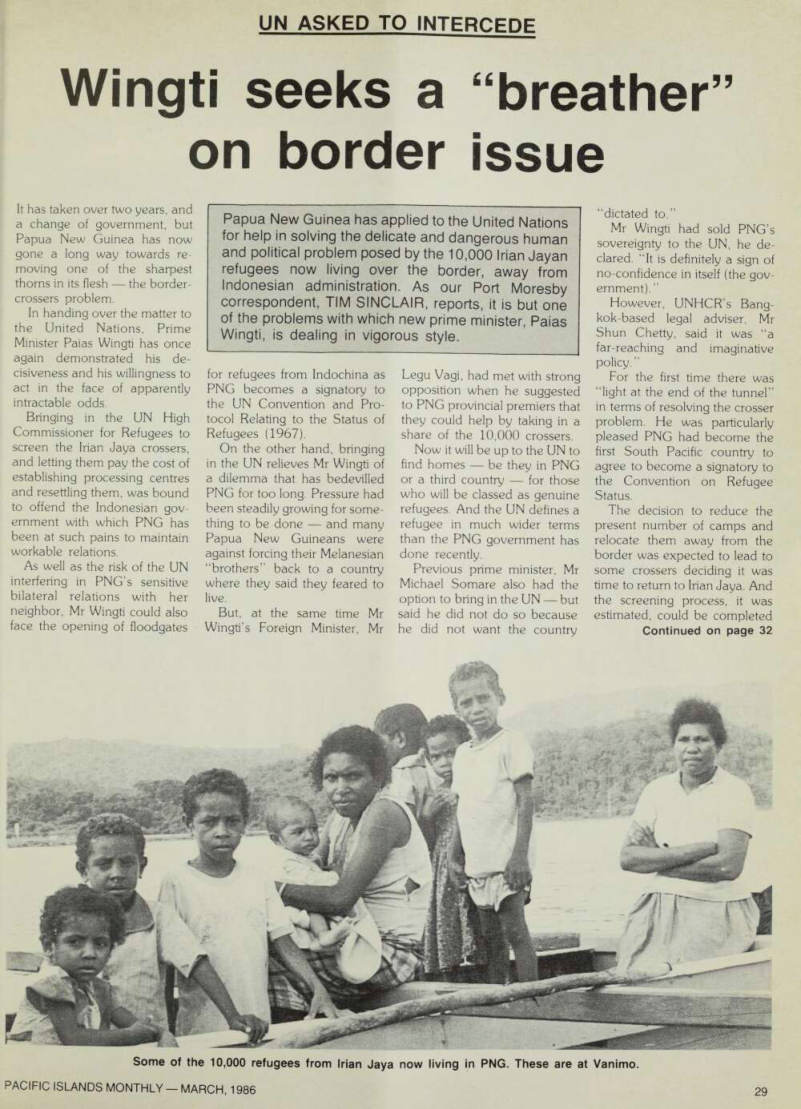
Papua New Guinea has applied to the United Nations for help in solving the delicate and dangerous human and political problem posed by the 10,000 Irian Jayan refugees now living over the border, away from Indonesian administration. As our Port Moresby correspondent, TIM SINCLAIR, reports, it is but one of the problems with which new prime minister, Paias Wingti, is dealing in vigorous style.
for refugees from Indochina as PNG becomes a signatory to the UN Convention and Pro tocol Relating to the Status of Refugees (1967).
On the other hand, bringing in the UN relieves Mr Wingti of a dilemma that has bedevilled PNG for too long. Pressure had been steadily growing for some thing to be done and many Papua New Guineans were against forcing their Melanesian “brothers” back to a country where they said they feared to live.
But, at the same time Mr Wingti’s Foreign Minister, Mr
Legu Vagi, had met with strong opposition when he suggested to PNG provincial premiers that they could help by taking in a share of the 10,000 crossers.
Now it will be up to the UN to find homes be they in PNG or a third country for those who will be classed as genuine refugees. And the UN defines a refugee in much wider terms than the PNG government has done recently.
Previous prime minister, Mr Michael Somare also had the option to bring in the UN but said he did not do so because he did not want the country
“dictated to.”
Mr Wingti had sold PNG’s sovereignty to the UN, he de clared. “It is definitely a sign of no-confidence in itself (the gov ernment).”
However, UNHCR’s Bang kok-based legal adviser, Mr Shun Chetty, said it was “a far-reaching and imaginative policy.”
For the first time there was “light at the end of the tunnel” in terms of resolving the Grosser problem. He was particularly pleased PNG had become the first South Pacific country to agree to become a signatory to the Convention on Refugee Status.
The decision to reduce the present number of camps and relocate them away from the border was expected to lead to some crossers deciding it was time to return to Irian Jaya. And the screening process, it was estimated, could be completed
Continued on page 32
Some of the 10,000 refugees from Irian Jaya now living in PNG. These are at Vanimo.
Continued from page 29
in a couple of months. PNG ministers and officials will help with the task.
The delicate task of presen ting PNG’s new stand to In donesia went to Foreign Minis ter Vagi, who met the Jakarta government in February.
He has had a political bapt ism of fire over the border issue.
His first Cabinet submission in December was rejected as “the same old stuff” as had been presented to the previous So mare government. He was forced back to the drawing board.
Then, in January, it came out that Mr Vagi had telexed pro vincial premiers asking them if they could resettle some of the crossers in their areas. Mr Wing ti did not know about it and was furious especially because the telexes contained confiden tial information.
The prime minister ordered all his ministers to keep silent on the issue and told Mr Vagi not to release a long-awaited policy statement.
A few days later Mr Vagi suffered a third rebuff when another of his submissions was rejected by Cabinet. A commit tee of six ministers and Foreign Affairs officials was appointed to make alterations and recom mendations.
The outcome was the calling in of the UN. Mr Vagi was despatched to explain it to neighboring nations.
Except for the border issue Mr Vagi has kept a low profile.
His only public pronouncement has been a stern lecture to the country’s newly-appointed envoys.
In despatching 11 new heads of overseas mission Mr Vagi announced steps had been taken to strengthen ties with Asia. A new mission is to be established in China and hon orary consuls will be appointed in Singapore, Hong Kong, Bangkok, Seoul, Tel Aviv, Munich and Hamburg.
China was a special case, he said. It had committed Kina7million as an interest-free loan to PNG for agricultural projects and Kina-800,000 on other projects.
Western Highlands MP, Kin di Lawi, Minister for Home Affairs in the Somare govern ment, said: “PNG is now depar ting from its traditional western
neighbors who have millions and millions of kina here and is now leaning towards the com munist/socialist bloc.”
Mr Wingti wants PNG to seek full membership of the Associa tion of South-east Asian Na tions (ASEAN), which has as one of its cornerstones total opposition to communism.
But, amidst what might look like some confusion, one thing is certain. Papua New Guinea is at least seen to be on the move, evidenced by, if nothing else, fireworks in all directions. As well as foreign affairs issues, the domestic scene has been one of turmoil. After the head-rolling exercise among public servants (see PIM, Jan, ’B6), has come the sackings of boards of statu tory bodies.
The Post and Telecommuni cations Board and the Har bours Board, decided to fight their sackings in court and the members of the coffee, copra and cocoa boards threatened to do the same, until Mr Wingti stepped in and asked the members to pledge loyalty to his government if they wanted to stay on.
On the law and order front, Police Commissioner David Ta sion has been deploying special police task forces to the coun try’s troublespots, where he has successfully contained escalat ing crime and tribal fights, arrested countless rape, rob bery and murder suspects, and recaptured prisoners on the run although they are still con tinuing to escape.
Revelations about the appall ing state of some of the coun try’s prisons have stirred the authorities to action and a Sri Lankan expert has been brought in to establish a strong rehabilitation program.
Indeed, much has been happening, and, if the atmos phere around Prime Minister Wingti is any guide, will con tinue to happen. Whether or not the country’s sudden frenzy of activity does, in fact, lead to “confusion and chaos” will de pend upon Wingti’s will and, at the moment, that looks strong indeed.
And whether the PNG public and its politicians remain satis fied, or even tolerant, of it will surely be known by the middle of 1987 when the voters will give their verdict in the next general election.