for new policy
pp. 27-28 · Read in the full issue
The States And The Islands
U.S. chorus grows for new policy
Pushed by three major regional anxieties, a great change finally appears to be on the way in American policy towards the small countries of the Paci fic.
Finally, and now very quick ly, the strategic pennies seem to be dropping and the Pacific lately has been crowded with parcels of investigating Con gressmen, and officials, includ ing some highly-polished brass from the Defense Department and equally eminent folk from the State Department. With the exception of an odd Congress man all appeared to have their ears, eyes and minds wide open.
This response, while woefully overdue, is very welcome, par ticularly to the many people, including some quite senior US State Department officials (and, of course, PIM), who have long called warnings but who, until now, have been pretty much ignored.
The great Washington awakening is the result of three major upsets in the region: the crisis in the Philippines with its consequent threat to US bases there, the growing Soviet pre sence spreading from Cam Ranh Bay, spiced by the fishing deal with Kiribati, and the ANZUS dust-up with New Zea land over nuclear ship visits with the related general Pacific attitude to nuclear testing as practised by the French.
As recently as the middle of 1985 such important reflectors of establishment positions as the Wall Street Journal were running editorials to the effect that the French were right, even in their attack upon Green peace, and that the New Zealanders and everyone else objecting to nuclear testing on Moruroa were utterly mis guided and ungrateful.
In general, the view was that the small nations of the Pacific should just shut-up and keep tugging forelock in the general direction of Constitution Ave nue.
But, regional politics are not made that way any more, and haven’t been for some time.
The San Francisco Chronicle added its not inconsiderable weight with an editorial, pub lished on December 29, 1985.
Our copy was sent by reader, W.J.Wiebe, of the University of Georgia, with the comment; “It is good to see the mainland people in the US getting the message PIM has been pub lishing..”
The Chronicle’s piece ran on the eve of the New Year and was a recommendation about resolutions and promises:
“...it’s a convenient time to suggest to the federal govern ment that it resolve for 1986 to take a fresh look at its relations with a whole group of tiny island nations of the south and central Pacific.
“Sitting at the edge of this vast and important ocean, we are in a position to observe what is happening among the people beyond the Golden Gate and to evaluate their problems. We have the strong impression that, sadly, no one in Washington is paying much attention to the Pacific, except for Hawaii, of course.
“Some of the people out there are now proudly indepen dent and tired of being taken for granted; they are, simply, mad as hell.
“These people are distressed
with the US for two main reasons - for the apparent US unwillingness to challenge, or even criticise, French nuclear weapons testing, and for the inability of the tiny new nations to control offshore tuna catches by American vessels. For many of the Pacific island nations, fish is just about their only re source. ”
The editorial went on to say that a “restructuring of Amer ican policy toward the problems of Papua New Guinea, the Samoas, Fiji, the Cooks and other islands,” should be undertaken by the Reagan ad ministration.
The newspaper referred to the speech in Washington late last year by F.Rawdon Dalrym ple, the Australian ambassador to the US (See PIM, Dec ’B5).
Continued on page 28
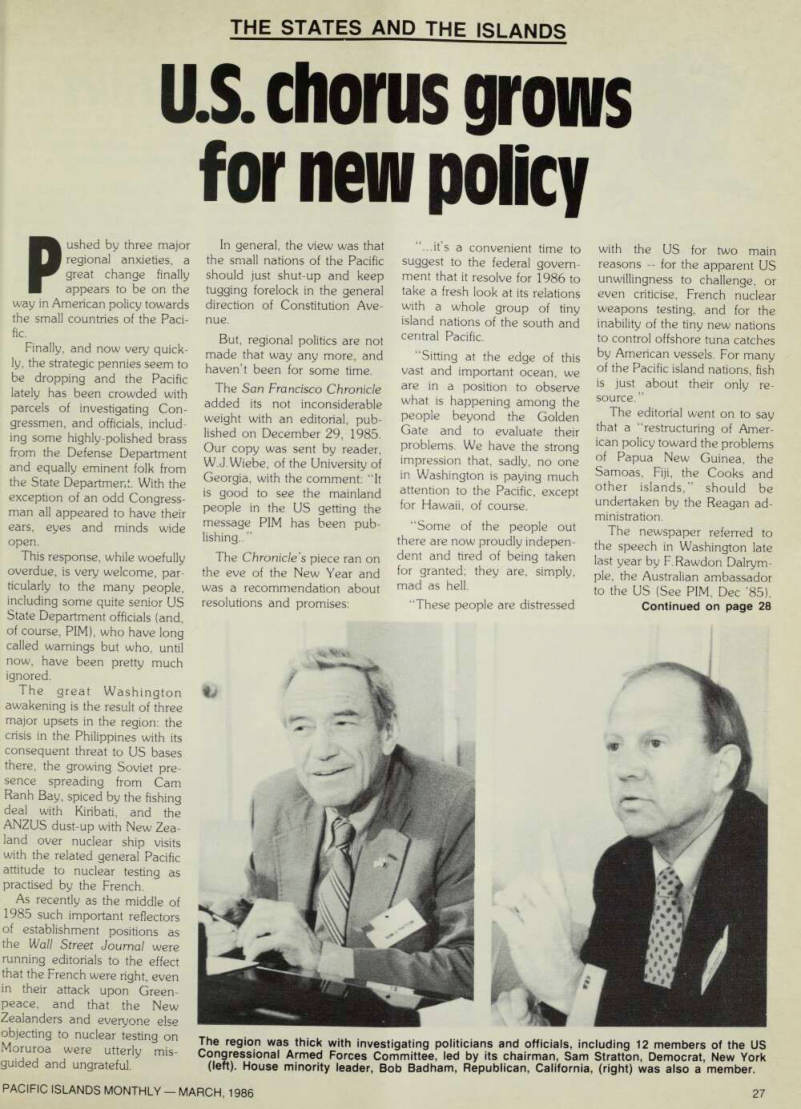
The region was thick with investigating politicians and officials, including 12 members of the US Congressional Armed Forces Committee, led by its chairman, Sam Stratton, Democrat, New York (left). House minority leader, Bob Badham, Republican, California, (right) was also a member.
using as its source, it said, “that authoritative chronicler of the South Pacific” Pacific Islands Monthly of Sydney."
The editorial concluded; “It is time for another look at US policy in the Pacific.”
More or less concurrently, the New York Times ran a piece saying, “We’re losing friends in the Pacific Islands,” and, lo and behold, The Wall Street Journal published a fea ture headed, “Pacific Islands are drifting away from the West.”
The Times piece was written by Jonathan M.Weisgall, a Washington lawyer who repre sents the people of Bikini Atoll,
and who therefore has a fairly special view, of a small comer of the ocean. But his article was an overview based upon the premise that “1985 may be remembered as the year the Pacific Ocean ceased to be America’s lake.
“... New Zealand refused port entry to a US destroyer, Australia backed down from a commitment to help monitor an MX missile test, and instability in the Philippines has raised questions about American bases there. Meanwhile, the Soviet Union, which has set up a major naval base in Vietnam, has offered economic aid to small island nations...(and) the Greenpeace affair has galva nised anti-nuclear sentiment in the region, much of it against the US.
“A subtle battle for the Pacific has started, and the United States should take immediate steps to shore up its faltering relations in the region,” Weisgall wrote.
The Wall Street Journal’s feature, by David Knibb, came under a sub-heading “Asia,” which perhaps betrays a con tinuing fogginess in US financial circles about the whereabouts of the biggest ocean on earth,
but it contained much good sense.
Knibb also pointed to Ambassador Dalrymple’s im portant Washington speech as a valuable exposition of Pacific attitudes and a warning that if something were not done to ease the minds in small nations, major problems would occur for a certain great power.
But he went on to say that Paias Wingti, the new prime minister of Papua New Guinea, had joined “a growing Pacific island trend toward younger leaders who lack close ties with the West.”
“Indeed,” he went on, “the younger generation of Pacific islanders coming to power is more nationalistic and more pragmatic. It cannot be taken for granted, as the West his torically has tended to do.
“Fiji’s Prime Minister, Ratu Sir Kamisese Mara, one of the South Pacific’s elder statesmen, warned during a recent visit to Washington that while the pro- Western disposition of the Paci fic helped over the years to keep the Soviets in check, the region is now ‘undergoing pro found changes.’
“...Papua New Guinea is a bridge between the Pacific and Southeast Asia,” wrote Knibb.
“Even before Wingti assumed power, PNG was shifting away from Australia. As Canberra’s aid has dropped, Port Mores by’s links with Asia have grown... PNG has increased its presence in Southeast Asian affairs over the past several years. These trends are likely to continue under Mr Wingti, who is especially interested in Chi na...”
Knibb went on to review the row between the US and the Solomons over the tunaboat Jeanette Diana and to look at the highly independent position of Vanuatu’s Walter Lini who has variously castigated Austra lia for exporting uranium and blasted the French over their testing and what he sees as their slow progress on independence in New Caledonia.
“If, and when, that inde pendence is granted,” said Knibb, “the Melanesian leaders of New Caledonia are unlikely to be more pro-Western than Lini.”
Knibb concluded that “the first step the US should take in solidifying its ties in the Pacific is to conclude the regional fishing agreement that it has been negotiating ... since 1983. The pact, which would put an end to what is perceived as US poaching, would require US fishermen to pay modest fees for the right to ply territorial waters. The longer-term answer involves more US economic help and genuine interest in island affairs,” he wrote.
Knibb reserved his final brickbat for Bernard Kalb, the US State Department spokes man, who, as a former CBS reporter in Southeast Asia, should have known better than to have quipped at a press conference that he was “waiting for news to arrive in a bottle” about the South Pacific Forum’s view of New Zealand’s nuclear ban.
“That brought laughter to the press conference, but disgust in the South Pacific where Mr Kalb’s remark suggested the State Department knew nothing about the annual meet ing of Pacific nations, the treaty they had adopted, or even where the Cook Islands were,” said Knibb.
“In reaching broader under standing with Pacific nations, recognition may be the greatest
challenge of all.”
Staff Writer.
Also concerned ... US Comman der in the Pacific, Admiral James Lyons.
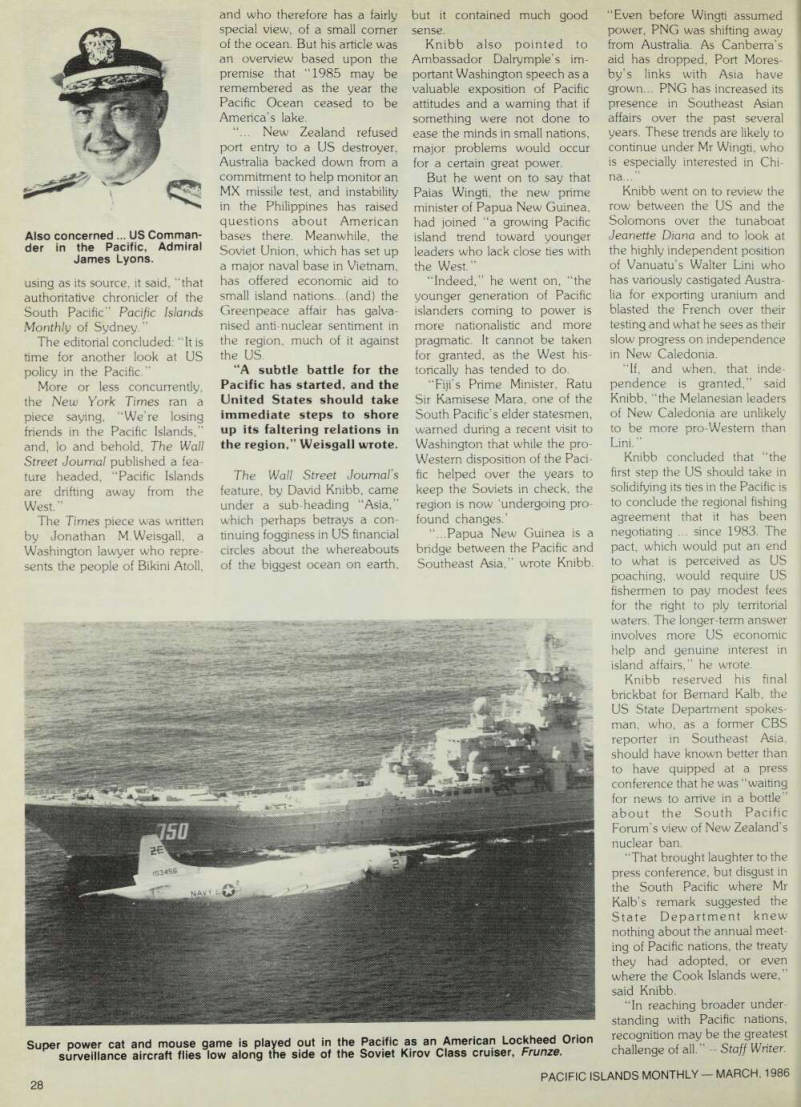
Super power cat and mouse game is played out in the Pacific as an American Lockheed Orion surveillance aircraft flies low along the side of the Soviet Kirov Class cruiser, Frunze.