Japanese welcomed back
pp. 42-43 · Read in the full issue
tropicalities
Japanese welcomed back to Micronesia
By the many thousands they step off the planes from Tokyo, two by two, one of the steadier pro cessions of travelling couples since Noah’s Ark.
They are Japanese honeymooners, and the large numbers who flock every day to the northern tier of Mic ronesia provide evidence that Japan has regained econo mically some of the Western Pacific islands that she lost militarily 40 years ago.
Japan dominates here, even though Saipan is part of a United States commonwealth these days, much of the North ern Marianas, in fact, has been turned into a Japanese warm weather playground over the last 15 years.
There is only one real in dustry, tourism, and most major hotels are owned by Japanese interests. Four of every five visitors to Saipan are Japanese, usually newly-weds lured by relatively inexpensive package tours.
The same is true in far larger numbers on nearby Guam which is an unincorporated territory of the US with impor tant American air and naval bases. Guam’s national slogan is ’’Where America’s Day Be gins.”
But of the 368,665 visitors to Guam last year, 82 per cent came from Japan. The US$22l million they spent accounted for about half of all the retail sales in the territory. In some sections of Saipan and Guam, Japanese signs are almost the only ones to be seen. Maps of Guam sold at the airport are written in Japanese, not Eng-
lish. Duty-free shops are stock ed with high-priced clothes from Europe, Italian and Eng lish leathergoods, French per fumes, and so-forth —a great range of goods considered pre stige symbols (and much more expensive) in Tokyo and Osaka.
The influx of Japanese tour ists has meant growth for other industries as well.
Two years ago there were three Japanese construction companies with offices on Guam. Now there are 10, be cause of the growing demand for new hotels, roads, airport construction and commercial buildings.
About the only non-Asian competition in this industry comes from New Zealand. A contractor from Auckland told me of attending a large meeting where bids were accepted for a small project related to a hotel being built on Saipan. ’’Except
for one or two South Koreans,” he said, ”1 was the only non- Japanese in the room.”
Japan controlled Micronesia - the Marianas, plus the Caro line and Marshall Islands - from 1918 to the end of World War II in 1945. Micronesia was, and remains, a strategically sensitive area, covering three million square miles of the Pacific and comprising about 2000 islands that today have a total popula tion of only 135,000.
Some islanders sometimes talk of the Japanese era as the “good old days,” partly reflec ting disenchantment with the United States, whose UN trusteeship for the last 38 years has produced little in the way of economic development.
In the 1930 s Japan operated
sugar cane plantations, fisheries and phosphate mines on many islands. The Garapan section of Saipan bustled with shops,
cinemas, and geisha houses.
Islanders were treated like second-class citizens, (much as Koreans are still in parts of Tokyo today), but at least, some say, things were lively.
The United States wrested military control of the Marianas from Japan after fierce battles in 1944. In a notably grim end to the fighting on Saipan thousands of Japanese civilians committed suicide by hurling first their children, and then themselves, from cliffs on the island’s northern end. Yester day’s horror has, however, be come today’s photographic opportunity, and now Japanese honeymoon couples take group bus tours to Suicide Cliff where they stand for the almost obligatory group and individual pictures.
Older Japanese, often accompanied by Buddhist priests, come periodically on
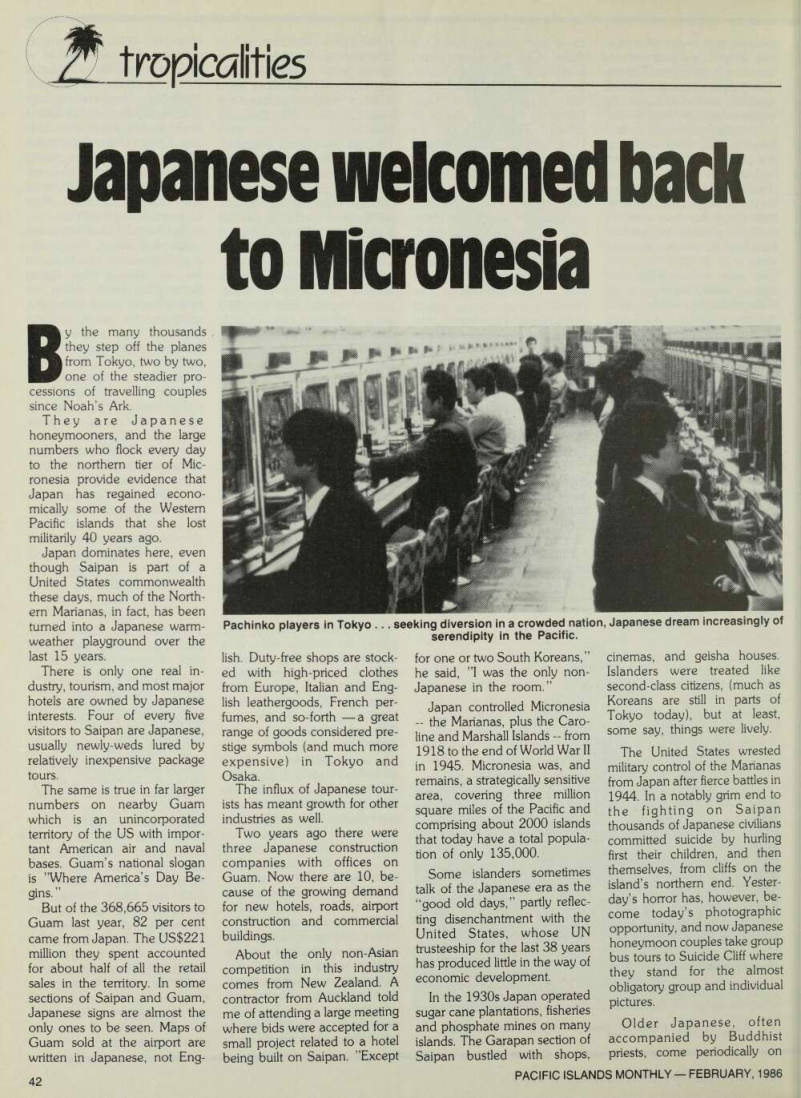
Pachinko players in Tokyo ... seeking diversion in a crowded nation, Japanese dream increasingly of serendipity in the Pacific.
the bones of dead relatives and friends.
The resurgence of Japanese economic influence is concen trated in the Marianas, but it is beginning to be felt eslewhere in Micronesia, too. From Palau in the western part of the island chain to the Marshalls in the east, local political leaders re gard Japanese tourism as their best chance to stimulate econo mies now largely dependent on United States aid.
The Japanese government has also begun to show re newed interest in its former territory. It has steadily in creased economic assistance, giving US$l7.6 million since 1980 to three semi-auton omous governments in the American trusteeship - Palau, the Marshall Islands, and the Federated States of Micronesia.
A good deal of this money has gone for road construction and for fisheries-related projects such as deep-storage refrigera tors being built on the islands of Ponape and Dublon in the FSM. In addition, Japanese tunaboat fleets contribute up to US$2 million a year for the right to fish in Micronesian waters.
Micronesians, especially those most critical of the Amer ican stewardship, say they are glad to receive Japan’s help. ’The Japanese went about it the right way,” says Asterio Takesy, a senior official on Ponape. ’They asked us what we needed, what we wanted.
The Americans are always tell ing us what to do. They say: This is what your problem is, and here’s how you must solve it.’ ”
A foreign ministry official in Tokyo, Akihiro Aoki, said Japanese aid was based on the government’s belief that ’’these countries have to be politically and economically stable.”
How deep Tokyo’s invest ment will go, however, is not clear. Japanese businessmen say they are hesitant to move in because of lingering economic and social problems that have kept Micronesian development at a low level throughout the post-war period.
But, today, it is no longer a matter of ’’the Japanese are coming.” In Micronesia they have again arrived, and are being warmly welcomed.
Clyde Haberman in The New York Times.