New Englander in Samoa
pp. 39-41 · Read in the full issue
The whaler who stayed: A New Englander in Samoa
Some say their influence began to be felt with Sam Comstock, “the demon harpooner of Nan tucket,” and how, at age 22, he axed his way to the bloodiest mutiny the Pacific had ever seen. The Globe had departed Edgartown in 1822 and by the time Captain John Percival’s men found the survivors, in 1827 on lonely Mili Atoll, there were only two alive of the whole ship’s company. One survivor was Will Lay, burned brown by the Pacific sun and wearing only a woven panda nus mat about his loins, whose first words to his rescuers were: “Is there anyone here from East Saybrook that’s where I’m from,” he jabbered over and over, “East Saybrook, Connec ticut. That’s where I’m from.
You from East Saybrook? It’s near New London. Falmouth?
That’s not near East Saybrook.
Nantucket? Yes, I know Nan tucket. I sailed on the Globe
JOSEPH THEROUX continues his occasional series on notable expatriates who have become part of the history of Samoa. In this three-part study he writes of the life and times of Elisha Lyman Hamilton who, arriving in Samoa in the early 1850 s as a crew member on a New England whaling ship, stayed there until his death in 1891. Himself a native of New England, Theroux did research on Hamilton in that part of the United States as well as in Samoa.
from Edgartown, across from Nantucket ...”
Percival himself was from East Barnstable and is buried there. It was by his nickname Mad Jack that he was better known. He had once quelled a mutiny by hurling a man over the ship’s side and in 1826 had captained the first ship to call officially at Honolulu.
The whalers discovered is lands and named islands: Gard ner, Mitchell, Fanning, Mas
sachusetts, Starbuck. For the 50 years that the whalers of New England ruled the Pacific, 1820-1870, they were known, loved, feared and hated from Honolulu to Honshu, from the Marshalls to the Marquesas.
There were hundreds of New Englanders who had ties to the South Seas. Many of them have been written of; many more have been forgotten. One place that has not forgotten is the old Whaling Museum, at 18
Johnny Cakehill in New Bed ford. For those who want to remember, or for those who have never heard, it is a reposi tory of relics of an age gone by, when New Englanders ruled the South Seas.
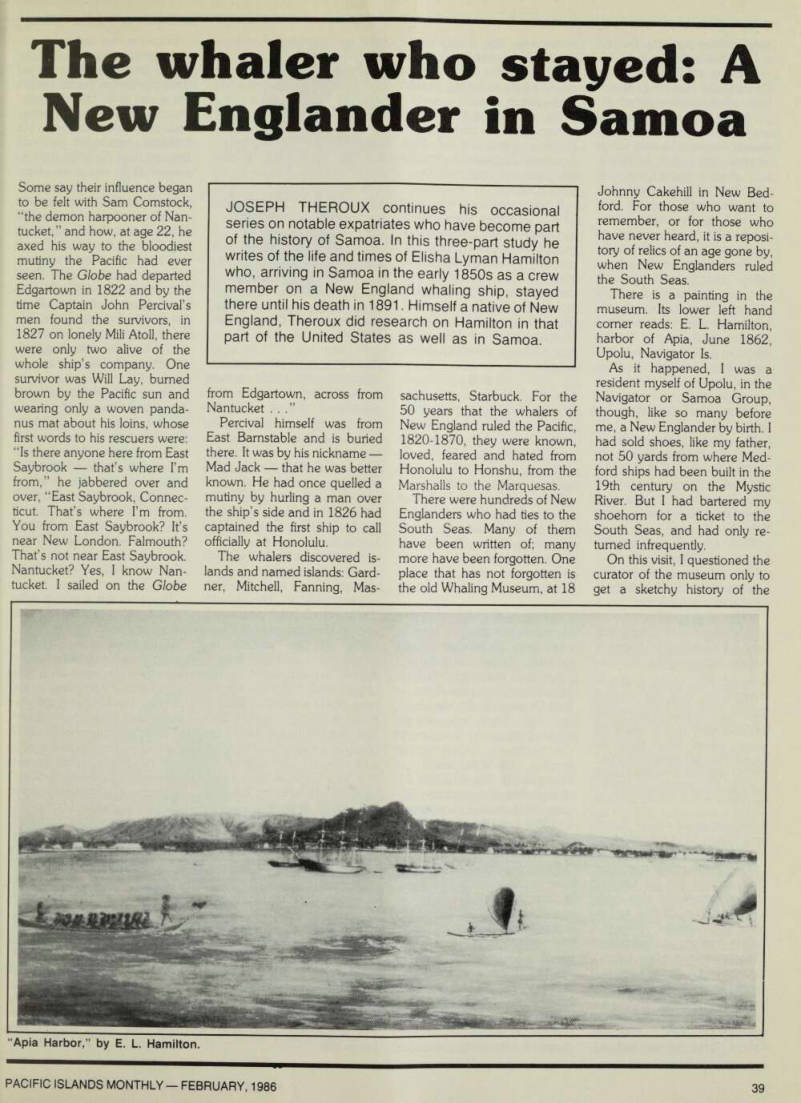
There is a painting in the museum. Its lower left hand corner reads: E. L. Hamilton, harbor of Apia, June 1862, Upolu, Navigator Is.
As it happened, I was a resident myself of Upolu, in the Navigator or Samoa Group, though, like so many before me, a New Englander by birth. I had sold shoes, like my father, not 50 yards from where Med ford ships had been built in the 19th century on the Mystic River. But I had bartered my shoehorn for a ticket to the South Seas, and had only re turned infrequently.
On this visit, I questioned the curator of the museum only to get a sketchy history of the
“Apia Harbor,” by E. L. Hamilton.
origins of the painting. He said it had been donated to the museum in 1952 by one “F. A.
Bowman of Brockton, Mass.”
Little more was known of it I had a copy of the painting made and, on my return to the islands, began collecting scraps of information on E. L. Hamil ton, which at first amounted to very little. I got involved in other writing projects and almost forgot the name and the painting. Then a chance remark set me off again on the trail.
I had been interviewing a village chief, a white man, in fact, who had been adopted by a Samoan family as an infant in 1903. We were discussing the peculiar land laws of Samoa when he happened to mention that the piece of land where his house stood was not com munally-owned.
“Who did you buy it from?” I asked.
“It was part of the old Sama soni Estate,” he replied.
“The Samasoni of Samaso ni’s Pool?” The nearby Loto-o- Samasoni was the setting of Somerset Maugham’s story “The Pool”.
“The same,” he said. “In English, it’s Hamilton.”
The painting came into my head, a view of the harbor from what’s now the wharf.
“Who was Hamilton?”
“He was the American vice consul 100 years ago, I remem ber my father saying. He lived “Where the wharf is now.”
The chief grinned. “That’s right And he was buried there, too. But they had to move his grave when they built the wharf. I played there as a boy. ”
“Do you know where 1 could get some more information on him?”
He shrugged. “The Lands and Survey Office should have something. ”
They had more than that.
Built around an old German filing system which was cross indexed and multi-filed and re corded in massive ledgers, it held a treasure of information.
Sitting amidst a pile of hand colored and beautifully lettered survey maps of the “Hamilton Estate,” I was handed yet an other packet by the Samoan manager. It was a thick en velope, long, narrow and yel
lowed with age. I slid out a bundle of papers and opened them. Across the top of the first page was the following, in neat 19th-century script; “This is the Last Will and Testament of me Elisha Lyman Hamilton, formerly of New London, Connecticut America and now a resident of . . .
Upolu Samoa ...”
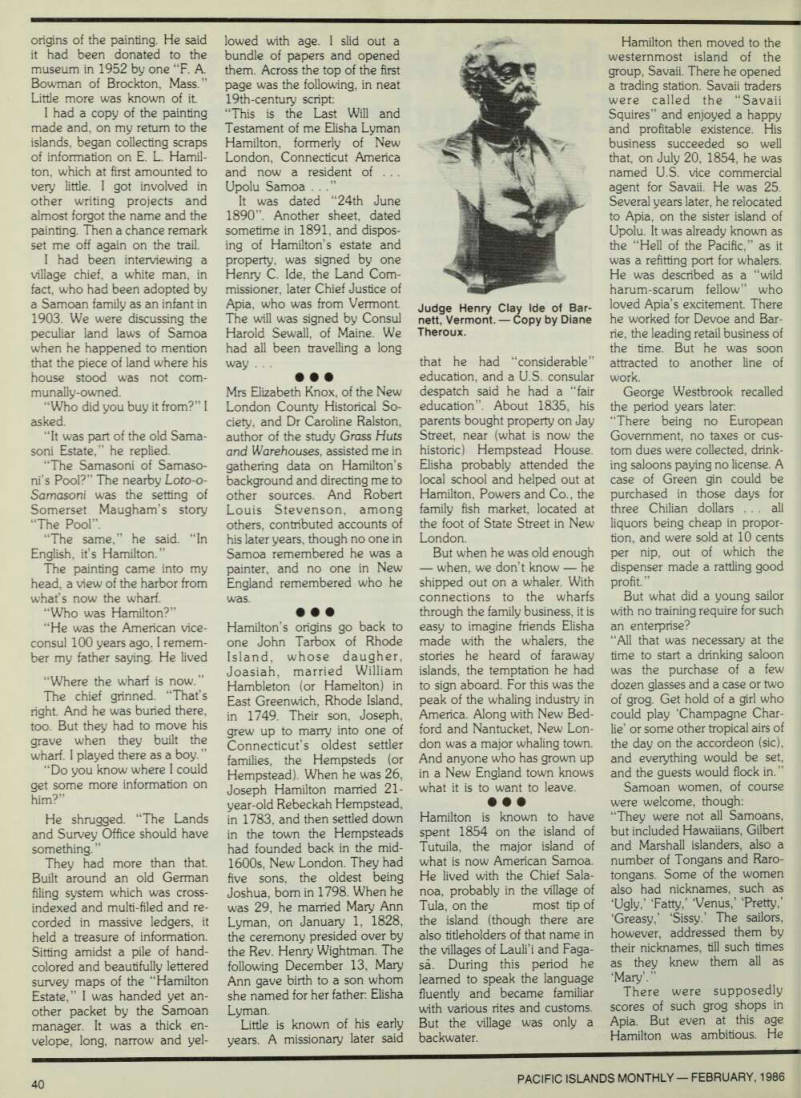
It was dated “24th June 1890”. Another sheet, dated sometime in 1891, and dispos ing of Hamilton’s estate and property, was signed by one Henry C. Ide, the Land Com missioner, later Chief Justice of Apia, who was from Vermont The will was signed by Consul Harold Sewall, of Maine. We had all been travelling a long way . . . • • • Mrs Elizabeth Knox, of the New London County Historical So ciety, and Dr Caroline Ralston, author of the study Grass Huts and Warehouses, assisted me in gathering data on Hamilton’s background and directing me to other sources. And Robert Louis Stevenson, among others, contributed accounts of his later years, though no one in Samoa remembered he was a painter, and no one in New England remembered who he was. • • • Hamilton’s origins go back to one John Tarbox of Rhode Island, whose daugher, Joasiah, married William Hambleton (or Hamelton) in East Greenwich, Rhode Island, in 1749. Their son, Joseph, grew up to marry into one of Connecticut’s oldest settler families, the Hempsteds (or Hempstead). When he was 26, Joseph Hamilton married 21year-old Rebeckah Hempstead, in 1783, and then settled down in the town the Hempsteads had founded back in the mid 1600s, New London. They had five sons, the oldest being Joshua, bom in 1798. When he was 29, he married Mary Ann Lyman, on January 1, 1828, the ceremony presided over by the Rev. Henry Wightman. The following December 13, Mary Ann gave birth to a son whom she named for her father: Elisha Lyman.
Little is known of his early years. A missionary later said
that he had “considerable” education, and a U.S. consular despatch said he had a “fair education”. About 1835, his parents bought property on Jay Street, near (what is now the historic) Hempstead House.
Elisha probably attended the local school and helped out at Hamilton, Powers and Co., the family fish market, located at the foot of State Street in New London.
But when he was old enough when, we don’t know he shipped out on a whaler. With connections to the wharfs through the family business, it is easy to imagine friends Elisha made with the whalers, the stories he heard of faraway islands, the temptation he had to sign aboard. For this was the peak of the whaling industry in America. Along with New Bed ford and Nantucket, New Lon don was a major whaling town.
And anyone who has grown up in a New England town knows what it is to want to leave. • • • Hamilton is known to have spent 1854 on the island of Tutuila, the major island of what is now American Samoa.
He lived with the Chief Sala noa, probably in the village of Tula, on the most tip of the island (though there are also titleholders of that name in the villages of Lauli’i and Faga sa. During this period he learned to speak the language fluently and became familiar with various rites and customs.
But the village was only a backwater.
Hamilton then moved to the westernmost island of the group, Savaii. There he opened a trading station. Savaii traders were called the “Savaii Squires” and enjoyed a happy and profitable existence. His business succeeded so well that, on July 20, 1854, he was named U.S. vice commercial agent for Savaii. He was 25.
Several years later, he relocated to Apia, on the sister island of Upolu. It was already known as the “Hell of the Pacific,” as it was a refitting port for whalers.
He was described as a “wild harum-scarum fellow” who loved Apia’s excitement. There he worked for Devoe and Bar rie, the leading retail business of the time. But he was soon attracted to another line of work.
George Westbrook recalled the period years later: “There being no European Government, no taxes or cus tom dues were collected, drink ing saloons paying no license. A case of Green gin could be purchased in those days for three Chilian dollars ... all liquors being cheap in propor tion, and were sold at 10 cents per nip, out of which the dispenser made a rattling good profit. ”
But what did a young sailor with no training require for such an enterprise?
“All that was necessary at the time to start a drinking saloon was the purchase of a few dozen glasses and a case or two of grog. Get hold of a girl who could play ‘Champagne Char lie’ or some other tropical airs of the day on the accordeon (sic), and everything would be set, and the guests would flock in. ”
Samoan women, of course were welcome, though: “They were not all Samoans, but included Hawaiians, Gilbert and Marshall islanders, also a number of Tongans and Raro tongans. Some of the women also had nicknames, such as ‘Ugly,’ ‘Fatty,’ ‘Venus,’ ‘Pretty,’ ‘Greasy,’ ‘Sissy.’ The sailors, however, addressed them by their nicknames, till such times as they knew them all as ‘Mary’.”
There were supposedly scores of such grog shops in Apia. But even at this age Hamilton was ambitious. He
Judge Henry Clay Ide of Bar nett, Vermont. - Copy by Diane Theroux.
became part owner of a bow ling alley. Local historian and one-time British consul Thomas Trood knew Hamilton at this time. In his book Island Re miniscences, he wrote: “At that time there was a bowling alley connected with the (main hotel, the Internatio nal); the resort of the elite of Apia every night but Sundays.
Devoe & Barrie, both from the States, had their store close to it ...” So perhaps the level of Hamilton’s clientele was impro ving.
In Apia he met Mary Ann Cawley, one of the daughters of William Cawley, whom Trood described as “an old British man-of-war sailor” who had settled down in Apia and mar ried a local girl. Though Mary Ann was older than Hamilton by 10 years, he was evidently attracted to the half-caste girl, and they were married in 1858.
They built a house on Matautu Point, the eastern peninsula of Apia harbor. Hamilton would call it home until his death.
Other interesting people lived on the point. Bully Hayes, the pirate, built a house there and installed his wife and daughters and would visit when he was feeling domestic. Thomas Trood wrote that the consuls
never interfered with him. One, Jonas Coe (of whom more later), was the American consu lar agent who was kept busy with a succession of wives (some say six) and a tribe of 18 children. There were also the Hort brothers, Abraham and Alfred, probably the only Jews who had businesses in Samoa and Tahiti, including “a small fleet of sailing vessels”. Needing a captain for one of their ships, the 400-ton Caroline Hort, they hired Hamilton, who suc cessfully sailed it from Apia to Levuka, Fiji, in 1860 (Trood was a passenger). After that Hamilton was always called “Captain” Hamilton. He proved he could handle ships, especially in the tricky reef passages, the real test of Pacific sailors. He continued as cap tain, on the Caroline Hort and others, on and off for the next dozen years, though the Hort brothers sold their business in 1862.
But evidently there were not enough trips to occupy him.
And finding no challenge in his work, no satisfaction in ladling out grog to drunken sailors, Hamilton began drinking him self into daily stupors. But since all later descriptions call him “one of the most respected
inhabitants of Samoa,” a dramatic change must have taken place. The Rev. A. W.
Murray, in his book, Forty Years Mission Work in Polynesia and New Guinea (1876) described him as: “A man of energetic character; he had considerable edu cational advantages, and was possessed of more than an average share of capacity and intelligence. Hence he was not a man to be a cipher. For good or evil he would make his influence felt.”
Murray witnessed an evil in fluence. On June 8, 1861, Murray wrote, Hamilton had been drinking with another man when he suddenly “rushed off . . . to avenge an insult which he supposed had been offered to his wife. He carried a loaded gun ...” (when he could not get the offender to come out of his house) “. . . in his rage and frenzy, he fired off his gun and wounded a native. Happily the wound was not in a vital part (and) he was induced to go home, and when the effects of the drink wore off, and he came to his sober senses, he was smitten with remorse, and was horrified at the idea of having come so near committing murder. ”
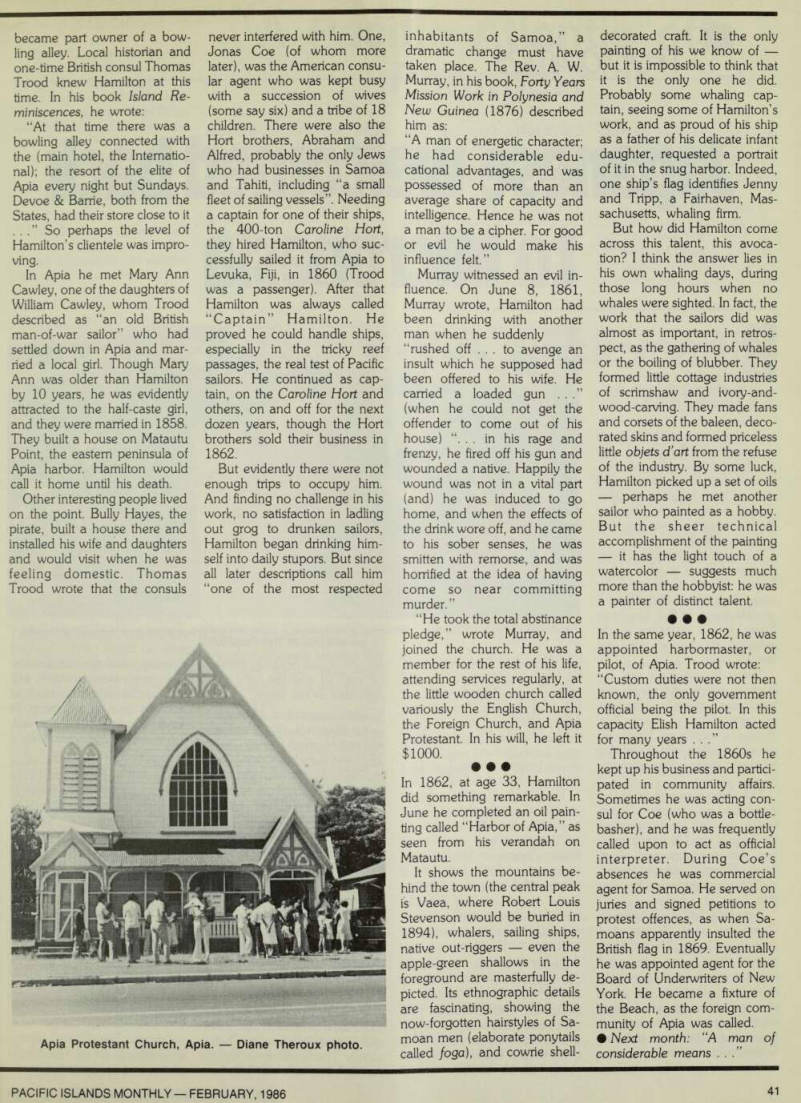
“He took the total abstinence pledge,” wrote Murray, and joined the church. He was a member for the rest of his life, attending services regularly, at the little wooden church called variously the English Church, the Foreign Church, and Apia Protestant. In his will, he left it
$Looo.
• • • In 1862, at age 33, Hamilton did something remarkable. In June he completed an oil pain ting called “Harbor of Apia,” as seen from his verandah on Matautu.
It shows the mountains be hind the town (the central peak is Vaea, where Robert Louis Stevenson would be buried in 1894), whalers, sailing ships, native out-riggers even the apple-green shallows in the foreground are masterfully de picted. Its ethnographic details are fascinating, showing the now-forgotten hairstyles of Sa moan men (elaborate ponytails called foga), and cowrie shell
decorated craft. It is the only painting of his we know of but it is impossible to think that it is the only one he did.
Probably some whaling cap tain, seeing some of Hamilton’s work, and as proud of his ship as a father of his delicate infant daughter, requested a portrait of it in the snug harbor. Indeed, one ship’s flag identifies Jenny and Tripp, a Fairhaven, Mas sachusetts, whaling firm.
But how did Hamilton come across this talent, this avoca tion? I think the answer lies in his own whaling days, during those long hours when no whales were sighted. In fact, the work that the sailors did was almost as important, in retros pect, as the gathering of whales or the boiling of blubber. They formed little cottage industries of scrimshaw and ivory-and wood-carving. They made fans and corsets of the baleen, deco rated skins and formed priceless little objets d’art from the refuse of the industry. By some luck, Hamilton picked up a set of oils perhaps he met another sailor who painted as a hobby.
But the sheer technical accomplishment of the painting it has the light touch of a watercolor suggests much more than the hobbyist: he was a painter of distinct talent. • • • In the same year, 1862, he was appointed harbormaster, or pilot, of Apia. Trood wrote: “Custom duties were not then known, the only government official being the pilot. In this capacity Elish Hamilton acted for many years ...”
Throughout the 1860 s he kept up his business and partici pated in community affairs.
Sometimes he was acting con sul for Coe (who was a bottle basher), and he was frequently called upon to act as official interpreter. During Coe’s absences he was commercial agent for Samoa. He served on juries and signed petitions to protest offences, as when Sa moans apparently insulted the British flag in 1869. Eventually he was appointed agent for the Board of Underwriters of New York. He became a fixture of the Beach, as the foreign com munity of Apia was called. • Next month: “A man of considerable means ...”
Apia Protestant Church, Apia. - Diane Theroux photo.