‘Magnificent obituary’
pp. 35-37 · Read in the full issue
books.
‘Magnificent obituary’ for the B.P.C.
The Fhosphateers: A History of the British Phosphate Commissioners and the Christmas Island Phosphate Commission. By Maslyn Wil liams and Barrie Macdonald.
Published 1985 by Melbourne University Press, Carlton, Vic toria, 3053, Australia. ISBN 0 522 84302 6. Price SA24.
Who could have foretold that the usually reticent and uncom municative British Phosphate Commission would have bowed out from the Pacific stage so gracefully with a
magnificent obituary revealing all, or nearly all, that over the years they were at such pains to conceal?
One may conjecture that the old hands in the B.P.C. were by now dead and that their succes sors had little idea of the often very human stories that lay buried in their files. Even so they deserve our thanks for engaging Maslyn Williams to write the commission’s history to the end of World War 11, and Barrie Macdonald to carry it forward to its dissolution, giving them virtual carte blanche to
see everything in their voluminous and meticulously preserved archives, and tell us the story that emerged accurately and without fear or favor.
The commission was wise to obtain the services of a professional author of the calibre of Williams, with a dozen or more successful books to his credit, including a more popular work on the same three islands; and, when the sheer immensity of the work involved became apparent, to let him share part of his burden with the younger Macdonald, who with his book
Cinderellas of the Empire has become the recognised authority on the recent history of the Central Pacific. Thus we were spared the staid eulogistic “company history” favored by too many commercial bodies, Like Nordhoff and Hall the styles of the two authors blend to produce a smoothly flowing narrative which commences in 1860 when the London ship ping firm of Houlder Brothers sent their teenage cadet John Arundel to prospect for deve lopment opportunities in the islands.
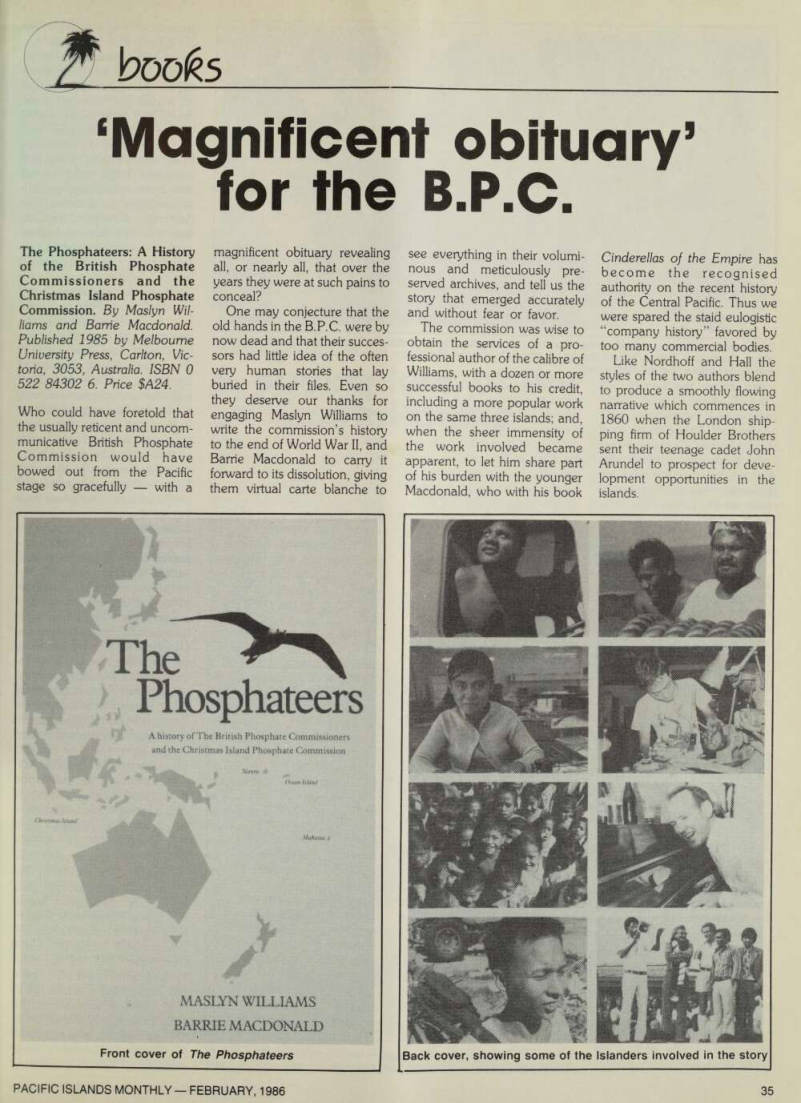
Back cover, showing some of the Islanders involved in the story
Front cover of The Phosphateers
We follow the fortunes of John T. Arundel and Com pany, which he founded and which in 1897 became the Pacific Islands Company with Lord Stanmore, formerly Sir Arthur Gordon of Fiji fame, as chairman, Arundel was vice chairman and George Ellis, one of his mother’s New Zealand connections, as Australian Rep resentative.
When the firm was seemingly on its last legs Albert Ellis, George’s younger brother, was providentially inspired to analy se a piece of “petrified wood” from Nauru, used as a doorstop in the Sydney office. It was 78 per cent phosphate of lime, and the company’s future was assured.
There followed the discovery of similar deposits on neighbor ing Ocean Island (or Banaba); the delicate negotiations with the Germans over Nauru rights, in which the latter appear to have been outwitted; the formation of the Pacific Phos phate Company, with German participation; and negotiations for mining rights with the Nau ruans and Banabans (in which, to our post-colonial era minds, the landowners were also out witted, though the deals seemed fair enough at the time).
The scene now shifts to detail the development of what be came a large-scale and in creasingly efficient enterprise for the extraction, shipping and sale of phosphate of lime on which the agricultural industries
of Australia and New Zealand came to rely until, as a result of World War 1, their govern ments, with the United King dom, bought out the company for £3V, 2 million and in 1920 appointed a commission to conduct what became known by everyone as the B.P.C.
Maslyn Williams has sketch ed the personalities of the key men in these pioneering and development stages with discernment tinged with humor.
Arundel, the Pacific Cecil Rhodes who would rather have been a missionary; Lord Stan more, the class-conscious aris tocrat who distrusted Austra lians; the Ellis brothers, George and Albert (later Sir Albert), who like Arundel blended com petency with piety; Sir Alwin Dickinson, the managing director who became the first U.K. commissioner; and Alfred Gaze, the Australasian Repre sentative, who managed the Nauru and Ocean Island opera tions with efficiency and pater nal benevolence.
Unlike the Pacific Phosphate Company, the B.P.C. operated from Melbourne from the be ginning and interest changes to inter-government ploys and the contentions of commissioners, notably the famous Pope affair which led to a Royal Commis sion; to trouble over lands and royalties with the Nauruans and Banabans, including the un fortunate 1928 acquisition of Banaban lands; and the disas trous results of World War 11, during which both islands were
occupied by the Japanese.
Barrie Macdonald concludes the history with a chronicle of post-war events: the 1948 acquisition of Christmas Island; resettlement of the Banabans on Rabi Island; Nauruan inde pendence and the formation of the Nauru Phosphate Corpora tion; Banaban court actions against the commission and U.K. Government; the end of the connection with Christmas; the last shipment from Ocean Island in 1979; and finally the winding up of the commission itself.
It was a unique organisation, efficiently run on behalf of the three governments by a staff of devoted technical experts who for the most part spent their working lives in the company and commission, whose para mount aims were to provide Australian and New Zealand farmers with phosphate at well under world prices regardless of all other considerations. But both company and commission were essentially part of a colo nial era in which Europeans employed low-paid colored in dentured labor to export mine ral resources from land belon ging to native owners who were inadequately compensated, at least by modern standards.
Christmas presents a slightly better picture in that the island was unoccupied.
With the post-World War II views on native rights which inevitably led to decolonisation, the commission could not hope to survive. Independent Nauru preferred to manage its own
phosphate industry; and had the Ocean Island deposits not run out the new Republic of Kiribati would surely have re quired the commission to sell on a cost-plus basis at world prices, the profit being shared between the Gilbertese and Banabans; while on Christmas Island trades unions, strikes and European wage rates for all soon made the industry uncom petitive, like so much of the Australian economy. And so, like the dinosaur, the once mighty commission died, an anachronism in the modem world.
This book is its epitaph: that it is a worthy one I can vouch for from my own knowledge of the commission’s operations, hav ing been connected with it directly or indirectly for most of my life. In the ’2os and ’3os I had many conversations with members of the original pioneer staff of the Pacific Phosphate Company and with old hands of the Pacific Islands Company such as George Cousins and Captain Theet, who first landed on Banaba in 1880 when trad ing for them.
Sir Albert Ellis was a great friend and a mine of informa tion on old Banaba during early vacations in New Zealand, and two voyages with him on phos phate-loading ships; and I stayed with Arthur Grimble for many months at the residency on Ocean Island when engaged on the Banaban lands settle ment which followed the com pulsory lands resumptions of 1931. My earliest recollection of Rotan, the formidable but in scrutable Banaban leader, was in that year when he handed me a bag containing 700 gol den sovereigns to obtain the services of a legal expert to defend his people’s rights.
Last June the Banaban com munity, with Tebuke, Rotan’s son, as their spokesman, gave my wife and me a thanksgiving dinner for having bought Rabi Island for their new home, which was at last recognised to have been a great bargain. It brought back memories of how nearly they had lost it, for in 1942 they had asked the West ern Pacific High Commission to buy Wakaya for them. The price immediately soared, while an agricultural survey showed it to be unsuitable for a large settlement, due to insufficient
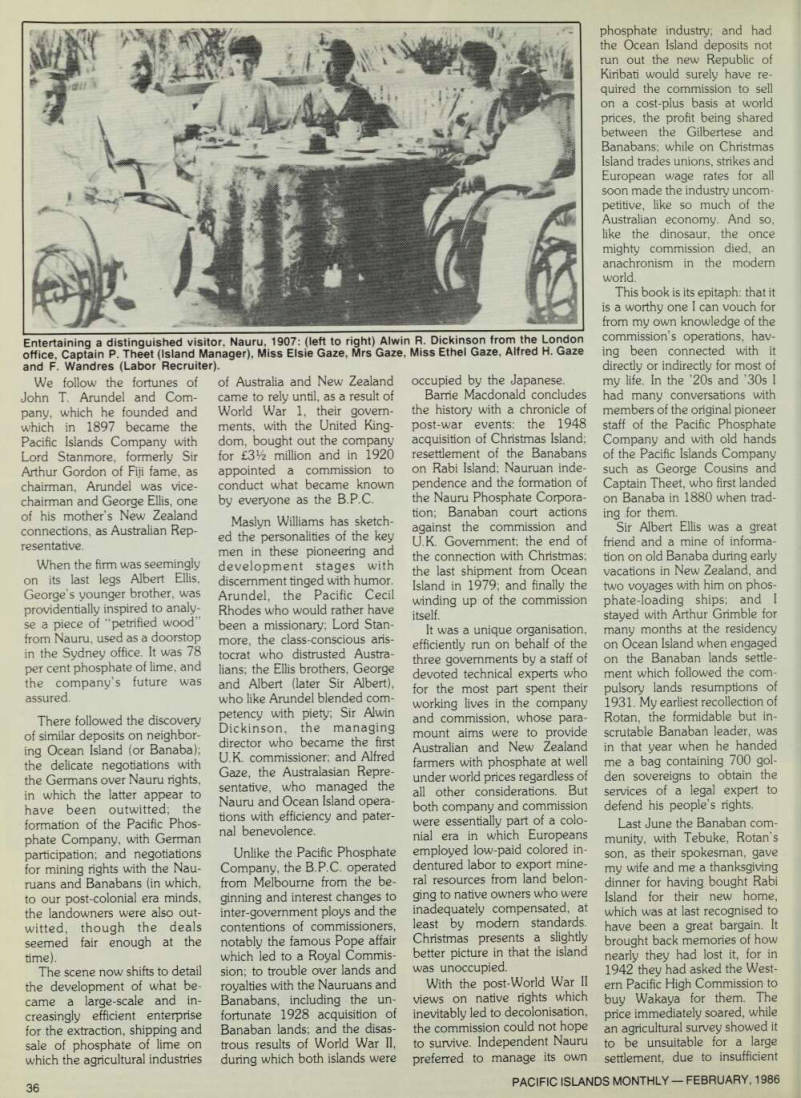
Entertaining a distinguished visitor, Nauru, 1907: (left to right) Alwin R. Dickinson from the London office. Captain P. Theet (Island Manager), Miss Elsie Gaze, Mrs Gaze, Miss Ethel Gaze, Alfred H. Gaze and F. Wandres (Labor Recruiter).
water and arable land.
Meanwhile I had acquired an option from Lever Brothers to acquire Rabi for the low price of £25,000 but the Banabans, who had never seen either island, declined to consider it.
Sir Harry Luke, the High Com missioner, thereupon directed that no further action should be taken to buy either island.
Days later, acting on a sud den impulse, I bearded the H.C. in his private room after he had enjoyed a good dinner and a comforting glass of grog.
“What momentous news brings you here at this hour,” asked Sir Harry. “The Banaban funds”, I replied, “which are now invested in Sydney at a ridiculously low four per cent.
May I please buy Rabi as an investment to sell again after the war at, our financial adviser guarantees, a very considerable profit?” He gave me one of his superb cigars and pronounced judgement: “Rabi may be bought as a pure investment, but not as a future home for the Banabans, for on that matter we can but respect their wishes. ”
And so when the war ended we were able to collect the Banabans from the Carolines and Gilberts, where the Japan ese had dumped the commun ity, and suggest to them that they should settle on their own island of Rabi until Ocean Is land could be rehabilitated ready for reoccupation. They decided to go as a temporary measure and, entirely of their own free will, have never left since. I felt that, through a lucky hunch, I had earned my dinner.
A reviewer must criticise something to maintain his morale, and I did regret that, despite the illustrations on the jacket, so little is said about commission relations with the islanders and the non-Euro pean labor force. This, how ever, is not really the authors’ fault but rather an indication that the commission, like the company, never had a defined policy on such matters.
From early days reliance was placed on the practical know ledge of native peoples ac quired by Albert Ellis, who certainly knew and loved the Banabans and Gilbertese but whose advice was based on increasingly outworn paternalis
tic views formed when he pioneered in the field at the turn of the century. This sufficed until World War 11, after which the commission was content to adopt ad hoc measures when ever they were faced with circumstances beyond control by precedent.
The Phosphateers is a book which admittedly calls for con centration from the reader and is perhaps too comprehensive for the general public, except as a reference work. But it is, and always will be, essential reading for those concerned with the development of the Pacific, whether as scholars, politicians, administrators or business ex
ecutives.
Harry Maude.
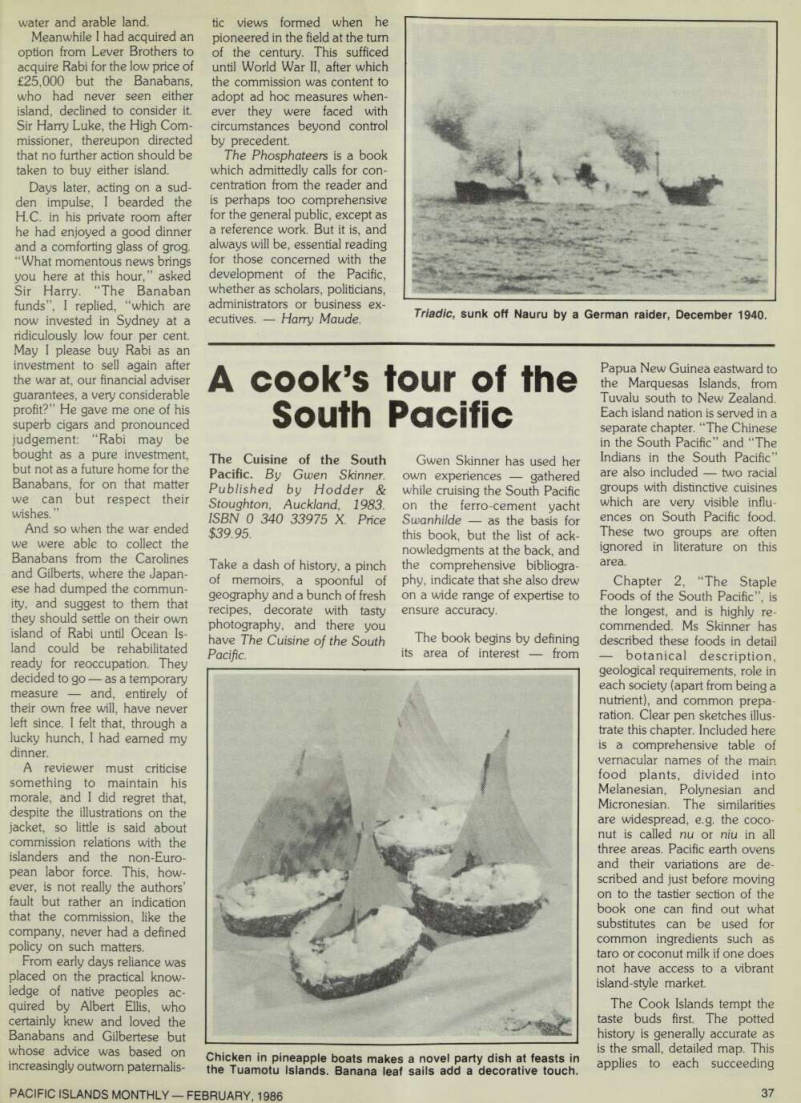
Triadic, sunk off Nauru by a German raider, December 1940.