Guam: commonwealth
pp. 47-48 · Read in the full issue
political currents
Guam: commonwealth status drive slows, but does not die
Hopes that Guam would be a commonwealth of the United States before 1987 died in August as drafters of the Guam Common wealth Act began a line-by-line review of their document.
The momentum gained dur ing a month of public hearings on the Act in July slowed when the review bogged down. In stead of setting a November date for a plebiscite on the Act, members of the Commission on Self-Determination said they hoped by November to be able to schedule a March or April vote.
“We’re looking at possibly March - March through May,” said Perry Taitano, a member of the commission and the Guam Superior Court adminis trator. That means the Act won’t go to the US Congress until then, and that hearings on it probably won’t be held until mid-1987. After Congressional approval, the Act must be sub mitted for a final vote on Guam.
Guam, a flag territory of the United States, has been seeking a change in political status for more than 15 years. In general terms the island’s residents want political autonomy close to that of a state and greater economic freedom. At the same time, they seek to maintain a strong tie to the US, with a preamble professing loyalty and concern for national interests.
The push to finish the Act, hold the plebiscite and get it to Congress by the end of 1985 was due, in part, to fear that if the Act didn’t get on the 1985
One of the more complicated and, for that reason probably less well-known, issues of the Pacific island countries is the future status of the US territories and protectorates of Micronesia and the adjoining areas. Most attention has centred on the Compact of Free Association of the Micronesian islands, but there is also a movement for new status for Guam, which has been more many years, and remains, an important forward US naval and air base. KATE POUND examines the political realities of this situation.
Congressional calendar, it would get lost in Washington’s 1986 election-year manoeuv rings.
Members of the commission, however, say now they’d rather take their time on the Act. “I
feel, honestly, that we should not rush this thing,” said Rudy Sablan, a former Guam lieutenant-governor.
In some ways, the delay will help the Commonwealth Act, Sablan said. At the moment,
the Compact of Free Associa tion, which establishes a new relationship between the US and the Federated States of Micronesia and the Republic of the Marshall Islands, has been snagged by congressional amendments the two island na tions find intolerable.
“I think if we go in now, or toward the end of the year, and this compact thing is still a problem, I’m not sure, just because we are a US territory, that we would be treated any differently,” he said.
“I’d rather get the compact out of the way so that when Guam’s case is heard, it is heard on its own merits.”
Even if the commission had met its original schedule, the
Past and present in Agana, Guam: centuries-old walls from the Spanish colonial period are backed by the Chase office tower, symbol of U.S. financial might... Now for the future? Paul Addison photo.
Act probably would have been bogged down in Congress until the compact was completed, said Robert Rogers, the com mission’s executive director.
“All the people in Washing ton who are reviewing the compact are the same people who would be reviewing Guam’s commonwealth. Ours would have been put on the back burner,” he said.
Waiting until the compact is settled also may give Guam officials an idea of what to expect when the Act gets to Congress which articles might draw fire, as Perry Taitano put it. Congressional objections, however, aren’t likely to change the commission’s positions, he said.
At this point, too, voter sup port is not a sure thing. A survey of the electorate, taken in July, indicated 36 per cent would vote for the Act and 16 per cent would oppose it. But a huge 32 per cent of voters did not know how they would vote, meaning that so far as the public was concerned, the whole issue was up in the air.
The bulk of those surveyed, and dozens of people who spoke at the July hearings, objected most strongly to a proposal to change the island’s name to Guahan. The word is a traditional Chamorro name for Guam.
The commissioners had chosen to use it in the Act in an attempt to create an indepen dent identity for the island, reflecting its Micronesian cul ture.
The objections to the change, however, prompted the com
missioners to consider placing it on a ballot separate from the vote on the Act.
Then a study from the Mic ronesia Area Research Center at the University of Guam, showed the name Guahan, although the current Chamorro name for the island, probably wasn’t its original name. The study showed both Guam and Guahan being used early in the Spanish era on Guam, which began in the 16th century and indicated both names probably were mispronunciations of an other word. The historical con fusion prompted the commis sion to eliminate the name change entirely.
“There really was no basis for it,” said Sablan, who had been one of the strongest supporters of the change. “I really wanted to keep it, but I really have no basis for it, except personal preference.”
The name change, however, is not necessarily dead, said commissioner Marilyn Manibu san, a Republican in Guam’s legislature. “Maybe down the line, when we’re framing our constitution, that can be thrown in there,“ she said.
The commission’s review of the Act has brought no major changes. Pehaps its most con
troversial section, the Chamor ro rights article, remains intact.
The article recognises the right of the Chamorros, Guam’s indi genous people, to have the ultimate say in the island’s status. N The article does not give Chamorros sole right to vote on the commonwealth, as many people have believed. It merely recognises that when Guam’s permanent ststus - statehood or independence - is decided in the future, that Chamorros have the right to make the decision.
Other changes have been more fine-tuning than anything else. For instance, the article applying portions of the US Constitution to Guam was clar ified. Because the Act had not listed several amendments, such as voting rights for women and the entire 14th Amend ment, many people told com missioners they feared those rights would be lost. Although the rights are guaranteed by the Supreme Court, the commis sioners decided to allay those fears.
“I had women asking me, including a woman in the Legislature, how I could do this to them,” Manibusan said about the fears of voting rights.
For the most part, those were the only really controversial sections of the Act. The survey showed most people were un familiar with the economic, labor and immigration provi sions in the Act, and unsure of their impact, but not so un certain as to vote against it.
The Act, as it is, has the tentative support of Guam’s Organisation of People for Indi genous Rights (OPIR). This group, which has argued that the current commonwealth pro cess is not legitimate because it is not limited to a Chamorro only vote, now is satisfied with the Chamorro rights provision and a Chamorro land trust provision in the Act, said Chris Perez Howard, a member of
Opir.
“We are, however, prepared to fight the draft Act, if, in the final analysis, it does not appear to protect the Chamorro people’s right to self-determina tion,’’ Howard said in a recent statement.
No major changes, however, are expected, commssioners said. At this point, unless OPIR reverses its stand, the Act is likely to get voter approval in the first plebiscite. “I’m not worried locally,” said Sablan.
Kate Pound, in Guam.
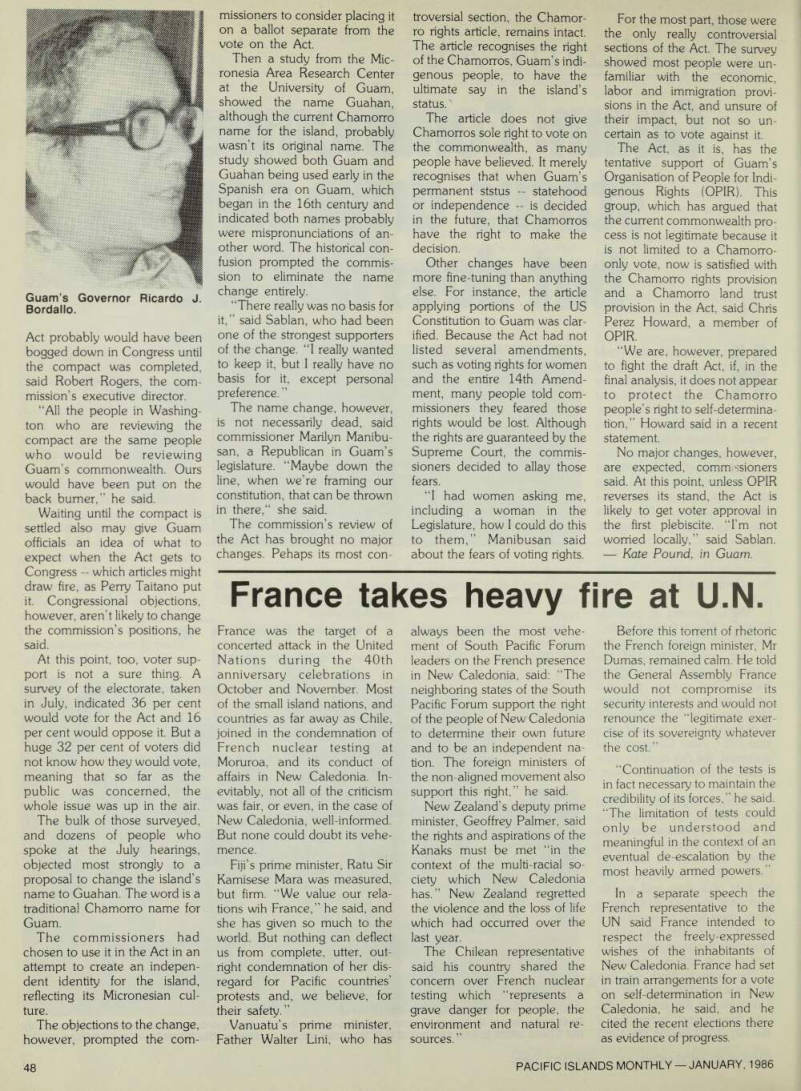
Guam’s Governor Ricardo J.
Bordallo.