Hawaiian besieged
pp. 45-46 · Read in the full issue
by “hamburgers”
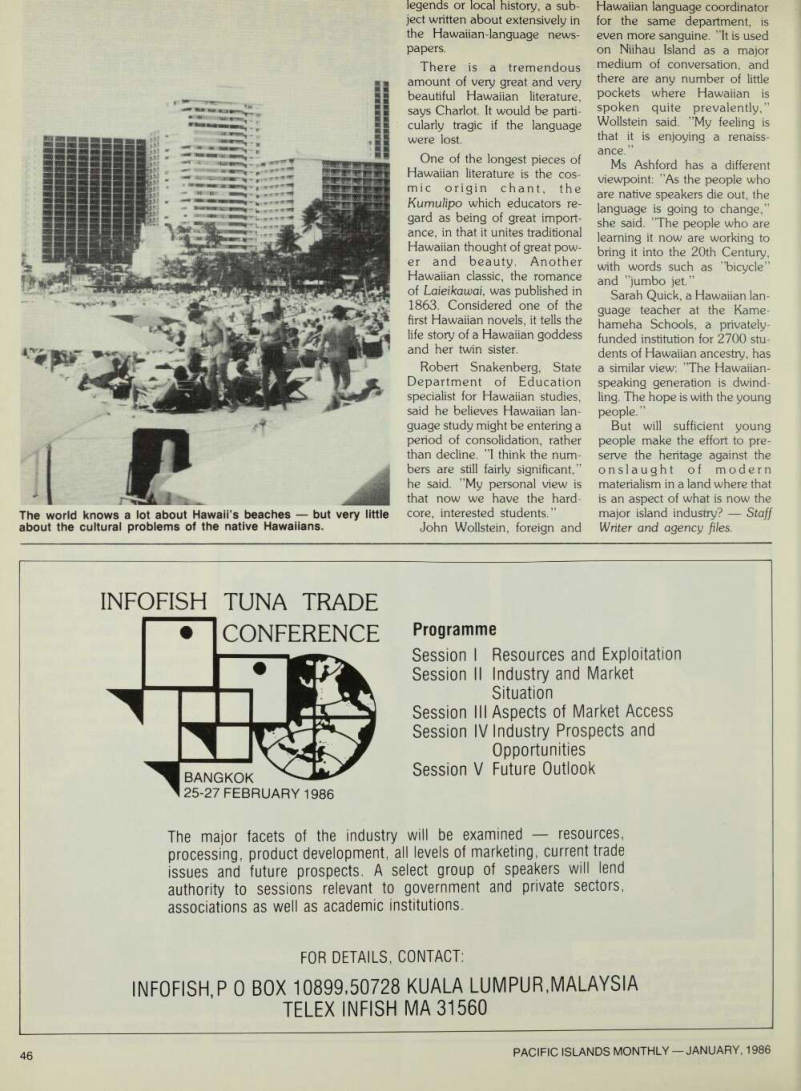
For most of the world, even in the Pacific Basin, Hawaii con jures visions of tourist hedon ism, Waikiki Beach and bikinis, bright shirts, bare feet and a bit of 20th-century barbarism a sort of ultra-tinselled American Dream, with all the trappings, ranging from Wendy’s Hot and Juicy Hamburgers, to rich widows in shorts two axe handles across, and the skinny hookers on Kapiolani Boule vard, all the way through to the genuine and expensive ele gance of the Halekulani Hotel.
Thus Hawaii is seen more as a Mainland U.S.A. playground than as a Pacific island. Inevit ably, the island culture has suffered under the imported onslaught of things and people.
If what exists on Waikiki could be called a culture it has much more to do with Miami, or Newport Beach, California, or even Atlantic City, than with the Pacific.
But there is another aspect of Hawaii which the tourists sel dom see and it is here that work is proceeding to preserve the islands’ links with their past and their own culture. In this area language is seen to be among the most important.
For most of the world, aloha sums up the spirit of the Hawaiian islands. Literally translated, the word means love, but it is mostly used as a word of greeting or farewell.
Of all Hawaiian words, aloha is ulikely to fade from use, but educators and native Hawaiians alike fear that the language itself may face that risk, and the islands will thus lose a critical link with the past.
The worst prospect is that gradually Hawaiian will be like Latin or Greek, so that only a few scholars will be able to read it, says John Chariot, a resear cher with the federally-funded
East-West Research Center in Honolulu. ’’You need a critical mass of speakers. You have to get the next generation to keep up the language,” he says.
Enrolment in high school and college-level Hawaiian lan guage courses has dropped more than 40 per cent since the 1977-78 school year, according to the islands’ educators.
According to the department of Indo-Pacific languages at the University of Hawaii, only a dozen students have graduated from their four-year Hawaiian language study program in the five years it has been offered.
Hawaiian, which is related to Tahitian, Samoan and Maori, is a flowing language in which individual words run together.
Every syllable ends in a vowel, and speakers must pay much greater attention to a word’s inflection than is necessary in English.
For example, depending on the inflection, the word kaua can mean; rain, two people, a class of slave people in old Hawaii, or a battle.
Hawaiian remained an un written language for centuries prior to the arrival in 1778 of Captain James Cook. Gradual ly Western missionaries devised a 12-letter alphabet for Hawaiian, and the written lan guage flourished.
Hawaiians published the first newspapers west of the Rock ies, said Chariot. At one point there were 14 Hawaiian-lan guage newspapers being pub lished simultaneously in the is lands.
Although no comprehensive count has been made, educa tors estimate there are between 1000 and 2000 native speakers of Hawaiian in the islands.
About 300 live on the private island of Niihau, where Hawaiian is spoken almost ex clusively and visitors are not allowed.
Only about 13 per cent of Hawaii’s population of 1.04 million identified themselves as Hawaiians, or part-Hawaiians, in the 1980 census. Just about every other race and nationality in the world was represented, and their common linking lan guage is American English. Few use any Hawaiian at all, except the odd word which has en tered the local street argot.
Educators have been work ing to draw Niihau residents and other native Hawaiian speakers into classrooms, along with other native speakers, to introduce young people to the language and to Hawaiian cul ture. Elementary schools insti tuted the programs in 1978. the same year Hawaiian was recognised as one of the two official languages of Hawaii.
Almost everyone involved in the study of Hawaiian agrees there is much work to be done studying the enormous amount of Hawaiian literature that has not been extensively analysed or translated.
Marguerite Ashford, a resear cher for the Bishop Museum, said use of the museum’s Hawaiian-language manu scripts has increased in recent years. The largest single group of researchers, she said, are native Hawaiians interested in tracing their family roots. The second-largest group was of those interested in Hawaiian
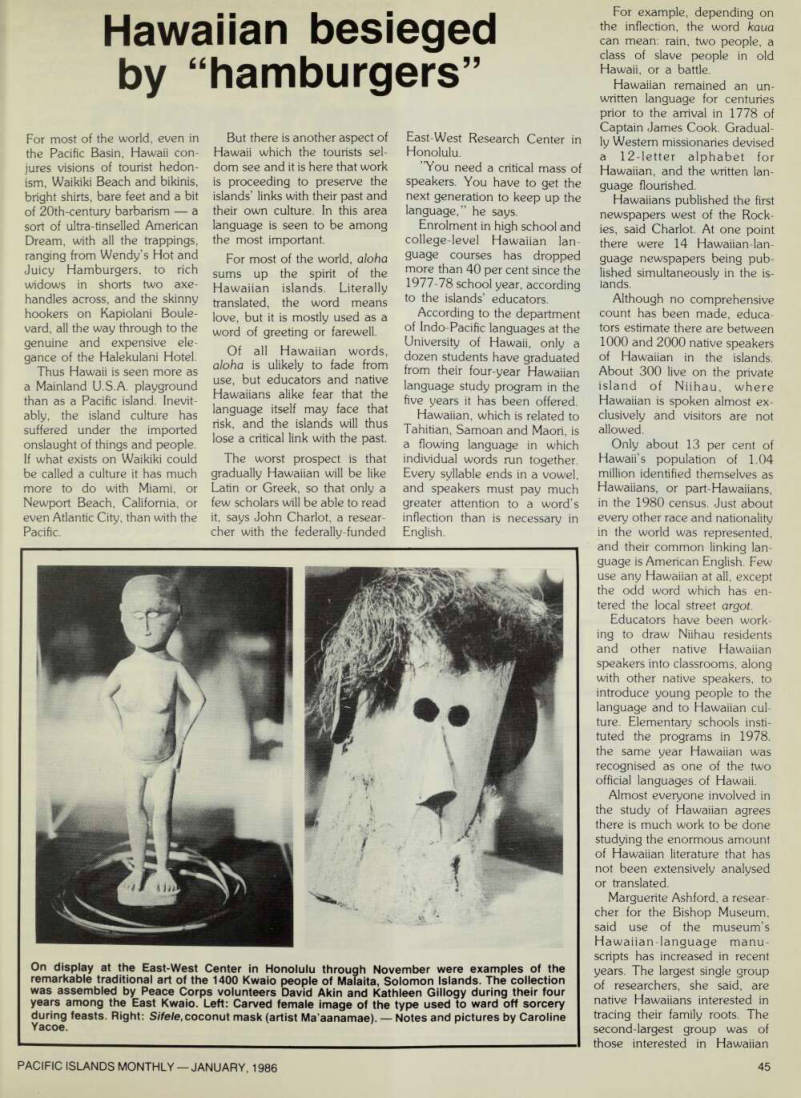
On display at the East-West Center in Honolulu through November were examples of the remarkable traditional art of the 1400 Kwaio people of Malaita, Solomon Islands. The collection was assembled by Peace Corps volunteers David Akin and Kathleen Gillogy during their four years among the East Kwaio. Left: Carved female image of the type used to ward off sorcery during feasts. Right: Sifele, coconut mask (artist Ma’aanamae). Notes and pictures by Caroline Yacoe.
legends or local history, a sub ject written about extensively in the Hawaiian-language news papers.
There is a tremendous amount of very great and very beautiful Hawaiian literature, says Chariot. It would be parti cularly tragic if the language were lost.
One of the longest pieces of Hawaiian literature is the cos mic origin chant, the Kumulipo which educators re gard as being of great import ance, in that it unites traditional Hawaiian thought of great pow er and beauty. Another Hawaiian classic, the romance of Laieikawai, was published in 1863. Considered one of the first Hawaiian novels, it tells the life story of a Hawaiian goddess and her twin sister.
Robert Snakenberg, State Department of Education specialist for Hawaiian studies, said he believes Hawaiian lan guage study might be entering a period of consolidation, rather than decline. ”1 think the num bers are still fairly significant,” he said. ”My personal view is that now we have the hard core, interested students.”
John Wollstein, foreign and
Hawaiian language coordinator for the same department, is even more sanguine. ”It is used on Niihau Island as a major medium of conversation, and there are any number of little pockets where Hawaiian is spoken quite prevalently,”
Wollstein said. ”My feeling is that it is enjoying a renaiss ance.”
Ms Ashford has a different viewpoint: ”As the people who are native speakers die out, the language is going to change,” she said. ’The people who are learning it now are working to bring it into the 20th Century, with words such as ’’bicycle” and ’’jumbo jet.”
Sarah Quick, a Hawaiian lan guage teacher at the Kame hameha Schools, a privately funded institution for 2700 stu dents of Hawaiian ancestry, has a similar view: ’’The Hawaiian speaking generation is dwind ling. The hope is with the young people.”
But will sufficient young people make the effort to pre serve the heritage against the onslaught of modern materialism in a land where that is an aspect of what is now the
major island industry?
Staff
Writer and agency files.
The world knows a lot about Hawaii’s beaches but very little about the cultural problems of the native Hawaiians.