purposes of comparison, the figures
pp. 40-41 · Read in the full issue
figures for currently used inter nal combustion engines against those for regenerative energy sources. In reality, each of the categories has a variety of de signs and end uses. Scale fac tors and manufacturing volumes have of course strong influence on prices. The size and end uses of the systems are especially adaptable for rural regions and do not represent the full spectrum of applica tions. The categories are as follows: Category A - Conventional internal combustion engines, including diesel. Their prices are inversely proportional to (kW) ratings. Prices near Austs36o per kW are typical for quality units above 250 kW (electric) rating. The major con straint is availability and the future cost of fuel.
Category B - ’’Producer gas” engines which are essentially modified internal combustion engines with gas-producing equipment, the fuel for which is derived from biomass via fermentation or pyrolysis pro cesses. Biomass material is just about any dry agricultural re sidue or animal manure, mak ing such concept a potential solution for rural regions, while using existing engines with some modification for the ener gy transition period and beyond.
The prices involved will not be significantly higher than those in Category A, as long as the ”gas producers,” ”gas cool ers,” and ”gas cleaners” are mass-produced. ’’Producer gas” engines are suitable for electricity generation in rural areas and for a variety of functions requiring mechanical power. Since agricultural areas are limited in some locations and, thus the quantity of agricultural wastes, this option may have limited application for parts of the Pacific.
Category C - A variety of essentially conventional internal combustion engines and/or small turbines modified to oper ate on substitute fuels made from ’’fuel crops.” The char acteristics and uses of these units are identical to those in Category A because the fuel processing is performed separ ately from the power units.
Therefore they can also be used for mobile equipment. Again a major constraint is the area available for growing the fuel crops, especially in countries where such land use could be competitive with food crops.
Category D - There is a revival in Stirling engine deve lopment, with promising mass production potential, with con sequent improvement in price.
Such engines are well suited for subsitute fuels such as methane from biomass processing, and they may become a suitable choice for the South Pacific beyond 1987 for small scale production of electrical energy.
Category E - Solar-thermal systems using flat plate collec tors are already fairly well deve loped and tried in agricultural applications requiring air or water temperatures below 100 deg C for drying or processing.
Where higher temperatures are needed, concentrating collec tors become necessary. Their cost is relatively affordable so long as thermal storage is not
needed; that is as long as the desired thermal treatment can be performed during sunshine hours. I have not included thermal storage in the tabulated system cost because of the very wide variety of designs possible.
Desalination and purification of water, using a variety of flat-plate collectors, could incur a cost of Austsso per square metre of properly situated still, built from concrete and glass (output near 1000 litres of potable water per square metre/ year). Local improvisations, and cheaper labor, might bring the cost down.
Category F - Solar-thermal electric systems are in the deve lopment stage and at present are too complex and costly for production of electricity or for cooling. Nevertheless, if current research and development is successful, they may become viable for certain applications.
Category G - Photo-voltaic systems are among the most promising for small to medium scale electricity generating sys
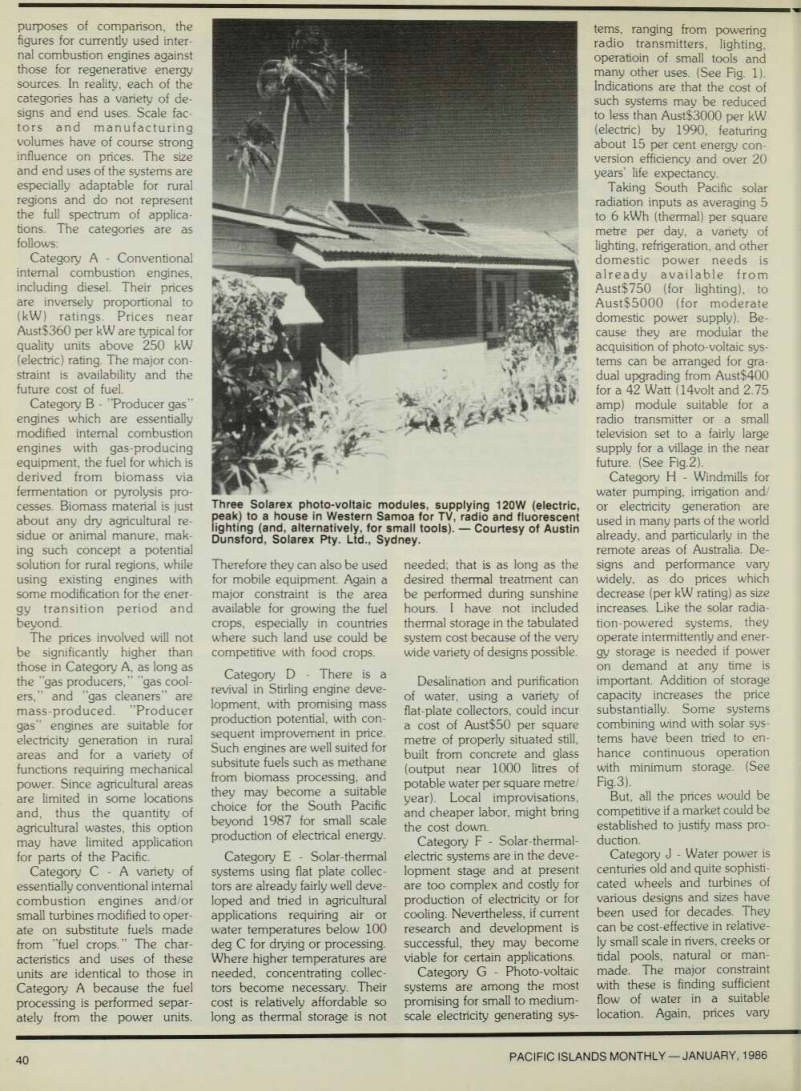
terns, ranging from powering radio transmitters, lighting, operatioin of small tools and many other uses. (See Fig. 1).
Indications are that the cost of such systems may be reduced to less than Austs3ooo per kW (electric) by 1990, featuring about 15 per cent energy con version efficiency and over 20 years’ life expectancy.
Taking South Pacific solar radiation inputs as averaging 5 to 6 kWh (thermal) per square metre per day, a variety of lighting, refrigeration, and other domestic power needs is already available from Austs7so (for lighting), to Austssooo (for moderate domestic power supply). Be cause they are modular the acquisition of photo-voltaic sys tems can be arranged for gra dual upgrading from Austs4oo for a 42 Watt (14volt and 2.75 amp) module suitable for a radio transmitter or a small television set to a fairly large supply for a village in the near future. (See Fig. 2).
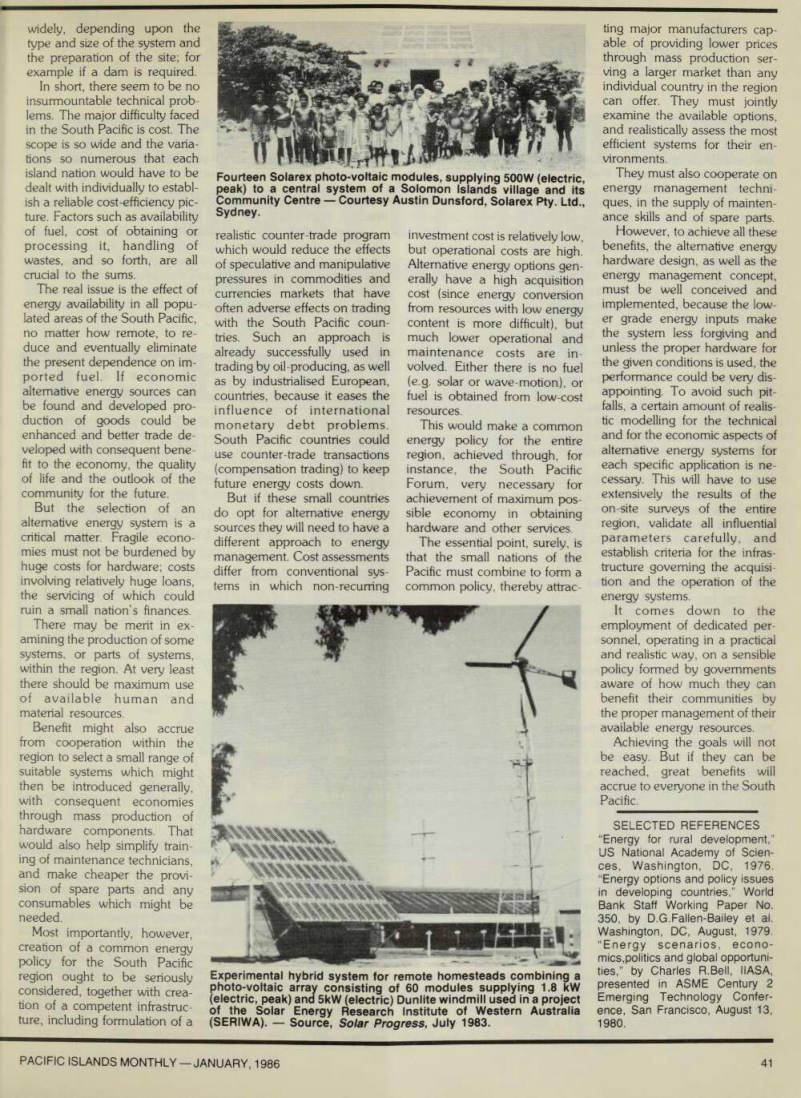
Category H - Windmills for water pumping, irrigation and/ or electricity generation are used in many parts of the world already, and particularly in the remote areas of Australia. De signs and performance vary widely, as do prices which decrease (per kW rating) as size increases. Like the solar radia tion-powered systems, they operate intermittently and ener gy storage is needed if power on demand at any time is important. Addition of storage capacity increases the price substantially. Some systems combining wind with solar sys tems have been tried to en hance continuous operation with minimum storage. (See Fig. 3).
But, all the prices would be competitive if a market could be established to justify mass pro duction.
Category J - Water power is centuries old and quite sophisti cated wheels and turbines of various designs and sizes have been used for decades. They can be cost-effective in relative ly small scale in rivers, creeks or tidal pools, natural or man made. The major constraint with these is finding sufficient flow of water in a suitable location. Again, prices vary
Three Solarex photo-voltaic modules, supplying 120W (electric, peak) to a house in Western Samoa for TV, radio and fluorescent lighting (and, alternatively, for small tools). Courtesy of Austin Dunsford, Solarex Pty. Ltd., Sydney.
widely, depending upon the type and size of the system and the preparation of the site; for example if a dam is required.
In short, there seem to be no insurmountable technical prob lems. The major difficulty faced in the South Pacific is cost. The scope is so wide and the varia tions so numerous that each island nation would have to be dealt with individually to establ ish a reliable cost-efficiency pic ture. Factors such as availability of fuel, cost of obtaining or processing it, handling of wastes, and so forth, are all crucial to the sums.
The real issue is the effect of energy availability in all popu lated areas of the South Pacific, no matter how remote, to re duce and eventually eliminate the present dependence on im ported fuel. If economic alternative energy sources can be found and developed pro duction of goods could be enhanced and better trade de veloped with consequent bene fit to the economy, the quality of life and the outlook of the community for the future.
But the selection of an alternative energy system is a critical matter. Fragile econo mies must not be burdened by huge costs for hardware; costs involving relatively huge loans, the servicing of which could ruin a small nation’s finances.
There may be merit in ex amining the production of some systems, or parts of systems, within the region. At very least there should be maximum use of available human and material resources.
Benefit might also accrue from cooperation within the region to select a small range of suitable systems which might then be introduced generally, with consequent economies through mass production of hardware components. That would also help simplify train ing of maintenance technicians, and make cheaper the provi sion of spare parts and any consumables which might be needed.
Most importantly, however, creation of a common energy policy for the South Pacific region ought to be seriously considered, together with crea tion of a competent infrastruc ture, including formulation of a
realistic counter-trade program which would reduce the effects of speculative and manipulative pressures in commodities and currencies markets that have often adverse effects on trading with the South Pacific coun tries. Such an approach is already successfully used in trading by oil-producing, as well as by industrialised European, countries, because it eases the influence of international monetary debt problems.
South Pacific countries could use counter-trade transactions (compensation trading) to keep future energy costs down.
But if these small countries do opt for alternative energy sources they will need to have a different approach to energy management. Cost assessments differ from conventional sys tems in which non-recurring
investment cost is relatively low, but operational costs are high.
Alternative energy options gen erally have a high acquisition cost (since energy conversion from resources with low energy content is more difficult), but much lower operational and maintenance costs are in volved. Either there is no fuel (e.g. solar or wave-motion), or fuel is obtained from low-cost resources.
This would make a common energy policy for the entire region, achieved through, for instance, the South Pacific Forum, very necessary for achievement of maximum pos sible economy in obtaining hardware and other services.
The essential point, surely, is that the small nations of the Pacific must combine to form a common policy, thereby attrac-
ting major manufacturers cap able of providing lower prices through mass production ser ving a larger market than any individual country in the region can offer. They must jointly examine the available options, and realistically assess the most efficient systems for their en vironments.
They must also cooperate on energy management techni ques, in the supply of mainten ance skills and of spare parts.
However, to achieve all these benefits, the alternative energy hardware design, as well as the energy management concept, must be well conceived and implemented, because the low er grade energy inputs make the system less forgiving and unless the proper hardware for the given conditions is used, the performance could be very dis appointing. To avoid such pit falls, a certain amount of realis tic modelling for the technical and for the economic aspects of alternative energy systems for each specific application is ne cessary. This will have to use extensively the results of the on-site surveys of the entire region, validate all influential parameters carefully, and establish criteria for the infras tructure governing the acquisi tion and the operation of the energy systems.
It comes down to the employment of dedicated per sonnel, operating in a practical and realistic way, on a sensible policy formed by governments aware of how much they can benefit their communities by the proper management of their available energy resources.
Achieving the goals will not be easy. But if they can be reached, great benefits will accrue to everyone in the South Pacific.
Selected References
“Energy for rural development,”
US National Academy of Scien ces, Washington, DC, 1976.
“Energy options and policy issues in developing countries,” World Bank Staff Working Paper No. 350, by D.G.Fallen-Bailey et al.
Washington, DC, August, 1979.
“Energy scenarios, econo mics,politics and global opportuni ties,” by Charles R.Bell, NASA, presented in ASME Century 2 Emerging Technology Confer ence, San Francisco, August 13, 1980.
Fourteen Solarex photo-voltaic modules, supplying 500W (electric, peak) to a central system of a Solomon Islands village and its Community Centre Courtesy Austin Dunsford, Solarex Pty. Ltd., Sydney.
Experimental hybrid system for remote homesteads combining a photo-voltaic array consisting of 60 modules supplying 1.8 kW (electric, peak) and 5kW (electric) Dunlite windmill used in a project of the Solar Energy Research Institute of Western Australia (SERIWA). Source, Solar Progress , July 1983.