approaching crisis
pp. 38-39 · Read in the full issue
Handling The Vital Options
Energy: the Pacific's approaching crisis
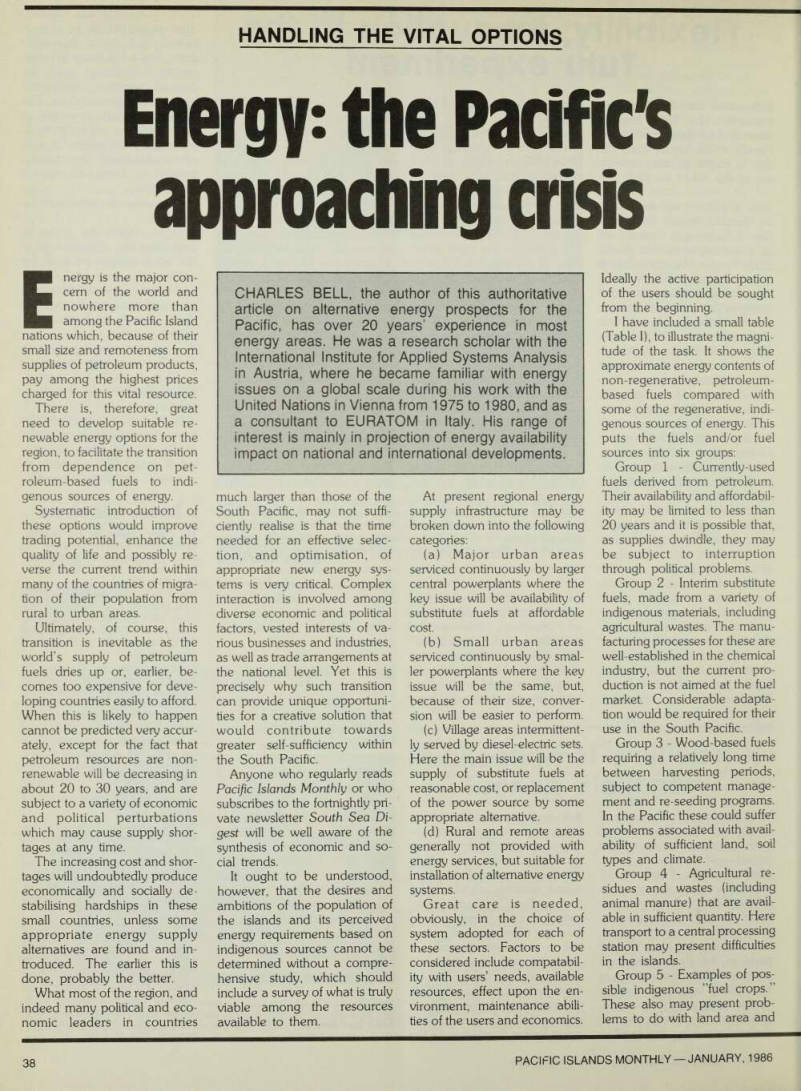
Energy is the major con cern of the world and nowhere more than among the Pacific Island nations which, because of their small size and remoteness from supplies of petroleum products, pay among the highest prices charged for this vital resource.
There is, therefore, great need to develop suitable re newable energy options for the region, to facilitate the transition from dependence on pet roleum-based fuels to indi genous sources of energy.
Systematic introduction of these options would improve trading potential, enhance the quality of life and possibly re verse the current trend within many of the countries of migra tion of their population from rural to urban areas.
Ultimately, of course, this transition is inevitable as the world’s supply of petroleum fuels dries up or, earlier, be comes too expensive for deve loping countries easily to afford.
When this is likely to happen cannot be predicted very accur ately, except for the fact that petroleum resources are non renewable will be decreasing in about 20 to 30 years, and are subject to a variety of economic and political perturbations which may cause supply shor tages at any time.
The increasing cost and shor tages will undoubtedly produce economically and socially de stabilising hardships in these small countries, unless some appropriate energy supply alternatives are found and in troduced. The earlier this is done, probably the better.
What most of the region, and indeed many political and eco nomic leaders in countries
CHARLES BELL, the author of this authoritative article on alternative energy prospects for the Pacific, has over 20 years’ experience in most energy areas. He was a research scholar with the International Institute for Applied Systems Analysis in Austria, where he became familiar with energy issues on a global scale during his work with the United Nations in Vienna from 1975 to 1980, and as a consultant to EURATOM in Italy. His range of interest is mainly in projection of energy availability impact on national and international developments.
much larger than those of the South Pacific, may not suffi ciently realise is that the time needed for an effective selec tion, and optimisation, of appropriate new energy sys tems is very critical. Complex interaction is involved among diverse economic and political factors, vested interests of va rious businesses and industries, as well as trade arrangements at the national level. Yet this is precisely why such transition can provide unique opportuni ties for a creative solution that would contribute towards greater self-sufficiency within the South Pacific.
Anyone who regularly reads Pacific Islands Monthly or who subscribes to the fortnightly pri vate newsletter South Sea Di gest will be well aware of the synthesis of economic and so cial trends.
It ought to be understood, however, that the desires and ambitions of the population of the islands and its perceived energy requirements based on indigenous sources cannot be determined without a compre hensive study, which should include a survey of what is truly viable among the resources available to them.
At present regional energy supply infrastructure may be broken down into the following categories: (a) Major urban areas serviced continuously by larger central powerplants where the key issue will be availability of substitute fuels at affordable cost. (b) Small urban areas serviced continuously by smal ler powerplants where the key issue will be the same, but, because of their size, conver sion will be easier to perform. (c) Village areas intermittent ly served by diesel-electric sets.
Here the main issue will be the supply of substitute fuels at reasonable cost, or replacement of the power source by some appropriate alternative. (d) Rural and remote areas generally not provided with energy services, but suitable for installation of alternative energy systems.
Great care is needed, obviously, in the choice of system adopted for each of these sectors. Factors to be considered include compatabil ity with users’ needs, available resources, effect upon the en vironment, maintenance abili ties of the users and economics.
Ideally the active participation of the users should be sought from the beginning.
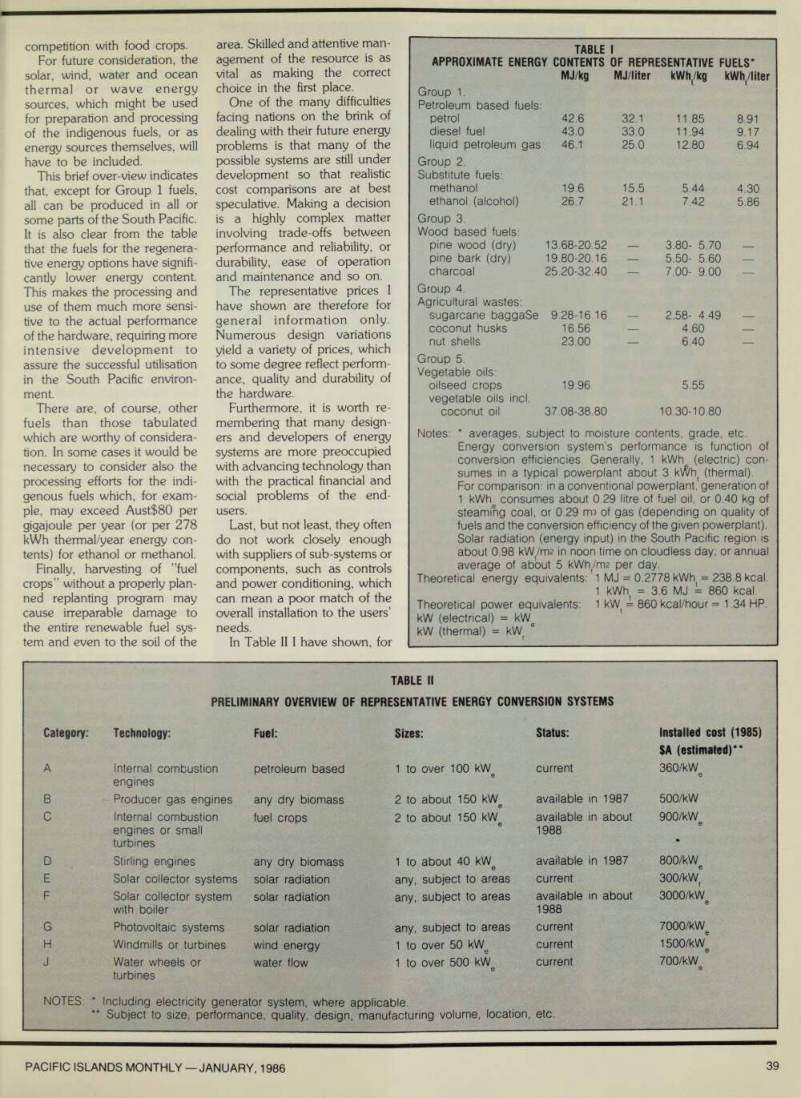
I have included a small table (Table I), to illustrate the magni tude of the task. It shows the approximate energy contents of non-regenerative, petroleum based fuels compared with some of the regenerative, indi genous sources of energy. This puts the fuels and/or fuel sources into six groups: Group 1 - Currently-used fuels derived from petroleum.
Their availability and affordabil ity may be limited to less than 20 years and it is possible that, as supplies dwindle, they may be subject to interruption through political problems.
Group 2 - Interim substitute fuels, made from a variety of indigenous materials, including agricultural wastes. The manu facturing processes for these are well-established in the chemical industry, but the current pro duction is not aimed at the fuel market. Considerable adapta tion would be required for their use in the South Pacific.
Group 3 - Wood-based fuels requiring a relatively long time between harvesting periods, subject to competent manage ment and re-seeding programs.
In the Pacific these could suffer problems associated with avail ability of sufficient land, soil types and climate.
Group 4 - Agricultural re sidues and wastes (including animal manure) that are avail able in sufficient quantity. Here transport to a central processing station may present difficulties in the islands.
Group 5 - Examples of pos sible indigenous ’’fuel crops.”
These also may present prob lems to do with land area and
competition with food crops.
For future consideration, the solar, wind, water and ocean thermal or wave energy sources, which might be used for preparation and processing of the indigenous fuels, or as energy sources themselves, will have to be included.
This brief over-view indicates that, except for Group 1 fuels, all can be produced in all or some parts of the South Pacific.
It is also clear from the table that the fuels for the regenera tive energy options have signifi cantly lower energy content.
This makes the processing and use of them much more sensi tive to the actual performance of the hardware, requiring more intensive development to assure the successful utilisation in the South Pacific environ ment.
There are, of course, other fuels than those tabulated which are worthy of considera tion. In some cases it would be necessary to consider also the processing efforts for the indi genous fuels which, for exam ple, may exceed AustsBo per gigajoule per year (or per 278 kWh thermal/year energy con tents) for ethanol or methanol.
Finally, harvesting of ’’fuel crops” without a properly plan ned replanting program may cause irreparable damage to the entire renewable fuel sys tem and even to the soil of the
area. Skilled and attentive man agement of the resource is as vital as making the correct choice in the first place.
One of the many difficulties facing nations on the brink of dealing with their future energy problems is that many of the possible systems are still under development so that realistic cost comparisons are at best speculative. Making a decision is a highly complex matter involving trade-offs between performance and reliability, or durability, ease of operation and maintenance and so on.
The representative prices I have shown are therefore for general information only.
Numerous design variations yield a variety of prices, which to some degree reflect perform ance, quality and durability of the hardware.
Furthermore, it is worth re membering that many design ers and developers of energy systems are more preoccupied with advancing technology than with the practical financial and social problems of the end users.
Last, but not least, they often do not work closely enough with suppliers of sub-systems or components, such as controls and power conditioning, which can mean a poor match of the overall installation to the users’ needs.
In Table II I have shown, for
Table 1
Approximate Energy Contents Of Representative Fuels*
MJ/kg MJ/llter
kWh/kg
kWlyilter
Group 1.
Petroleum based fuels; petrol 42.6 32.1 11.85 8,91 diesel fuel 43.0 33.0 11.94 9.17 liquid petroleum gas 46.1 25.0 12.80 6.94 Group 2.
Substitute fuels: methanol 19.6 15.5 5.44 4.30 ethanol (alcohol) 26.7 21.1 7.42 5,86 Group 3.
Wood based fuels: pine wood (dry) 13.68-20.52 — 3.80- 5.70 — pine bark (dry) 19.80-20.16 — 5.50- 5.60 — charcoal 25.20-32.40 — 7.00- 9.00 — Group 4.
Agricultural wastes: sugarcane baggaSe 9.28-16.16 — 2.58- 4.49 — coconut husks 16.56 4.60 — nut shells 23.00 — 6.40 — Group 5.
Vegetable oils; oilseed crops 19.96 5.55 vegetable oils incl. coconut oil 37.08-38.80 10.30-10.80 Notes: * averages, subject to moisture contents, grade, etc.
Energy conversion system's performance is function of conversion efficiencies. Generally, 1 kWh (electric) consumes in a typical powerplant about 3 kwh (thermal).
For comparison: in a conventional powerplant, generation of 1 kWh consumes about 0.29 litre of fuel oil, or 0.40 kg of steaming coal, or 0.29 ma of gas (depending on quality of fuels and the conversion efficiency of the given powerplant).
Solar radiation (energy input) in the South Pacific region is about 0.98 kW/ma in noon time on cloudless day; or annual average of about 5 kWh/ma per day.
Theoretical energy equivalents: 1 MJ = 0.2778 kWh = 238.8 kcal. 1 kWh = 3.6 MJ = 860 kcal.
Theoretical power equivalents. 1 kW, = 860 kcal/hour = 1,34 HP. kW (electrical) = kW kW (thermal) = kW e
Table Ii
PRELIMINARY OVERVIEW OF REPRESENTATIVE ENERGY CONVERSION SYSTEMS Category: Technology: Fuel: Sizes: Status: Installed cost (1985) $A (estimated)** A Internal combustion petroleum based 1 to over 100 kW g current 360/kW e engines B Producer gas engines any dry biomass 2 to about 150 kW e available in 1987 500/kW C Internal combustion fuel crops 2 to about 150 kW e available in about 900/kW e engines or small 1988 turbines • D Stirling engines any dry biomass 1 to about 40 kW e available in 1987 800/kW e E Solar collector systems solar radiation any, subject to areas current 300/kW ( F Solar collector system solar radiation any, subject to areas available in about 3000/kW e with boiler 1988 G Photovoltaic systems solar radiation any, subject to areas current 7000/kW e H Windmills or turbines wind energy 1 to over 50 kW e current 1500/kW e J Water wheels or water flow 1 to over 500 kW g current 700/kW e turbines
Notes:
* Including electricity generator system, where applicable. ** Subject to size, performance, quality, design, manufacturing volume, location, etc.