sports leadership
pp. 50-51 · Read in the full issue
Vast Complex Building
Hawaii bids for Pacific sports leadership
Strenuous physical activ ity has no place in most people’s dreams of a holiday paradise in the Pacific. Sporting ambitions on holidays seldom extend further than a leisurely stroll around a golf course, a day’s fishing off some palm-fringed shore, or simply a dip in a gin-clear ocean.
Even spectator sport tends to concentrate on the semi-com atose - navel contemplation, bird-watching; gentle things like that.
But in spite of these results from almost all efforts at market research among tourists, an American firm is planning to build a huge, first-class sporting complex at Waikoloa, amid the volcanic black lava fields and green hills of the popular Koha la coast on the ’’Big Island” of Hawaii.
Plans for Sports World so far unveiled by the Transcontinen tal Development Corporation of Santa Barbara, California, include an athletics-cycling-
A lavish new complex is under construction in Hawaii, aiming to become the centre of 21st Century sporting interests in the Pacific Basin. And, as JIM SHRIMPTON reports here, the Island nations will have a chance to test their athletic prowess on these new fields.
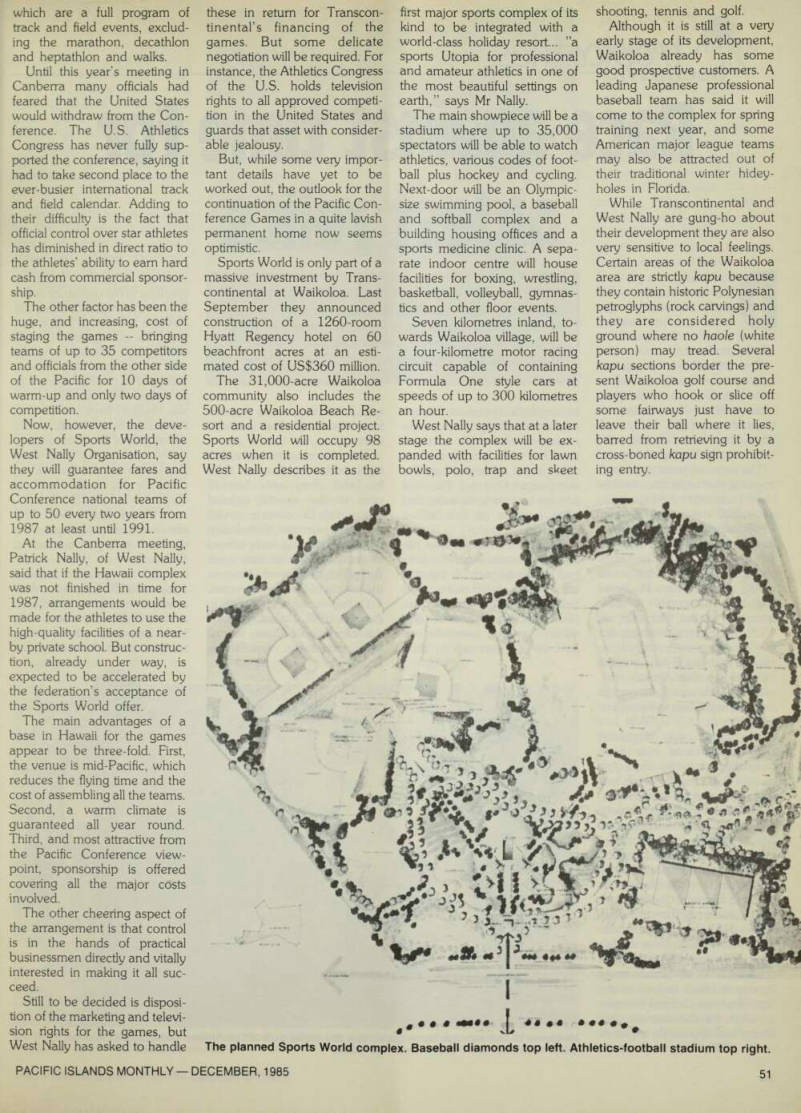
football stadium with seating for 35,000, an indoor sports centre, four baseball-softball diamonds, and a grand prix motor track, as well as two new golf courses.
Transcontinental says it is confident that with the proper promotion, there will be suffi cient interest among tourists who flock to Hawaii in their tens of thousands all year round, mainly from the mainland U.S.A. and Japan, to make a success of the multi-million dol lar project. They are also look ing towards revenue from the major U.S. and international television networks covering the world-class sporting events they plan to stage at their
complex.
Indeed, plans are already well afoot for such events.
Already an international games has been planned, using the well-established Pacific Confer ence Games as the vehicle. This multi-sports event has been held every four years since 1969 but in future will be staged every two years and restricted to athletes under the age of 20.
The venue for at least the next three series of these games will be the giant new Sports World centre.
The new format was decided in Canberra, Australia, at a meeting of the Pacific Confer ence Games Federation at
which China was admitted as a sixth member, joining Australia, New Zealand, Canada, Japan and the United States. Australia and New Zealand athletic offi cials have already welcomed the plan to expose their young athletes to top-class competi tion, especially with the inaugu ral world junior championships being held next year in Athens.
While the Pacific Islands is not yet part of the Conference efforts are being made to bring them in through a special series of events, for islanders only, held in conjunction with the main games. This Australian suggestion, if approved, would give island athletes an excellent chance to gain experience of both competition and training methods. A decision will be made late this year on how soon to hold this element of the competitions.
The new and elaborate venue in Hawaii, and the deci sion to restrict the event to juniors, have given new life to the Pacific Conference Games
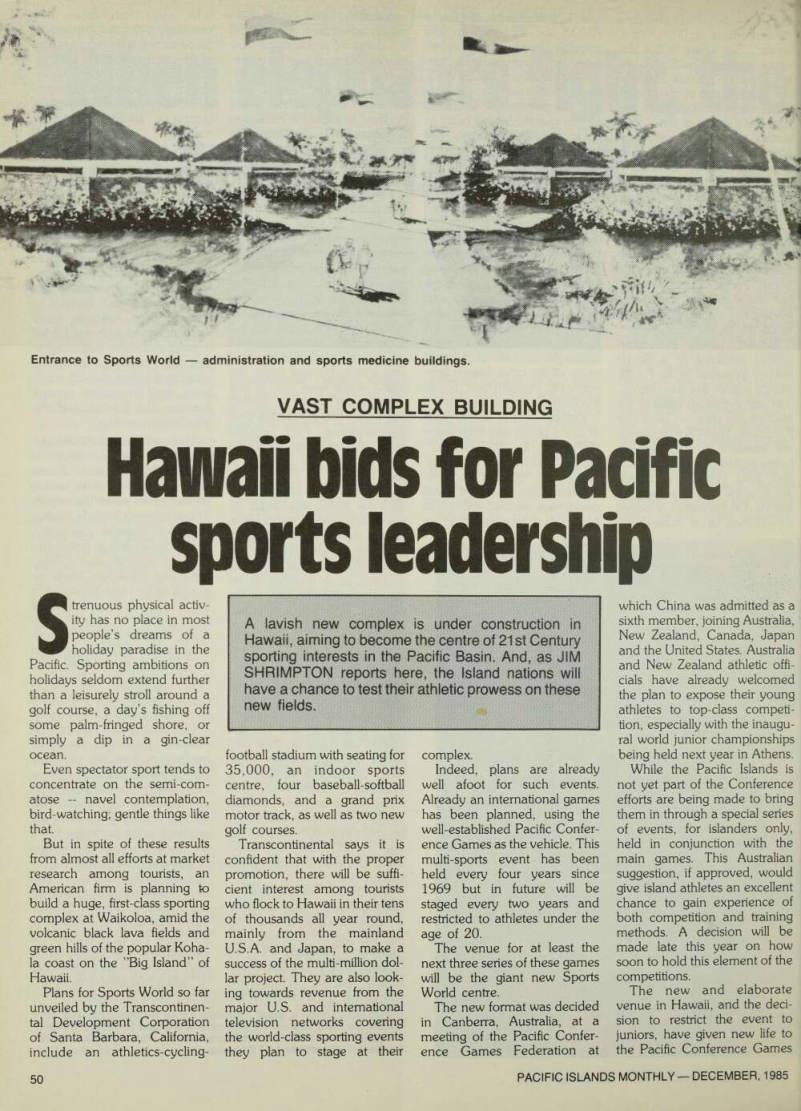
Entrance to Sports World - administration and sports medicine buildings.
which are a full program of track and field events, exclud ing the marathon, decathlon and heptathlon and walks.
Until this year’s meeting in Canberra many officials had feared that the United States would withdraw from the Con ference. The U.S. Athletics Congress has never fully sup ported the conference, saying it had to take second place to the ever-busier international track and field calendar. Adding to their difficulty is the fact that official control over star athletes has diminished in direct ratio to the athletes’ ability to earn hard cash from commercial sponsor ship.
The other factor has been the huge, and increasing, cost of staging the games - bringing teams of up to 35 competitors and officials from the other side of the Pacific for 10 days of warm-up and only two days of competition.
Now, however, the deve lopers of Sports World, the West Nally Organisation, say they will guarantee fares and accommodation for Pacific Conference national teams of up to 50 every two years from 1987 at least until 1991.
At the Canberra meeting, Patrick Nally, of West Nally, said that if the Hawaii complex was not finished in time for 1987, arrangements would be made for the athletes to use the high-quality facilities of a near by private school. But construc tion, already under way, is expected to be accelerated by the federation’s acceptance of the Sports World offer.
The main advantages of a base in Hawaii for the games appear to be three-fold. First, the venue is mid-Pacific, which reduces the flying time and the cost of assembling all the teams.
Second, a warm climate is guaranteed all year round.
Third, and most attractive from the Pacific Conference view point, sponsorship is offered covering all the major costs involved.
The other cheering aspect of the arrangement is that control is in the hands of practical businessmen directly and vitally interested in making it all suc ceed.
Still to be decided is disposi tion of the marketing and televi sion rights for the games, but West Nally has asked to handle
these in return for Transcon tinental’s financing of the games. But some delicate negotiation will be required. For instance, the Athletics Congress of the U.S. holds television rights to all approved competi tion in the United States and guards that asset with consider able jealousy.
But, while some very impor tant details have yet to be worked out, the outlook for the continuation of the Pacific Con ference Games in a quite lavish permanent home now seems optimistic.
Sports World is only part of a massive investment by Trans continental at Waikoloa. Last September they announced construction of a 1260-room Hyatt Regency hotel on 60 beachfront acres at an esti mated cost of US$36O million.
The 31,000-acre Waikoloa community also includes the 500-acre Waikoloa Beach Re sort and a residential project.
Sports World will occupy 98 acres when it is completed.
West Nally describes it as the
first major sports complex of its kind to be integrated with a world-class holiday resort... ”a sports Utopia for professional and amateur athletics in one of the most beautiful settings on earth,” says Mr Nally.
The main showpiece will be a stadium where up to 35,000 spectators will be able to watch athletics, various codes of foot ball plus hockey and cycling.
Next-door will be an Olympic size swimming pool, a baseball and softball complex and a building housing offices and a sports medicine clinic. A sepa rate indoor centre will house facilities for boxing, wrestling, basketball, volleyball, gymnas tics and other floor events.
Seven kilometres inland, to wards Waikoloa village, will be a four-kilometre motor racing circuit capable of containing Formula One style cars at speeds of up to 300 kilometres an hour.
West Nally says that at a later stage the complex will be ex panded with facilities for lawn bowls, polo, trap and skeet
shooting, tennis and golf.
Although it is still at a very early stage of its development, Waikoloa already has some good prospective customers. A leading Japanese professional baseball team has said it will come to the complex for spring training next year, and some American major league teams may also be attracted out of their traditional winter hidey holes in Florida.
While Transcontinental and West Nally are gung-ho about their development they are also very sensitive to local feelings.
Certain areas of the Waikoloa area are strictly kapu because they contain historic Polynesian petroglyphs (rock carvings) and they are considered holy ground where no haole (white person) may tread. Several kapu sections border the pre sent Waikoloa golf course and players who hook or slice off some fairways just have to leave their ball where it lies, barred from retrieving it by a cross-boned kapu sign prohibit ing entry.
The planned Sports World complex. Baseball diamonds top left. Athletics-football stadium top right.