oldest relics
pp. 52-53 · Read in the full issue
tropicalities
Race against time for oldest relics
Don’t bank on it yet . . .
But conservation work could conceivably begin soon on the oldest known relics of Europeans in the South Pacific.
The relics are two ancient iron cannons outside the entr ance of the (now-defunct) Musee de la Decouverte at Point Venus, Tahiti. Their con dition has been steadily de teriorating for the past 16 years.
The cannons were recovered from the reef at Amanu Atoll in the Tuamotu Archipelago, about 800 km east of Tahiti, in 1968 following the publication of an article by me in PIM for January of that year. The article was entitled “Were Europeans Living in the Eastern Pacific in the 16th Century?” It drew attention to the fact that, in 1929, the French administrator of the Tuamotus, Francois Herve, had found four ancient cannons on the Amanu reef, one of which was recovered at the time and taken to Tahiti, but later lost.
The article also suggested that the cannons may have belonged to the Spanish caravel San Lesmes which had disappeared in the eastern Paci fic in 1526; that the caravel’s crew may have inter-married with Polynesian women; and that this could account for the European appearance of many Polynesians in the Society Is lands in Captain Cook’s day.
One reader of the article was Claude Maureau, commander and senior flying officer at Hao Atoll, forward base for the nuclear tests at Moruroa. As Amanu is Hao’s nearest neigh bor, Maureau decided to make a search for the cannons that Herve had apparently left on its reef in 1929. Using a helicopter,
ROBERT LANGDON here relates the long-running, and yet to be completed, tale of the discovery and attempted conservation of cannons from the 16th century Spanish caravel, San Lesmes, the oldest known relics of Europeans in the South Pacific.
he made a systematic recon naissance and sighted two can nons near the atoll’s northern tip. They were lying in shallow water about 15 metres from the outer edge of the reef. The third cannon was not to be seen, and what became of it is still a mystery.
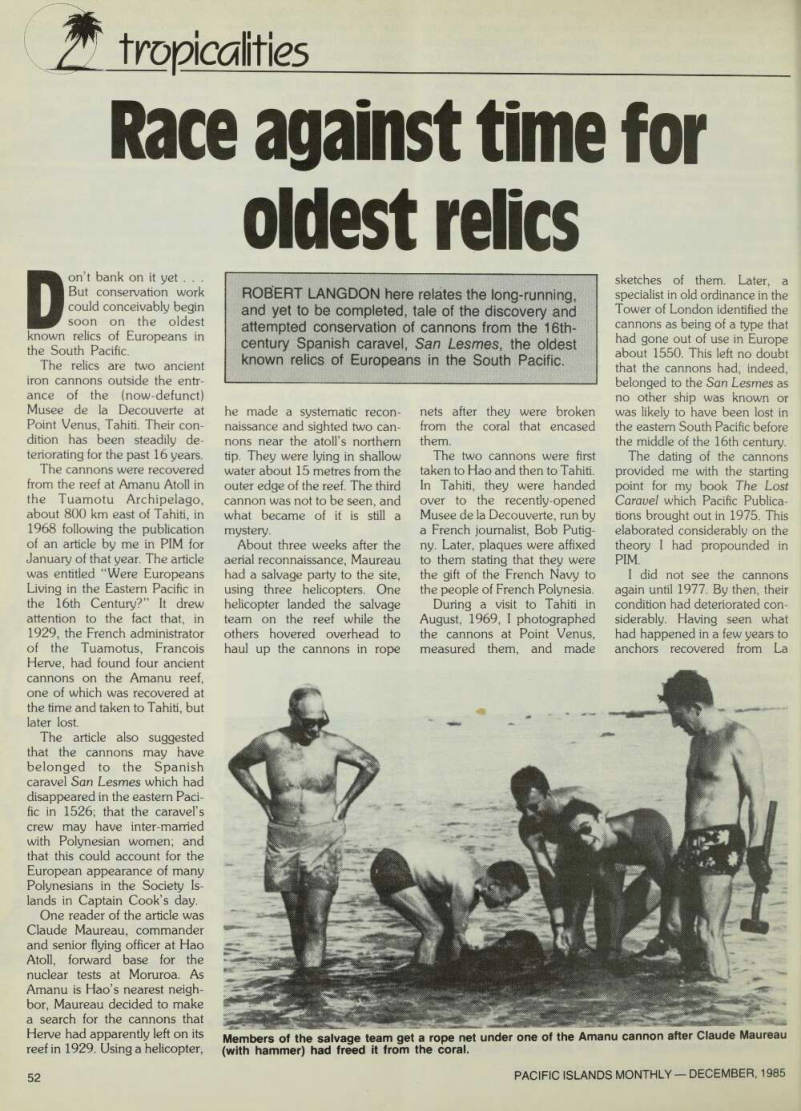
About three weeks after the aerial reconnaissance, Maureau had a salvage party to the site, using three helicopters. One helicopter landed the salvage team on the reef while the others hovered overhead to haul up the cannons in rope
nets after they were broken from the coral that encased them.
The two cannons were first taken to Hao and then to Tahiti.
In Tahiti, they were handed over to the recently-opened Musee de la Decouverte, run by a French journalist, Bob Putig ny. Later, plaques were affixed to them stating that they were the gift of the French Navy to the people of French Polynesia.
During a visit to Tahiti in August, 1969, I photographed the cannons at Point Venus, measured them, and made
sketches of them. Later, a specialist in old ordinance in the Tower of London identified the cannons as being of a type that had gone out of use in Europe about 1550. This left no doubt that the cannons had, indeed, belonged to the San Lesmes as no other ship was known or was likely to have been lost in the eastern South Pacific before the middle of the 16th century.
The dating of the cannons provided me with the starting point for my book The Lost Caravel which Pacific Publica tions brought out in 1975. This elaborated considerably on the theory I had propounded in
Pim.
I did not see the cannons again until 1977. By then, their condition had deteriorated con siderably. Having seen what had happened in a few years to anchors recovered from La
Members of the salvage team get a rope net under one of the Amanu cannon after Claude Maureau (with hammer) had freed it from the coral.
Perouse’s ship Boussole in 1962, I became concerned that the fate of the cannons would be the same unless efforts were made to preserve them. How ever, interviews and correspondence I had with authorities in Tahiti on this subject got nowhere; and on subsequent visits to Tahiti in 1979 and 1984 the condi tion of the cannons was even worse.
Finally, during a visit to Paris in May this year, I found a group of people who took an instant and almost passionate interest in the preservation of the cannons. These people were members of the Cercle D’Etudes sur ITle de Paques to whom I had been invited to give a talk. My talk, entitled “History is in their Blood,” described how 20 present-day Easter Islanders with no known non-Easter Island ancestors had been found in 1972 to have certain genes that are peculiar to Basques. I argued that the explanation for this appeared to be that the Easter Islanders were descendants of a Basque seaman of the San Lesmes.
A second speaker at the same meeting was Claude Maureau, the man responsible for the recovery of the San Lesmes cannons. Like myself, he emphasised that unless posi tive steps were taken soon to preserve the cannons, they would probably be nothing but heaps of rust in about five
years. Members of the audience became quite excited about this.
Later, reports on the talks by Maureau and myself were sent to the Tahiti newspaper, La Depeche. They made front page news on successive days.
That on Maureau’s talk was headed “It is necessary to save the cannons of the San Lesmes.” It was illustrated by several photographs that starkly demonstrated what 16 years of exposure to the elements had done to the cannons.
The report attracted the attention of two Munich men, Dieter and Volker Flach, specialists in restoration. They told La Depeche that even at
this late stage they could save the cannons; and on October 14, La Depeche published a report from them outlining what work would be required to conserve them for “an indefi nite period.”
Now, it seems, all that is needed is a green light from the political representatives of the owners of the cannons, the people of French Polynesia, to go ahead with conservation work. That, of course, will cost money. But so what? Where else in the South Pacific can you see anything of European origin even half as old as the San Lesmes cannons? Or which offer such food for thought?
An October, 1985, picture of the cannon. Rust has eaten deeply into the metal. - In about five years, “heaps of rust”? La Depeche photo.
A Tahitian taxi driver poses with one of the two cannon recovered from Amanu at Point Venus, Tahiti, in August 1969. Their corrugated surfaces which indicated their ancient method of manufacture were then clearly visible. The cannon were later placed on wooden mounts.