"When elephants fight, the
pp. 48-49 · Read in the full issue
Soviet Power In The Pacific-Ii
"When elephants fight, the grass is crushed”
The prospect of a Soviet threat to the South Paci fic has been the subject of recurrent, if not wide spread, speculation within the region for more than a decade.
Over such an extended period of time, it might be expected that some serious consideration would be devoted to assessing the nature and character of the alleged threat. And indeed such is the case. Unfortunately little of this body of scholarship found its way into the October PIM article by the former director of the Micronesian Area Research Center, Dirk Anthony Ballendorf.
Ballendorf promised to take a “hard look” at three questions crucial to any analysis of the validity of Moscow’s ambition in the region; “What are the Soviet interests in the Pacific?
What is the present Soviet presence? And is it a threat?”
The questions are clearly appropriate but the avowed “hard look” dissolved into a vague and unfocused stare.
What are the Soviet interests according to Ballendorf? He makes an oblique reference to Soviet envy, apparently to obtain a missile-testing facility of the type the Americans enjoy at Kwajalein. No other aims are as (in)directly adduced, not even the fish which are the ostensible ground for the Soviet relationship with Kiribati, and which Ballendorf stated to be the basis for current regional fears regarding Moscow.
One only has to look to the recent record of Soviet activity in the region to see that, how ever limited the USSR’s in terests may be, they are more extensive than Ballendorf inti mated. The Soviet Union has sought episodically to secure a resident diplomatic mission in the South Pacific. It has regular-
Debate continues over the degree of Soviet ambi tions and adventurism in the Pacific, and how they may be countered. Dr RICHARD HERR, of the University of Tasmania, here takes issue with the article in our October issue written by Dr Dirk Anthony Ballendorf.
ly attempted (largely without success) to develop an aid presence, including the widely reported offer of hydrographic assistance through the Commit tee for Co-ordination of Joint Prospecting for Mineral Re sources in South Pacific Offshore Areas (CCOP/ SOPAC). The Soviets once en joyed a large share of the regional tourist cruise ship mar ket, although this went into decline in reaction to the Afgha nistan invasion and allegations of electoral interference in Fiji. (Fiji has announced recently, however, that the ban on Soviet cruise ships will be lifted.) Moscow’s cultivation of alternative trade union associa tions has attracted comment, while the allegations of financial intervention in Fiji’s national elections provoked a royal commission. Clearly the USSR does have specific interests in the region that it does wish to pursue.
Being a global superpower, it is scarcely surprising that the Soviet Union has wide interests of which some will include the South Pacific.
What is open to question is whether the Soviet Union wants a presence in the region for its own sake or in order to gain leverage against the pre eminence of its Western oppo nents. One might have ex pected Ballendorf s “hard look” to turn its scrutiny on to such questions as whether or not the Soviets have paid a higher than commercial rate for their access
to Kiribati waters (as has been alleged), and, if so, whether or not this shows a desperation for acceptance or masks ulterior, strategic goals. Similar ques tions could have been asked about Moscows’s persistent wooing of CCOP/SOPAC members.
Related to this “ends or
means” question is the issue of surrogates. Much of the profes sed fear of Soviet designs on the region has arisen recently not so much from the actions of the USSR itself as from the activities of states some believe to be Moscow’s stalking horses in the South Pacific. Ballen dorf s “hard look” did not en compass the Cuban relation ship with Vanuatu, the Libyan conncection with New Caledo nia, or the rumored North Ko rean attemps to make a contact in the area.
There was direct answer at least to Ballendorf s second question regarding the current status of the Soviet presence.
He wrote that it has already a “tremendous military pre sence”. But where is this pre sence located? The Soviets are in the Pacific, it is true, although not necessarily in the South Pacific region. Ballendorf has followed the ploy of some other writers who would titillate or alarm by alternating the use of the word “Pacific” between a Pacific Islands referent, and its broader oceanic basin usage.
As he suggested himself, the Cam Ranh Bay facility has essentially an Asian purpose for the Soviets. It might be deve loped to project power into the South Pacific Islands region, but there appears to be little evidence of a compelling desire to do this at the moment.
Indeed, where Ballendorf offered evidence of a Soviet military presence in the Pacific Islands region, this is in connec tion with American bases in the Micronesian area Guam and Kwajalein. These Soviet vessels are transient in that they are home-ported outside the region and their purpose is clearly aimed at the US rather than the Islands. On the matter of Soviet surveillance, it is noteworthy
that Ballendorf extended this to Kiribati by bringing up the popular image of Russian surveillance vessels being “dis guised” as fishing boats. While clearly such attempts at decep tion are practised, it is normal for the pseudo-fishing boats to go to surveillance targets, not for surveillance vessels to go to fishing grounds.
Turning to the third question is there a threat? again the reader gets no direct answer.
Ballendorf appears to have dis missed the issue with some cavalier and sophomoric sophistry about Islanders being “smart” enough to play the superpowers off against each other, and about double stan dards. If so, he has done the Kiribati Government a grave disservice as well as misread much of the other Islands gov ernments’ concern over Soviet involvement in the region.
Kiribati went to some pains to avoid giving any impression of “playing the ANZUS card”.
Indeed, had he been only seek ing an aid increase from the Western allies, President Tabai could have secured enough to have saved face and, by not
proceeding with the Russian access agreement, avoided all the domestic problems he now faces. Further, as additional evi dence that Tabai was not in sensitive to the possibility of wider motives, his government declined to allow the Soviets to negotiate on Tarawa or, in the agreement, to gain onshore advantages they reportedly sought.
Perhaps the key to the issue of a putative Soviet threat is to be found in what Ballendorf called the double standard of Western states having relations with the USSR while discourag ing the Islands from following their example. In this he substi tuted the piety of a legal equal ity of sovereign states for the good sense of recognising their differing physical capacities in a way which, by and large, the Island states have not. It was great power rivalry a century ago which cost the Islands their independence. Few regional policy-makers have suggested they wish to risk a return to such rivalry.
It is scarcely a double stan dard for states with wider in terests and greater resources to have a more extensive array of international contacts than less well endowed states. And the decision as to whether or no Island governments can, or are willing to, cope with a potential ly demanding relationship is not one which is made in Canberra or Wellington. One only has to look at the Solomons’ genuine annoyance over the Soviet observers at the CCOP/SOPAC meeting in Honiara in Septem ber this year to see that the Islands will make up their own minds on such matters. Also, were Canberra determined, for example, to put the Islands into a diplomatic cocoon, Australia would hardly have established an office at the UN to allow the region’s microstates to interact more fully with the entire world community.
The article also contained comment which may be ques tioned on the ground of accura cy. On the commission side: Ballendorf indicated that the Russian access agreement with Kiribati was to “be put to the people”. It is not clear that this
was ever intended, but obviously it has not happened.
Since such a referendum is one of the goals of the new opposi tion party, the Christian Demo crats. one assumes the govern ment does not intend itself to pursue a plebiscite on the matter.
On the matter of omissions, it is somewhat surprising that the former director of the Microne sian Area Research Center could discuss the prospects of a Soviet relationship with the Micronesian entities without mentioning the strategic denial provisions in their compacts.
While these provisions might not preclude any chance of some formal relations, they were designed with the USSR in mind and one would imagine that some heartburn would be generated before the US could bring itself to accept contact between the Soviets and the Micronesian entities.
To conclude, the Soviet Un ion does have a variety of interests in the South Pacific which might lead it to seek a greater presence in the region.
These interests include fishing, transport, science, diplomacy, and trade, as well as global and regional strategic and military objectives. However, these in terests so far have appeared to be very modest relative to its other global and regional ambi tions. Moscow still has no resi dent missions in the region and very little else to show for more than a decade of opportunity.
On these grounds one might have little quibble with Ballen dorfs sketchy but similar con clusions. However, his artful implication that the relatively benign past is justification for a more adventurous future does give cause for reservations. Bal lendorf himself pointed to the problem when he wrote that if the Soviets get up to anything in Kiribati the Americans “have probably anticipated it. . . and have a defence already worked out”. Clearly, a major defence interest by either superpower in the South Pacific will provoke a counter-response by the other.
And, as the African proverb has it, “when two elephants fight, it is the grass that suffers”.
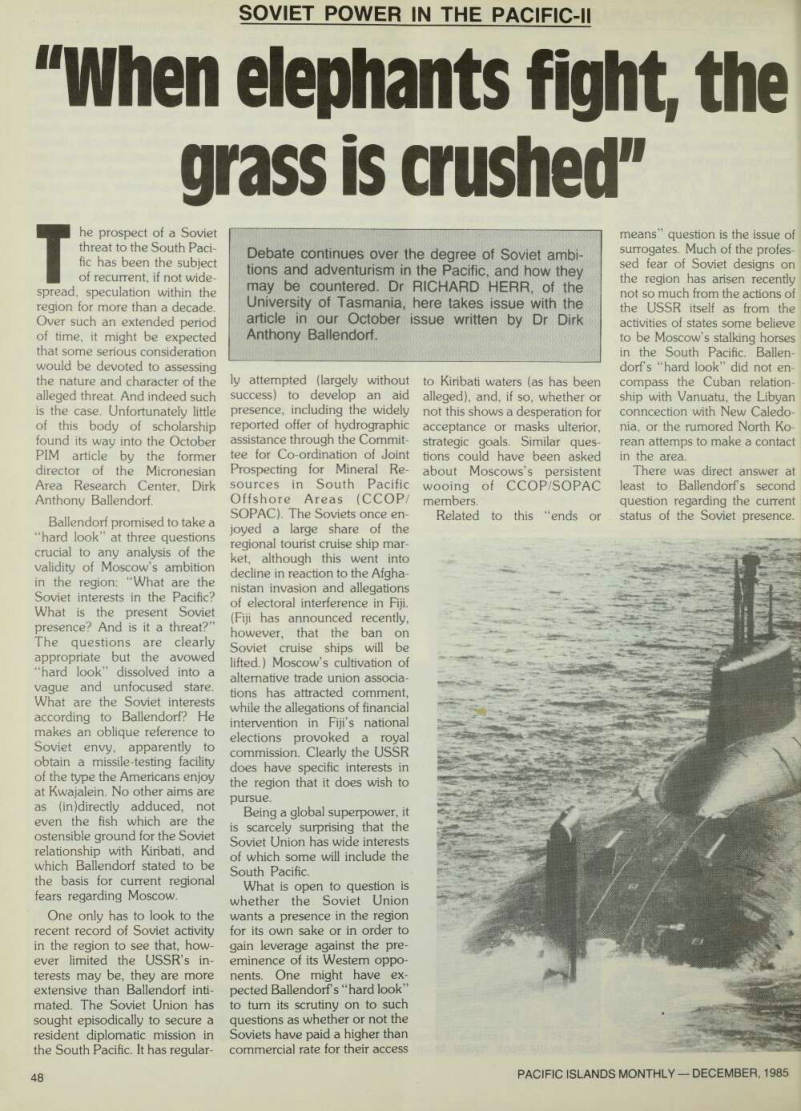
The Soviet Union’s giant Typhoon class nuclear-powered sub marine on manoeuvres. Its dimensions are said to exceed those of a football field. Photo from Soviet Military Power, published 1985 by the US department of Defense.
The growing numbers of operational, nuclear powered TYPHOON-Class ballistic missile submarines contribute to the Soviet Union's increasingly more capable land, see, end air forces with nuclear attack misstons.