For Paua Sup, first
p. 47 · Read in the full issue
Foods Of Papua New Guinea
For Paua Sup, first catch your snake!
Kaikai Aniani: A guide to bush foods markets and culin ary arts of Papua New Guinea. By R. J. May. Pub lished by Robert Brown and Associates, Bathurst Australia, 1984. 192 pp. ISBN 0909197 52 0. Price $21.95.
Mumued Mumut, Beche-de- Mer Soup, Baked Snake, Sago Grub Sate, Sea Urchin Omelette recipes for these and other culinary delights are to be found in Kaikai Aniani by R. J. May, a man who obvious ly enjoys his food.
Dr May has been associated with Papua New Guinea since 1970, and is well known for his work and research there he was awarded the Papua New Guinea Independence Medal for his services to research in 1977.
The preface tells us that when he and his wife first arrived in PNG they had great difficulty in finding anyone, na tional or expatriate, who could identify, let alone tell them how to cook, any but the most common of fruit and vegetables from the markets. The expats dined on what they knew tired, wilted and grossly over priced after transport from Aus tralia while the nationals also ate just what they recognised from their own districts.
Kaikai Aniani was written, therefore, to enliven the menus of both sets of diners. But it is not just a cook book, it is also a most useful reference work for those interested in the dietary habits and patterns of the people of Papua New Guinea, and their methods of cultiva tion.
Part One begins by giving the three main classifications of the people of PNG according to their methods of agriculture: the lowland shifting cultivators who rotate their gardens, allowing the bush to regenerate and thus replenish the earth; the sago eaters who mostly inhabit the swampy river lowlands and de ltas they collect the sago
from the natural stands of palms, supplementing their diet with fish protein; and the High landers who have more sophisticated agricultural sys tems and to whom meat pro tein, whether reared or hunted, is most important. These de scriptions are followed by a well illustrated section on the diffe rent methods of food prepara tion preferred by the various groups, the role played by feasting within the societies, food taboos, and the signi ficance of yams.
“A Checklist of Eatables” also has classifications this time of food types: Roots and Tubers, Sago and Other Star ches, Green Leaves and Shoots, Cucurbits, Legumes and Other Vegetables, Nuts and Fruits, Seafood and Meats.
The descriptions make for easy identification and give sugges tions for best appreciation.
Each is accompanied by either a photograph or drawing. It is a little disconcerting to find “People” in the Meat category.
It says “few recipes for human flesh have been recorded, but it seems to have been cooked like any other meat and was gener
ally preferred to pig. . . (it) tasted like opossum. ” While the author assures us each recipe is tried and true, this taste sensa tion was reported by an earlier intrepid gourmet.
Part Two of Kaikai Aniani is where we find ingredients for Mumued Mumut and other dishes. The author doesn’t claim that these are traditional recipes, rather that they are ways of preparing PNG foods.
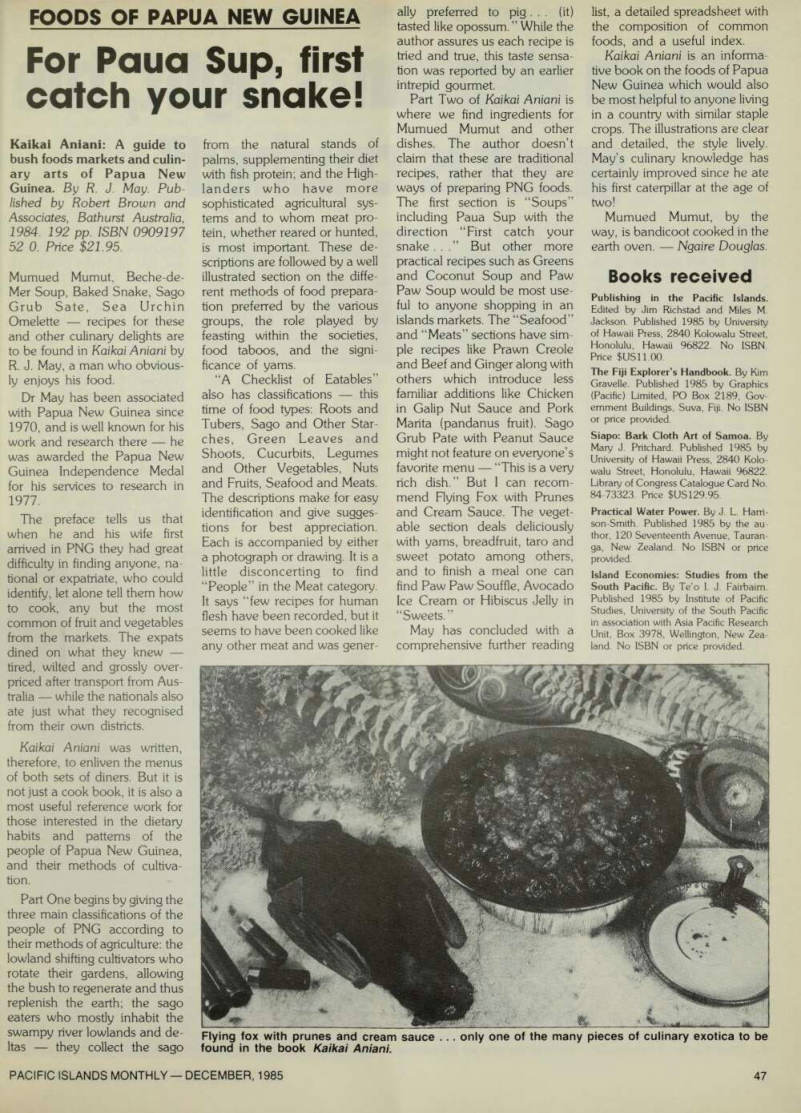
The first section is “Soups” including Paua Sup with the direction “First catch your snake...” But other more practical recipes such as Greens and Coconut Soup and Paw Paw Soup would be most use ful to anyone shopping in an islands markets. The “Seafood” and “Meats” sections have sim ple recipes like Prawn Creole and Beef and Ginger along with others which introduce less familiar additions like Chicken in Galip Nut Sauce and Pork Marita (pandanus fruit). Sago Grub Pate with Peanut Sauce might not feature on everyone’s favorite menu “This is a very rich dish.” But I can recom mend Flying Fox with Prunes and Cream Sauce. The veget able section deals deliciously with yams, breadfruit, taro and sweet potato among others, and to finish a meal one can find Paw Paw Souffle, Avocado Ice Cream or Hibiscus Jelly in “Sweets. ”
May has concluded with a comprehensive further reading
list, a detailed spreadsheet with the composition of common foods, and a useful index.
Kaikai Aniani is an informa tive book on the foods of Papua New Guinea which would also be most helpful to anyone living in a country with similar staple crops. The illustrations are clear
and detailed, the style lively.
May’s culinary knowledge has
certainly improved since he ate his first caterpillar at the age of two!
Mumued Mumut, by the
way, is bandicoot cooked in the
earth oven. Ngaire Douglas.
Books received
Publishing in the Pacific Islands.
Edited by Jim Richstad and Miles M.
Jackson. Published 1985 by University of Hawaii Press, 2840 Kolowalu Street, Honolulu, Hawaii 96822. No ISBN.
Price SUS 11.00.
The Fiji Explorer’s Handbook. By Kim Gravelle. Published 1985 by Graphics (Pacific) Limited, PO Box 2189, Gov ernment Buildings, Suva, Fiji. No ISBN or price provided.
Siapo: Bark Cloth Art of Samoa. By Mary J. Pritchard. Published 1985 by University of Hawaii Press, 2840 Kolo walu Street, Honolulu, Hawaii 96822.
Library of Congress Catalogue Card No. 84-73323. Price 5U5129.95.
Practiced Water Power. By J. L. Harri son-Smith. Published 1985 by the au thor, 120 Seventeenth Avenue, Tauran ga, New Zealand. No ISBN or price provided.
Island Economies: Studies from the South Pacific. By Te’o I. J. Fairbaim.
Published 1985 by Institute of Pacific Studies, University of the South Pacific in association with Asia Pacific Research Unit, Box 3978, Wellington, New Zea land. No ISBN or price provided.
Flying fox with prunes and cream sauce ... only one of the many pieces of culinary exotica to be found in the book Kaikai Aniani.