Action Song
pp. 45-46 · Read in the full issue

books
Celebrating the Maori Action Song
The Maori Action Song. By Jennifer Shennan. Published 1984 by the blew Zealand Council for Educational Re search, P.O. Box 3231, Wel lington, New Zealand. 112 pp.
Issn 0111-2422, Isbn 0 90
8567 34 0. $NZ11.95. Over seas $U.5.10.00.
“We are the people who carve and dance like this” express es what the book, The Maori Action Song, is all about. This book is alive it glows with the warmth which its author, Jennifer Shennan, feels for her subject and the people from whom it springs. But it is held firmly within the discipline of research carefully done and of logical planning in the way the material is set forth.
In the foreword Wiremu Par ker writes; “Action songs are not residual elements of a bygone Maoritanga (Maori arts and culture). Rather they are a vital, exhilarating, resonant, thriving and integral part of Maori life today. Among other benefits, they are a form of therapy for a people under going an identity crisis. Song and dance are among the means by which human beings everywhere purge their souls of the tensions of daily strife and maintain some harmony with the world around and beyond them.”
On the dedication page a quotation from the French poet, Paul Valery states: “The dance, in my opinion, is much more than an exercise, an en tertainment, an ornament, a society pastime; it is a serious thing and, in some aspects, even a holy thing.”
As for my own view of Jennifer Shennan’s careful work and her sincere dedication in researching the subject of Maori action songs, I can only cheer that someone in the South Pacific has made avail-
able to us all this fine collation of history; of varied expert points of view, and that she has been able to open wide a window on the comparative styles which have developed over several periods since the great gathering of Maori people in Rotorua in 1901.
Of course her photographs of and text concerning the Maori Haka of ancient days (which is a basis of the Maori Action Song), and as experienced from the first days of contact with the people from Europe, are an important foundation for Miss Shennan’s book. She builds upon the haka to portray the values inherent in the many influences which have gone into the creation of Maori Ac tion Songs as they developed and are known today. Though there remains an affinity with pristine haka, the action song is
indeed a genre of its own.
It is said that there was no portrayal in the 1901 gathering of the action song. There were instead traditional ngeris, karangas, hakas, peruperus, waiatas, etc. A committee was formed “to oversee perform ance standards”. The chairman was Tarau Marumaru of Nga tiapa. “The wearing of a feath er, the poise of a weapon, the gyration of a poi ball, the shape of a taua or haka party . . . was discussed at length and some times decided upon.” Thus we can acknowledge a precedent for the careful vetting done today for competitions between dancing groups representing many scattered areas and tribes from all parts of New Zealand.
The 1906-07 International Exhibition held in Christchurch was a second large gathering of Maori people - but this time
with Pacific Island groups from Rarotonga, from Fiji and Niue (whose leaders apologised that they had “left their singers at home” so they showed only crafts). “There were regular performances from the Fijian and Rarotongan groups which, as well as performing war dances, enacted dramas with traditional dances woven into the course of narrative ... All the (Maori) performers would have returned home aware of the uniqueness of their own dances, but also no doubt with ideas to imitate Rarotongan dances. These included love songs in which expressive hand and arm movements alluded to images of the text. ” Miss Shen nan asks could these dances have provided some inspiration or influence on the subsequent development of Maori Action Songs?
Another early Pacific Island link, this time with the Waikato people of the Hamilton area, was joined when a Cook Island group visited Princess Te Puea and her people. She later or ganised “a touring concert party whose repertoire included action songs, yet it is quite clear that the Maori dance style was not overtly modelled on other Polynesian dances, even if some of the formal features may have given early inspira tion”.
Once the leaders in Maori communities accepted the Ac tion Song it quickly became popular until it is now “effec tively the national dance of New Zealand”. Miss Shennan gives many examples of how the Maori leaders composed action songs for their people.
Two great Maori men of the early 20th century, Sir Apirana Ngata and Hone Heke, “amused themselves by in terpreting the popular songs of the day into Maori and singing them over together”. But a prominent composer, the Rev.
Kingi Ihaka, outlines his approach as: “First the theme is decided this is directed to
wards the occasion. The music is composed, the text is then worked out”. Tuini Ngawai, leader of a culture group at Tokomaru Bay in the 1930 s and ’4os, said that “words come to her in a dream”. The song Arohaina Mai which she regards as her best “took only a few minutes to compose”. But in Rotorua with the strong tourist intake it was different with “the need to welcome visitors”. The farewells to de parting soldiers during the two world wars, then the welcome parties when the men returned, also had a strong effect in disseminating new composi tions. Again some used popular tunes of the day, while other composers created not only the words and the stylised move ments but also the music.
No matter what the catalyst for the rebirth of action songs, these are often set to beautiful poetic texts which are express ed by the flowing arms and hands. The feet keep the beat and in New Zealand different from the dance of other Pacific island peoples the body sways from side to side. In the Maori culture the right foot
keeps the rhythm. The foot is set down on the beat and then is raised again in continuous accent and non-accent as the weight is transferred once again on to the left foot. This swaying to the right and left makes the tubes of dried flax in the piu piu skirts (phormium tenax, or in the Maori language “harakeke”) softly swish from side to side like the ocean tides or if the body moves a little forward or back the skirt opens like a flower and closes with a swishing clicking sound that is a kind of gentle tympany.
This Maori action song book contains a wealth of know ledge. Not only is the Action- Song-dance traced via the haka (according to early researchers Johannes Anderson and Elsdon Best the word haka is best translated as posture dance), and via the Cook Island visits and on through the great Maori composers of the renaissance about 1918 to 1940 or 1950 (as the book sets the time when action songs came into their own) but there are also delightful chapters on “Images of Dance in Wood-carving” and “Dance in Legend and Mythol
ogy”, and, although “Maori dancing is recognised as a group activity” there are some lovely lines about a daughter of a chief, Te Puhihuia, who danced solo for some distin guished visitors. It is quoted from the legend of Te Ponga and Puhihuia, translated by Margaret Orbell; “When she came out in front of the ranks of the haka, her body bent in one direction and another! Yes, when they saw what a high-born girl can do!
They kept gazing at her eyes; anana, they were like a waxing moon rising over the horizon!
And so the visitors were com pletely overcome with the beauty and grace of this woman, and when Te Ponga, the chief of the travelling party, saw her beauty, his heart was driven wild.”
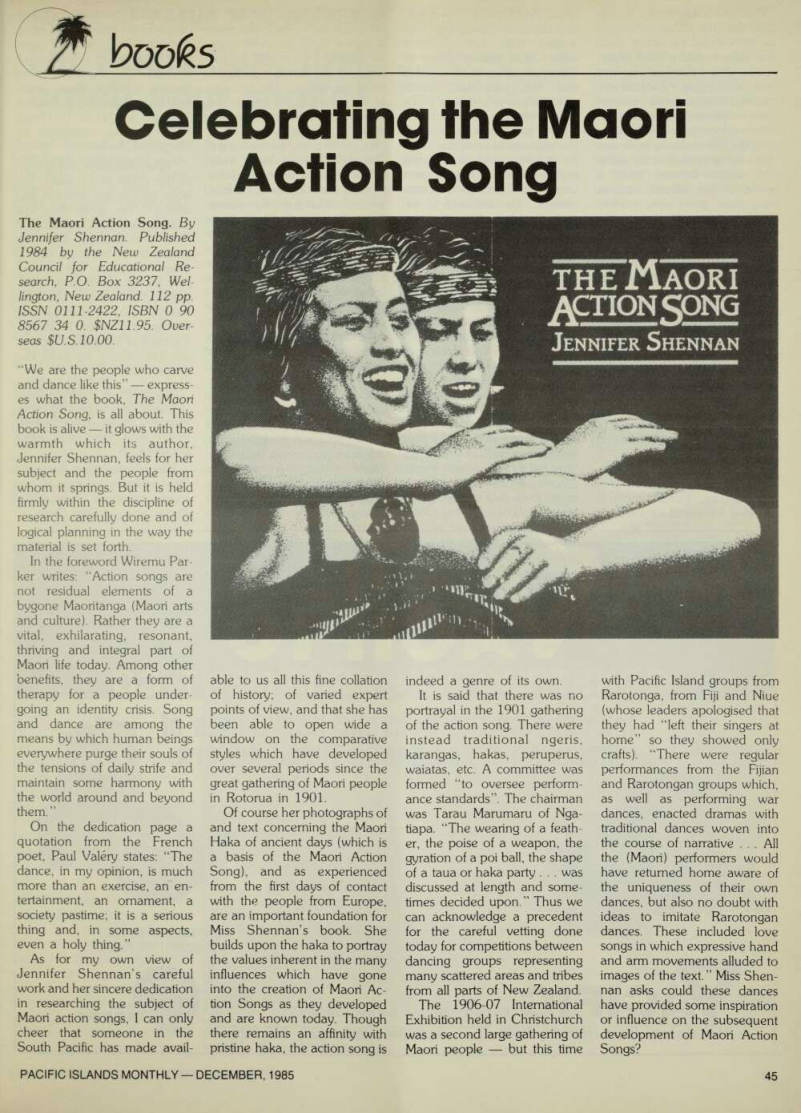
Altogether a splendid book complete with an excellent glos sary and index. It is well illus trated with black and white photographs.
The Maori Action Song is a fine addition to the all too sparse collection of books on
Pacific arts.
Beth Dean.