History painting: Cook's artists at full stretch
pp. 42-44 · Read in the full issue
There follows the third and final instalment of Professor Bernard Smith’s lecture “The Functions of Art on Cook’s Voyages”. The lecture was second in the series known as The Dulcie Stretton Lecture, sponsored by The Library Society of the State Library of New South Wales.
I suspect that Banks became envious of Parkinson’s work on the Endeavour, especially after the quarrel with Stanfield. Consider this instance. Parkinson made the wash drawing, The Tree on One Tree Hill, at Matavai Bay in Tahiti. At right a Polynesian is to be seen carrying breadfruit, at left another carries a bundle of tapa cloth. Nearby, two Europeans, perhaps Banks and Solander out botanising, and at centre a seated figure, Parkinson, presumably, drawing. Banks after Parkinson’s death took these and other drawings by Parkinson into his possession and handed one to John Barralet, an Irish artist, to make a preparatory finished drawing from which an engraving might be cut to publish in Hawkesworth’s Voyages. In this case Barralet made two versions. In the first, the central figure that I presume to represent Parkinson in the original drawing, was first drawn and then erased. In the second drawing Barralet has omitted the central seated figure and transformed the two European figures into Polynesians, presumably so that the engraving would look more exotic. Were the changes made at Banks’s suggestion?
If this seems uncharitable to Banks, it should be considered along with Banks’s reply to Hawkesworth when he asked whether the use that he had made of Parkinson’s materials in preparing the published account of the voyage should be mentioned. A friend of the Parkinsons, Dr Fothergill had suggested it. Banks’s reply was
definite: “As for Dr Fothergill’s intention of saying that Parkinson’s materials had been used by you I am strongly of the opinion that that should not be”. Nor was it. And from that day to this Parkinson’s contribution to the voyage has been much under valued, and largely because of Banks’s firm desire to suppress his name.
Captain Cook also made unacknowledged use of Parkinson’s drawings, though in his case the reasons are more understandable.
But it has led to the traditional ascription to Cook of drawing which he in fact never made. There is a manuscript in the British Library, Add MS 7065, which is entitled “Charts, Plans, Views and Drawings taken on Board His Majesty’s Bark Endeavour in the Years 1768, 1769 and 1770 by Lieut. James Cook”. That sounds straightforward enough. But few if any of the drawings in the manuscript are in fact by Cook’s hand though Beaglehole, Skelton and others have, not surprisingly, on the evidence of the title, ascribed the drawings to Cook.
Most of the work is by Charles Praval, a seaman who joined the Endeavour at Batavia after the crew was depleted by death from malaria and dysentery. Praval at first intended to work his way home as a supemumary for victuals only. But late in January 1771 Parkinson and Sporing died within a few hours of one another, leaving no artist on board. At this stage, if would seem, Praval told
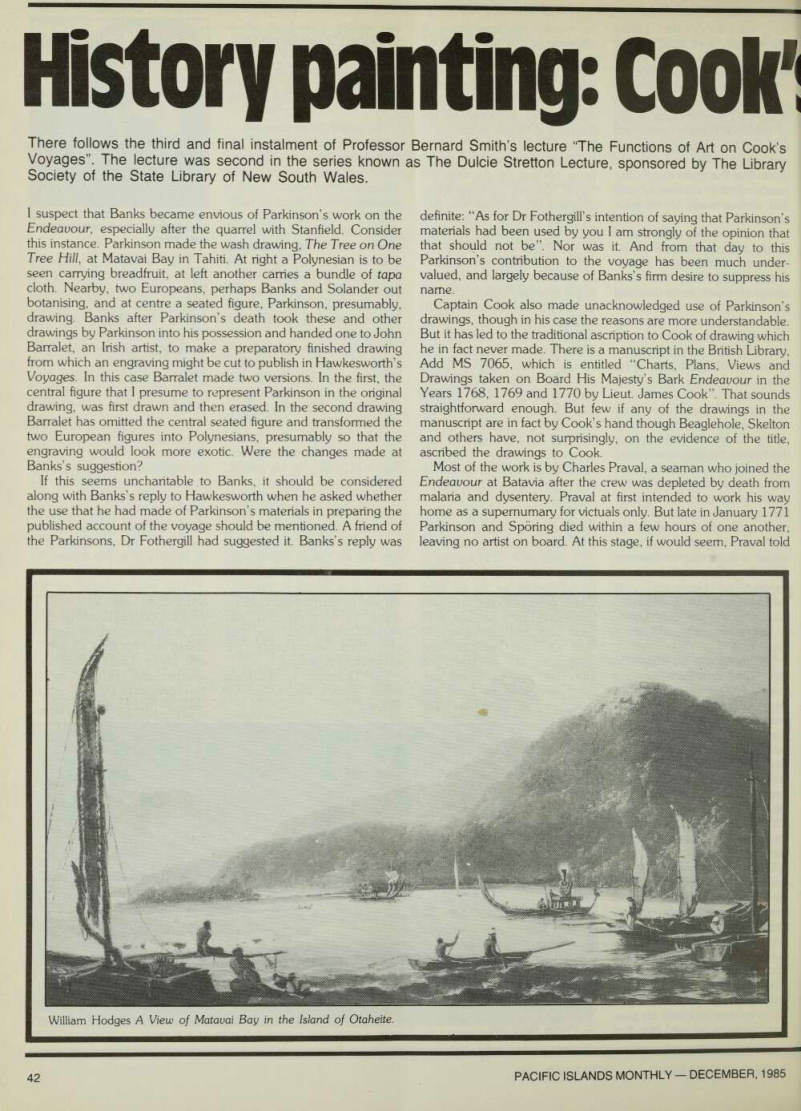
William Hodges A View of Matauai Bay in the Island of Otaheite.
Banks that he possessed some skill in copying drawings, at which, I have no doubt, Banks gave him a Parkinson drawing, now lost, of an Aborigine drawn at Endeavour River. Praval copied the lost drawing and inscribed his name beneath. R. A. Skelton described this drawing as that of a Melanesian native drawn by Praval before he joined the Endeavour. But a comparison of the drawing with the written descriptions by Banks and Parkinson of Aborigines at Endeavour leaves little doubt that this is a depiction of one encountered there; for it depicts the frizzy hair, the arm bands, the bone necklet, the nose ornaments worn by Endeavour River Aborigines. Nor need the white shirt and white armband deter us, for we know that Cook handed out clothing which the natives later discarded. For the original drawing Parkinson seems to have induced the Aborigine to wear a shirt; and the shirt armband may have been an innovation of the Aborigine, replacing the traditional bark armband. Parkinson, a pious young Quaker, was somewhat reluctant to draw the genitals of nude figures. This is the only case we know of in which an Aborigine appears to have actually posed for his portraits, and we know it only through a rather poor copy.
At that time Cook was preparing the fair copy of his log now known as the “Admiralty Journal” (from which Hawkesworth worked), and he required illustrations to accompany it. Banks must have shown Cook Praval’s copy of Parkinson’s drawing. Cook thereupon set Praval to copy drawings by Sporing and Parkinson, to make drawings of artifacts collected on the voyage, and to design the title page of what is now Add MS 7085. This may explain why, a fortnight after the death of Parkinson and Sporing, Praval’s name is changed on the Endeavour Muster book from that
of a supernumerary listed for victuals only to that of an AB for wages and victuals. That the drawings in Add MS 7085 are indeed by Praval is clear from an even cursory stylistic examination. The dots for tree foliage and the use of overlapping hatching are features of his penmanship.
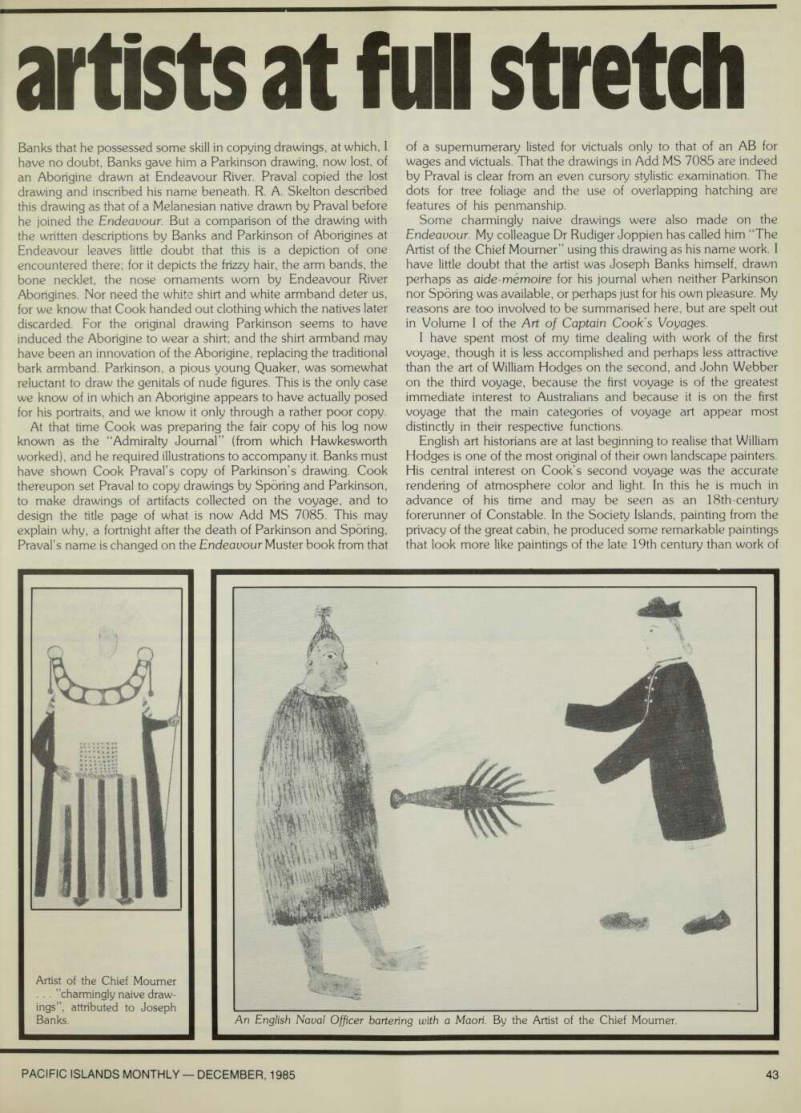
Some charmingly naive drawings were also made on the Endeavour. My colleague Dr Rudiger Joppien has called him “The Artist of the Chief Mourner” using this drawing as his name work. I have little doubt that the artist was Joseph Banks himself, drawn perhaps as aide-memoire for his journal when neither Parkinson nor Sporing was available, or perhaps just for his own pleasure. My reasons are too involved to be summarised here, but are spelt out in Volume I of the Art of Captain Cook’s Voyages.
I have spent most of my time dealing with work of the first voyage, though it is less accomplished and perhaps less attractive than the art of William Hodges on the second, and John Webber on the third voyage, because the first voyage is of the greatest immediate interest to Australians and because it is on the first voyage that the main categories of voyage art appear most distinctly in their respective functions.
English art historians are at last beginning to realise that William Hodges is one of the most original of their own landscape painters.
His central interest on Cook’s second voyage was the accurate rendering of atmosphere color and light. In this he is much in advance of his time and may be seen as an 18th-century forerunner of Constable. In the Society Islands, painting from the privacy of the great cabin, he produced some remarkable paintings that look more like paintings of the late 19th century than work of
Artist of the Chief Mourner . . . "charmingly naive draw ings”, attributed to Joseph Banks.
An English Naval Officer bartering with a Maori. By the Artist of the Chief Mourner.
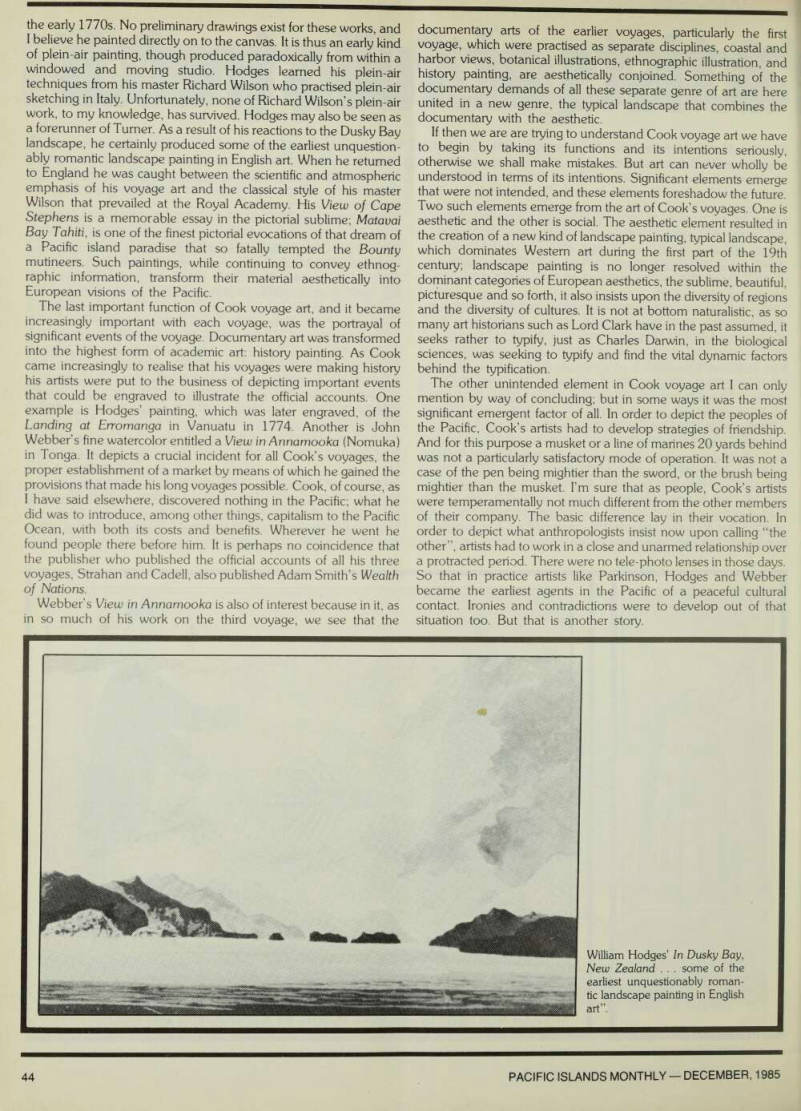
the early 17705. No preliminary drawings exist for these works, and I believe he painted directly on to the canvas. It is thus an early kind of plein-air painting, though produced paradoxically from within a windowed and moving studio. Hodges learned his plein-air techniques from his master Richard Wilson who practised plein-air sketching in Italy. Unfortunately, none of Richard Wilson’s plein-air work, to my knowledge, has survived. Hodges may also be seen as a forerunner of Turner. As a result of his reactions to the Dusky Bay landscape, he certainly produced some of the earliest unquestion ably romantic landscape painting in English art. When he returned to England he was caught between the scientific and atmospheric emphasis of his voyage art and the classical style of his master Wilson that prevailed at the Royal Academy. His View of Cape Stephens is a memorable essay in the pictorial sublime; Matauai Bay Tahiti , is one of the finest pictorial evocations of that dream of a Pacific island paradise that so fatally tempted the Bounty mutineers. Such paintings, while continuing to convey ethnog raphic information, transform their material aesthetically into European visions of the Pacific.
The last important function of Cook voyage art, and it became increasingly important with each voyage, was the portrayal of significant events of the voyage. Documentary art was transformed into the highest form of academic art: history painting. As Cook came increasingly to realise that his voyages were making history his artists were put to the business of depicting important events that could be engraved to illustrate the official accounts. One example is Hodges’ painting, which was later engraved, of the Landing at Erromanga in Vanuatu in 1774. Another is John Webber’s fine watercolor entitled a View in Annamooka (Nomuka) in Tonga. It depicts a crucial incident for all Cook’s voyages, the proper establishment of a market by means of which he gained the provisions that made his long voyages possible. Cook, of course, as I have said elsewhere, discovered nothing in the Pacific; what he did was to introduce, among other things, capitalism to the Pacific Ocean, with both its costs and benefits. Wherever he went he found people there before him. It is perhaps no coincidence that the publisher who published the official accounts of all his three voyages, Strahan and Cadell, also published Adam Smith’s Wealth of Nations.
Webber’s View in Annamooka is also of interest because in it, as in so much of his work on the third voyage, we see that the
documentary arts of the earlier voyages, particularly the first voyage, which were practised as separate disciplines, coastal and harbor views, botanical illustrations, ethnographic illustration, and history painting, are aesthetically conjoined. Something of the documentary demands of all these separate genre of art are here united in a new genre, the typical landscape that combines the documentary with the aesthetic.
If then we are are trying to understand Cook voyage art we have to begin by taking its functions and its intentions seriously, otherwise we shall make mistakes. But art can never wholly be understood in terms of its intentions. Significant elements emerge that were not intended, and these elements foreshadow the future.
Two such elements emerge from the art of Cook’s voyages. One is aesthetic and the other is social. The aesthetic element resulted in the creation of a new kind of landscape painting, typical landscape, which dominates Western art during the first part of the 19th century; landscape painting is no longer resolved within the dominant categories of European aesthetics, the sublime, beautiful, picturesque and so forth, it also insists upon the diversity of regions and the diversity of cultures. It is not at bottom naturalistic, as so many art historians such as Lord Clark have in the past assumed, it seeks rather to typify, just as Charles Darwin, in the biological sciences, was seeking to typify and find the vital dynamic factors behind the typification.
The other unintended element in Cook voyage art I can only mention by way of concluding; but in some ways it was the most significant emergent factor of all. In order to depict the peoples of the Pacific, Cook’s artists had to develop strategies of friendship.
And for this purpose a musket or a line of marines 20 yards behind was not a particularly satisfactory mode of operation. It was not a case of the pen being mightier than the sword, or the brush being mightier than the musket. I’m sure that as people, Cook’s artists were temperamentally not much different from the other members of their company. The basic difference lay in their vocation. In order to depict what anthropologists insist now upon calling “the other”, artists had to work in a close and unarmed relationship over a protracted period. There were no tele-photo lenses in those days.
So that in practice artists like Parkinson, Hodges and Webber became the earliest agents in the Pacific of a peaceful cultural contact. Ironies and contradictions were to develop out of that situation too. But that is another story.
William Hodges’ In Dusky Bay, New Zealand . . . some of the earliest unquestionably roman tic landscape painting in English art”.