Australian guns
pp. 39-41 · Read in the full issue
“Last Anniversary” Of 1985
when French faced Australian guns
It takes some effort of the imagination to register firmly what were the strategic realities of the day 45 years ago. World War II was still “taking shape.” Great Britain and Australia were at war with Germany. But, in the rest of the world, neither Japan (apart from its war in China), nor the Soviet Union was yet a belligerent. The US was distant and uninvolved, with serious and legitimate doubts hovering over its uli mate intentions.
Australia’s minister to Washington, R.G.Casey, re ported as follows on a con versation he had on September 16, 1940, with US Secretary of State, Cordell Hull: “He said American public opinion was not ready for any thing that could be called a military alliance in the Pacific but that short of that he be lieved a great deal could be done by ’keeping the Japanese guessing.’ He repeated that it was possible for the British Empire and the United States to take ’parallel action’ but not ’joint action’ in the present state of public opinion.
“He said he did not believe it was in the interest of the British Empire, or the United States of America, to go to war with Japan in present circumstances or even in the future. He thought America’s role central producer of weapons and munitions for us at least in present circumstances.
Casey said Hull told him “in great confidence” that the US was considering new measures to “put the screw” on Japan.
These included a loan of SUS2S million to China, a
Before ringing out 1985 with its spate of 40th anniversaries of various events associated with the end of World War 11, it is worthwhile to consider another war-time anniversary falling this year a 45th anniversary this time, and therefore not of an event occurring at the war’s end, but in its very early days.
That event was the successful Anglo-Australian intervention of September-October, 1940, in the affairs of New Caledonia which led to the replace ment of a pro-Vichy administration in Noumea by a pro-Free French one. From the viewpoint of the subsequent war in the southwest Pacific, this anniversary is arguably quite as significant as any other observed in the course of the year. PIM associate editor, MALCOLM SALMON, here recalls this piece of high history.
“more serious” embargo on petroleum and scrap to Japan (a clear indication that existing impediments to such trade were ineffective), and an “embargo on import of Japanese silk...”
Casey concluded his account of the conversation with the remark: “Australian press representa tives here most anxious to learn what is going on. I have on/y told them that it is important to give some prominence to the conversations with the Secre tary of State for the benefit of the Japanese, but to stop short of giving Australian public to believe that mutual defensive arrangement is about to be consummated.”
So, for the time being Britain, Australia, remained alone. And the background to the deve loping action in New Caledonia remained accordingly a speci fically Anglo-French conflict, of a type which seems anachronis tic today, but with which the world had been familiar for hundreds of years. Indeed, it is as hard to envisage such a conflict today as it is to keep in mind that both Britain and France in 1940 were what neither of them is today pre-eminent Great Powers.
Following the fall of France after five weeks of fighting in June, 1940,throughout the vast French colonial empire there developed an intense struggle between supporters of the col laborationist Vichy government in France, and the newly emerged Free French move ment, headed by General Charles de Gaulle for the loyal ty of the colonial populations.
The official word from Vichy was that the colonies were to
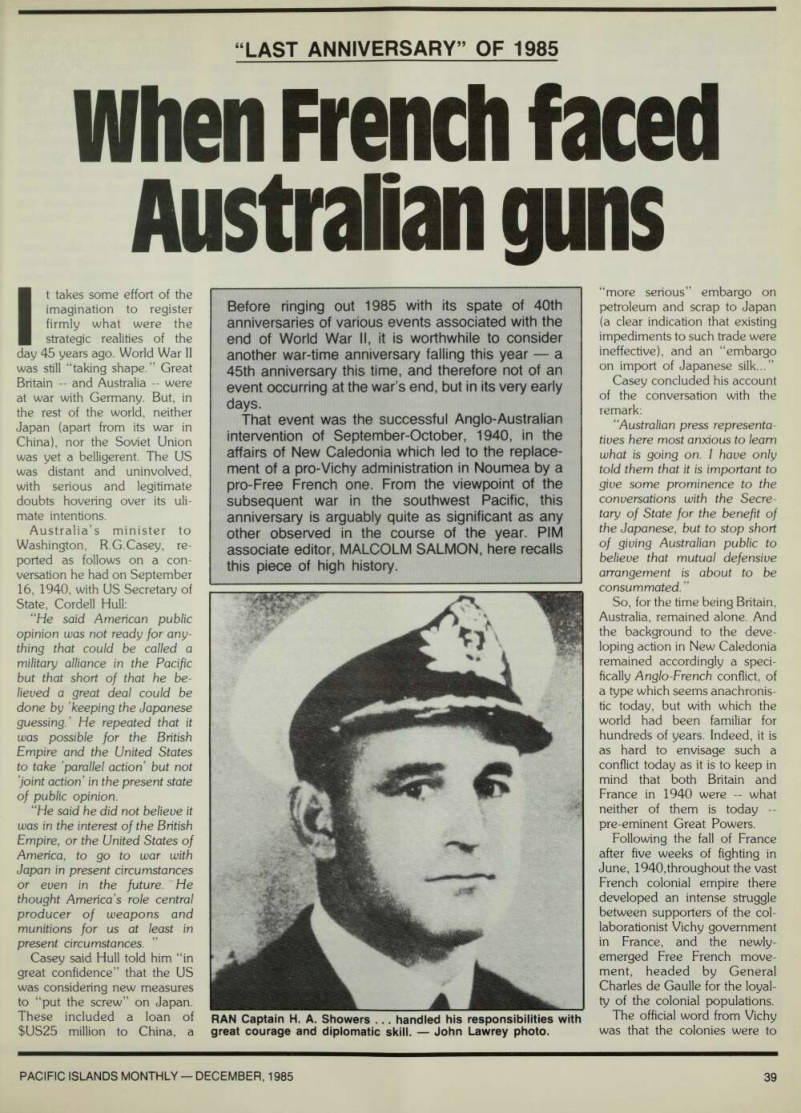
RAN Captain H. A. Showers ... handled his responsibilities with great courage and diplomatic skill. - John Lawrey photo.
remain “neutral” but the dy namics of war soon made non sense of this directive.
The British were extremely active in seeking to undermine Vichy influence in the colonies and to promote that of de Gaulle.
On July 3, 1940, less than a fortnight after the June 22 armistice with Germany, British warships struck at a French naval squadron in the major French naval base of Mers-el- Kebir in Algeria’s Gulf of Oran.
The squadron was sent to the bottom, with the loss of 1200 French naval personnel. The British acted in the - under standable, but mistaken - belief that the Vichy regime was about to hand the French navy over to the Germans. The inci dent was used in France to fan the flames of an already raging anglophobia, and to this day the name “Mers-el-Kebir” re mains a powerful trigger for anti-British sentiment among Frenchmen, not least those in New Caledonia.
In September British war ships were to mount an attack on the Vichy stronghold of Dakar, Senegal, in West Africa.
Their aim was to crush the Vichy garrison, and instal de Gaulle and his headquarters there, it being felt highly desir able that he should operate from French territory rather than from London. But the Vichy resistance was too strong, and the attack was disconti nued.
Such was the immediate con text of the plan spelled out in a
message sent on August 30, 1940, by Lord Caldecote, U.K.Secretary for Dominion Affairs, to Sir Geoffrey Whis kard, U.K.High Commissioner to Australia.
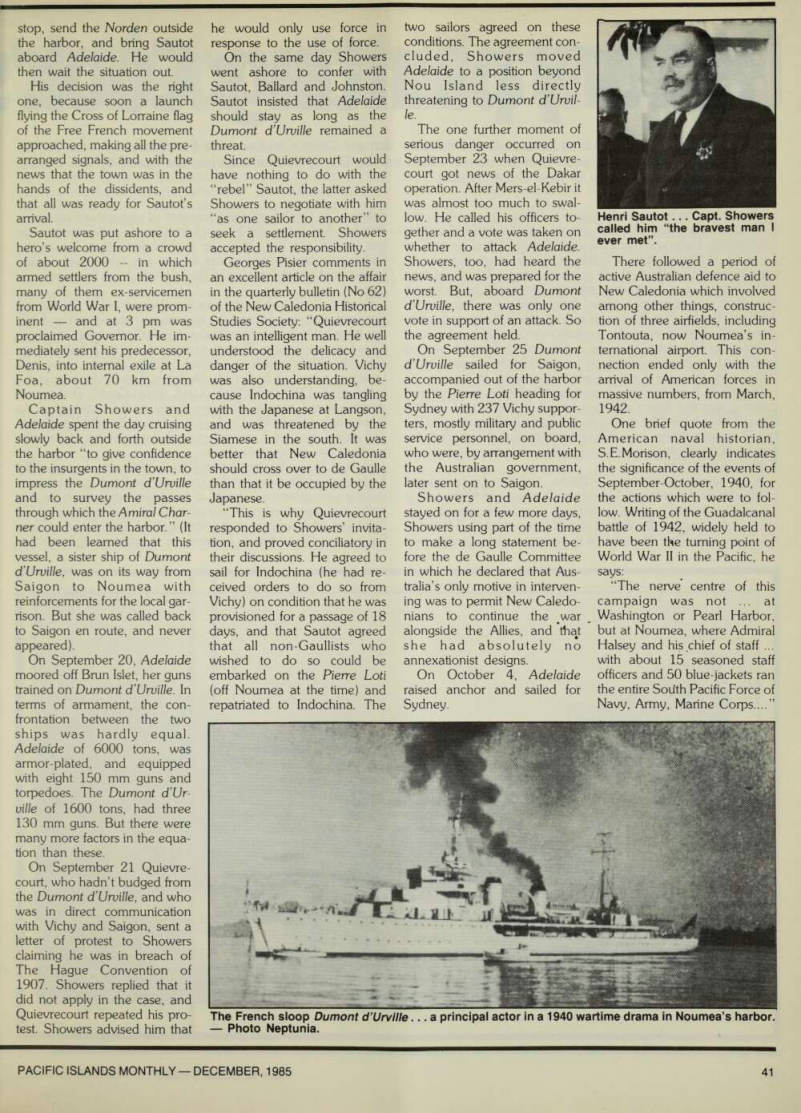
Lord Caldecote said that his government had become aware that because of a message they had received that the popula tion of New Caledonia was anti-Vichy, the Vichy authorities had ordered the sloop Dumont d’Uwille to proceed from Pape ete to Noumea where its cap tain, Toussaint de Quievre court, was to assess the situa tion. It had further become aware that Quievrecourt had recommended strong measures against pro-Gaullist elements in the colony, and “the deve lopment of trade with Japan and America to oust British economic influence.”
He went on; “It seems un likely that so long as the Dumont d’Uwille remains at Noumea the anti-Vichy ele ments in New Caledonia will be able to resist the imposition of a pro-Vichy government.”
He said the British govern ment had been asked by Gen eral de Gaulle whether one of His Majesty’s ships could take the then French Resident Com missioner in the New Hebrides, Henri Sautot, an ardent Gaul list, from Port-Vila to Noumea, adding; “If this could be arranged and the immediate return of the Dumont d’Uwille to Papeete could be secured, there seems reason to believe that de Gaulle elements in the colony would be encouraged to
depose the Governor and de clare openly against Vichy.”
Lord Caledcote was nothing if not precise. He said; “New Caledonia falls within the limits of the Australian naval station and any naval action in these waters would therefore be a matter for the Royal Australian Navy.
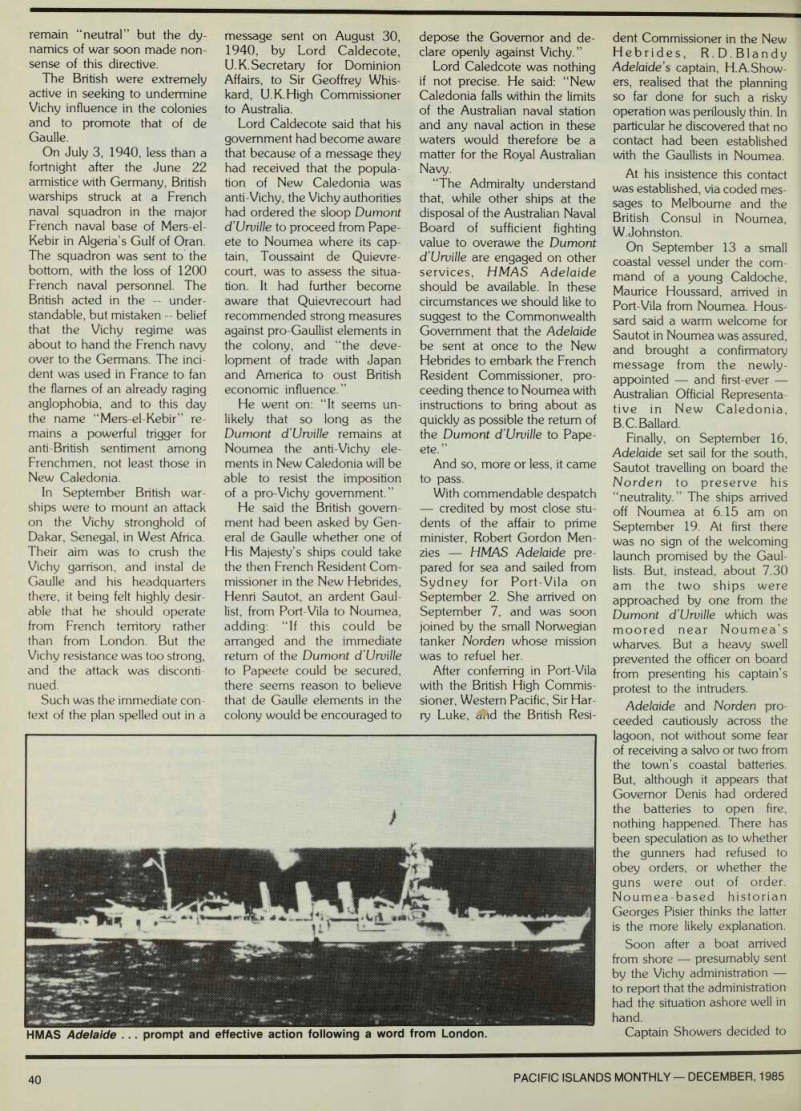
“The Admiralty understand that, while other ships at the disposal of the Australian Naval Board of sufficient fighting value to overawe the Dumont d’Uwille are engaged on other services, HMAS Adelaide should be available. In these circumstances we should like to suggest to the Commonwealth Government that the Adelaide be sent at once to the New Hebrides to embark the French Resident Commissioner, pro ceeding thence to Noumea with instructions to bring about as quickly as possible the return of the Dumont d’Uwille to Pape ete. ”
And so, more or less, it came to pass.
With commendable despatch credited by most close stu dents of the affair to prime minister, Robert Gordon Men zies HMAS Adelaide pre pared for sea and sailed from Sydney for Port-Vila on September 2. She arrived on September 7, and was soon joined by the small Norwegian tanker Norden whose mission was to refuel her.
After conferring in Port-Vila with the British High Commis sioner, Western Pacific, Sir Har ry Luke, afid the British Resi-
dent Commissioner in the New
Hebrides, R.D.Blandy
Adelaide’s captain, H.A.Show ers, realised that the planning so far done for such a risky operation was perilously thin. In particular he discovered that no contact had been established with the Gaullists in Noumea.
At his insistence this contact was established, via coded mes sages to Melbourne and the British Consul in Noumea, W.Johnston.
On September 13 a small coastal vessel under the com mand of a young Caldoche, Maurice Houssard, arrived in Port-Vila from Noumea. Hous sard said a warm welcome for Sautot in Noumea was assured, and brought a confirmatory message from the newly appointed and first-ever Australian Official Representa tive in New Caledonia, B.C. Ballard.
Finally, on September 16, Adelaide set sail for the south, Sautot travelling on board the Norden to preserve his “neutrality.” The ships arrived off Noumea at 6.15 am on September 19. At first there was no sign of the welcoming launch promised by the Gaul lists. But, instead, about 7.30 am the two ships were approached by one from the Dumont d’Uwille which was moored near Noumea’s wharves. But a heavy swell prevented the officer on board from presenting his captain’s protest to the intruders.
Adelaide and Norden pro ceeded cautiously across the lagoon, not without some fear of receiving a salvo or two from the town’s coastal batteries.
But, although it appears that Governor Denis had ordered the batteries to open fire, nothing happened. There has been speculation as to whether the gunners had refused to obey orders, or whether the guns were out of order.
Noumea-based historian Georges Pisier thinks the latter is the more likely explanation.
Soon after a boat arrived from shore presumably sent by the Vichy administration to report that the administration had the situation ashore well in hand.
Captain Showers decided to
HMAS Adelaide ... prompt and effective action following a word from London.
stop, send the Norden outside the harbor, and bring Sautot aboard Adelaide. He would then wait the situation out.
His decision was the right one, because soon a launch flying the Cross of Lorraine flag of the Free French movement approached, making all the pre arranged signals, and with the news that the town was in the hands of the dissidents, and that all was ready for Sautot’s arrival.
Sautot was put ashore to a hero’s welcome from a crowd of about 2000 in which armed settlers from the bush, many of them ex-servicemen from World War I, were prom inent and at 3 pm was proclaimed Governor. He im mediately sent his predecessor, Denis, into internal exile at La Foa, about 70 km from Noumea.
Captain Showers and Adelaide spent the day cruising slowly back and forth outside the harbor “to give confidence to the insurgents in the town, to impress the Dumont d’Urville and to survey the passes through which the Amiral Char ner could enter the harbor.” (It had been learned that this vessel, a sister ship of Dumont d’Urville, was on its way from Saigon to Noumea with reinforcements for the local gar rison. But she was called back to Saigon en route, and never appeared).
On September 20, Adelaide moored off Brun Islet, her guns trained on Dumont d’Urville. In terms of armament, the con frontation between the two ships was hardly equal.
Adelaide of 6000 tons, was armor-plated, and equipped with eight 150 mm guns and torpedoes. The Dumont d’Ur ville of 1600 tons, had three 130 mm guns. But there were many more factors in the equa tion than these.
On September 21 Quievre court, who hadn’t budged from the Dumont d’Urville, and who was in direct communication with Vichy and Saigon, sent a letter of protest to Showers claiming he was in breach of The Hague Convention of 1907. Showers replied that it did not apply in the case, and Quievrecourt repeated his pro test. Showers advised him that
he would only use force in response to the use of force.
On the same day Showers went ashore to confer with Sautot, Ballard and Johnston.
Sautot insisted that Adelaide should stay as long as the Dumont d’Urville remained a threat.
Since Quievrecourt would have nothing to do with the “rebel” Sautot, the latter asked Showers to negotiate with him “as one sailor to another” to seek a settlement. Showers accepted the responsibility.
Georges Pisier comments in an excellent article on the affair in the quarterly bulletin (No 62) of the New Caledonia Historical Studies Society: “Quievrecourt was an intelligent man. He well understood the delicacy and danger of the situation. Vichy was also understanding, be cause Indochina was tangling with the Japanese at Langson, and was threatened by the Siamese in the south. It was better that New Caledonia should cross over to de Gaulle than that it be occupied by the Japanese.
“This is why Quievrecourt responded to Showers’ invita tion, and proved conciliatory in their discussions. He agreed to sail for Indochina (he had re ceived orders to do so from Vichy) on condition that he was provisioned for a passage of 18 days, and that Sautot agreed that all non-Gaullists who wished to do so could be embarked on the Pierre Loti (off Noumea at the time) and repatriated to Indochina. The
two sailors agreed on these conditions. The agreement con cluded, Showers moved Adelaide to a position beyond Nou Island less directly threatening to Dumont d'Urvil le.
The one further moment of serious danger occurred on September 23 when Quievre court got news of the Dakar operation. After Mers-el-Kebir it was almost too much to swal low. He called his officers to gether and a vote was taken on whether to attack Adelaide.
Showers, too, had heard the news, and was prepared for the worst. But, aboard Dumont d’Urville, there was only one vote in support of an attack. So the agreement held.
On September 25 Dumont d’Urville sailed for Saigon, accompanied out of the harbor by the Pierre Loti heading for Sydney with 237 Vichy suppor ters, mostly military and public service personnel, on board, who were, by arrangement with the Australian government, later sent on to Saigon.
Showers and Adelaide stayed on for a few more days, Showers using part of the time to make a long statement be fore the de Gaulle Committee in which he declared that Aus tralia’s only motive in interven ing was to permit New Caledo nians to continue the % war alongside the Allies, and tha t she had absolutely no annexationist designs.
On October 4, Adelaide raised anchor and sailed for Sydney.
There followed a period of active Australian defence aid to New Caledonia which involved among other things, construc tion of three airfields, including Tontouta, now Noumea’s in ternational airport. This con nection ended only with the arrival of American forces in massive numbers, from March, 1942.
One brief quote from the American naval historian, S.E.Morison, clearly indicates the significance of the events of September-October, 1940, for the actions which were to fol low. Writing of the Guadalcanal battle of 1942, widely held to have been the turning point of World War II in the Pacific, he says: “The nerve centre of this campaign was not ... at Washington or Pearl Harbor, but at Noumea, where Admiral Halsey and his chief of staff ... with about 15 seasoned staff officers and 50 blue-jackets ran the entire Sou’th Pacific Force of Navy, Army, Marine Corps...”
Henri Sautot... Capt. Showers called him “the bravest man I ever met”.
The French sloop Dumont d’Urville ... a principal actor in a 1940 wartime drama in Noumea’s harbor.
Photo Neptunia.