Greenpeace v.
pp. 29-30 · Read in the full issue
The Mangareva Story
Gambierdiscus
Ever since French combat di vers sank the Rainbow Warrior in July, the world has been asking why they committed this “absurd and criminal” act to use the words employed by President Mitterrand himself in his first statement on the affair, rapidly forgotten. Our answer in a previous column (PIM Oct. pl 9) was that the French milit ary high command learned well in advance, through various snoopers and spies, of the (in their eyes) unforgivable plans hatched by the Greenpeace leaders to embark on this vessel for the 1985 protest cruise to Moruroa both a group of Tahi tian freedom fighters, and a couple of medical doctors.
What seemed especially to alarm the French authorities was that they rightly suspected that the task of the doctors was to land on other atolls in the Tuamotus in order to examine the effects of radiation on the environment and the inhabi tants after the 112 nuclear tests made so far.
One of their supposed targets was the Mangareva or Gambier islands, 250 nautical miles east of Moruroa, where a major health problem has long ex isted. What has happened there is that all fish in the circular, 24-km wide lagoon have been poisonous since the French tests began in 1966, and that as a result all the 500-600 inhabi tants have been poisoned, most more than once.
Some readers may find it a little surprising that the Man garevans have knowingly gone on eating poisonous fish over such a long period, considering the severe suffering they must endure each time in the form of fever, vomiting, headaches, muscular pains and in some instances partial or total para lysis. But for those who under stand that there is no other protein source on these rocky, barren islands, the risks the islanders deliberately and cheerfully take become more comprehensible.
Like all true Polynesians, few
of the Mangarevans can resist the temptation to catch and eat the swarms of fat fish they see every day in the lagoon. Some have tried to protect themselves by feeding morsels of the fish they now and then catch, against all warnings, to cats and dogs. The result has been that these poor substitutes for experimental guinea pigs have rapidly expired.
The intensity of the epidemic soon attracted the attention of American and Japanese toxic fish experts, and eventually also prompted the Louis Malarde medical research institute in
Papeete, originally set up to combat elephantiasis and tuberculosis, to launch a large scale investigation. One thing that all these scientists im mediately agreed on was that the symptoms described above were not caused by eating fish directly contaminated by radio active fallout from the French tests at Moruroa. Incidentally, radiation of this type has been fully documented in Micronesia by American toxologists, whereas no comparable data from French Polynesia is avail able. Most of the fish irradiated there during the years from 1966-74, when nuclear tests were made in the atmosphere, have by now left the area, died or been eaten by the islan ders.
Thanks to the brilliant re search carried out by Dr Raymond Bagnis of the Institut Louis Malarde, the whole
Postmark Papeete
mechanism of the totally diffe rent type of ciguatera fish poisoning was eventually disco vered. Briefly stated, it is caused by the ingestion by lagoon fish of a species of microscopic brown algae of the dinof lagellate family, named Gam bierdiscus toxicus after the is land group where it was first identified by Dr Bagnis. His research team has also clearly established that this algae, which already in pre-European times occasionally caused fish everywhere in tropical waters to become poisonous, multiplies in an explosive manner when the coral reef on which they grow is damaged and/or killed.
In the past, the damage was mostly inflicted by natural agents like cyclones and tidal
Marie-Thérèse and Bengt Danielsson
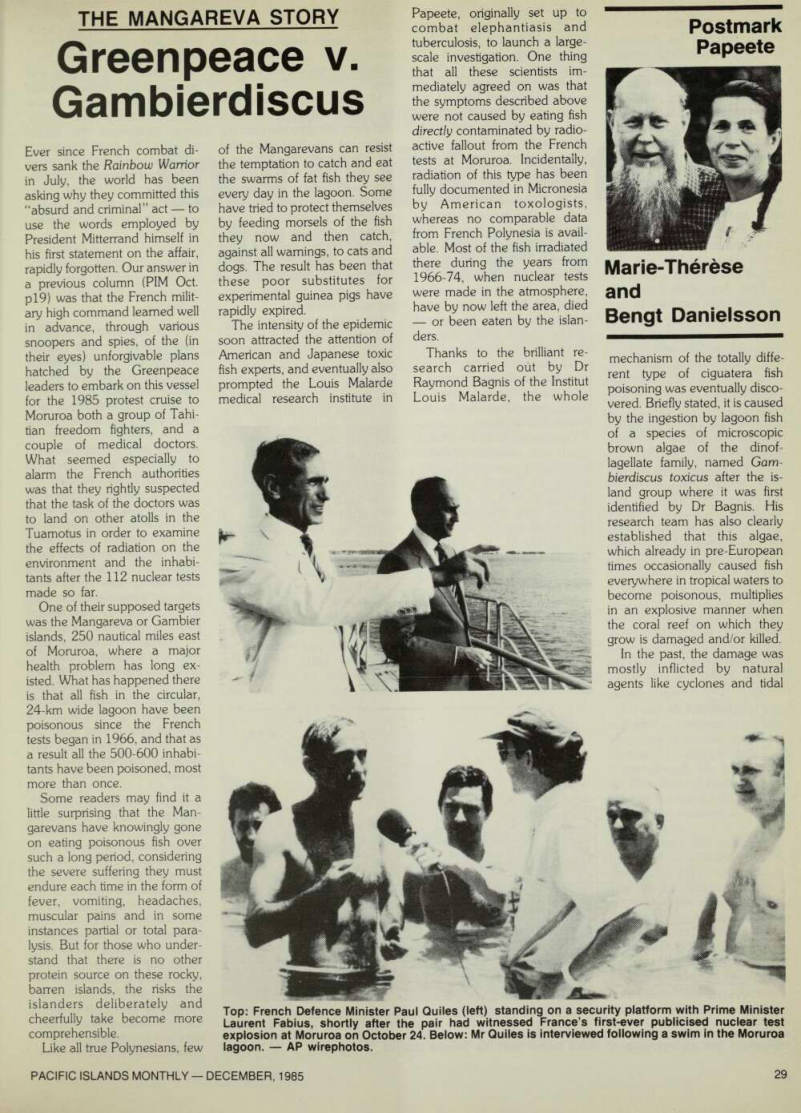
Top: French Defence Minister Paul Quiles (left) standing on a security platform with Prime Minister Laurent Fabius, shortly after the pair had witnessed France’s first-ever publicised nuclear test explosion at Moruroa on October 24. Below: Mr Quiles is interviewed following a swim in the Moruroa lagoon. - AP wirephotos.
waves. But with the advent of Europeans, the destruction is mostly wrought by dredging, dumping, dynamiting, sewage and waste disposal. An iron ship wrecked on a reef is also a powerful coral killer.
The question that from the beginning was uppermost in our minds was therefore: Who polluted the Mangareva la goon? The inhabitants unhesi tatingly singled out the CEP army bombers as the sole cul prits, and complained bitterly along these lines to the few French governors and adminis trators who cared to visit the remote and isolated islands. To no avail. And when these offi cial visits were reported in our French-language newspapers, the stories were exclusively about the friendly and hospit able Mangarevans, and the wonderfully warm reception they gave their beloved French masters.
We denounced this conspira cy of silence several years ago in these columns (PIM Nov ’Bl, p 22), and pointed out, among other things, the disastrous effects on the health of the islanders from such sources of contamination as radio-active fallout, the frequent discharges from warships, and the dum ping by the CEP of contamin ated material in the Mangareva lagoon.
We repeated the gist of our revelations and accusations during the International Coral Reef Congress held in Tahiti at the end of May this year (PIM Aug p 7), when a special semi
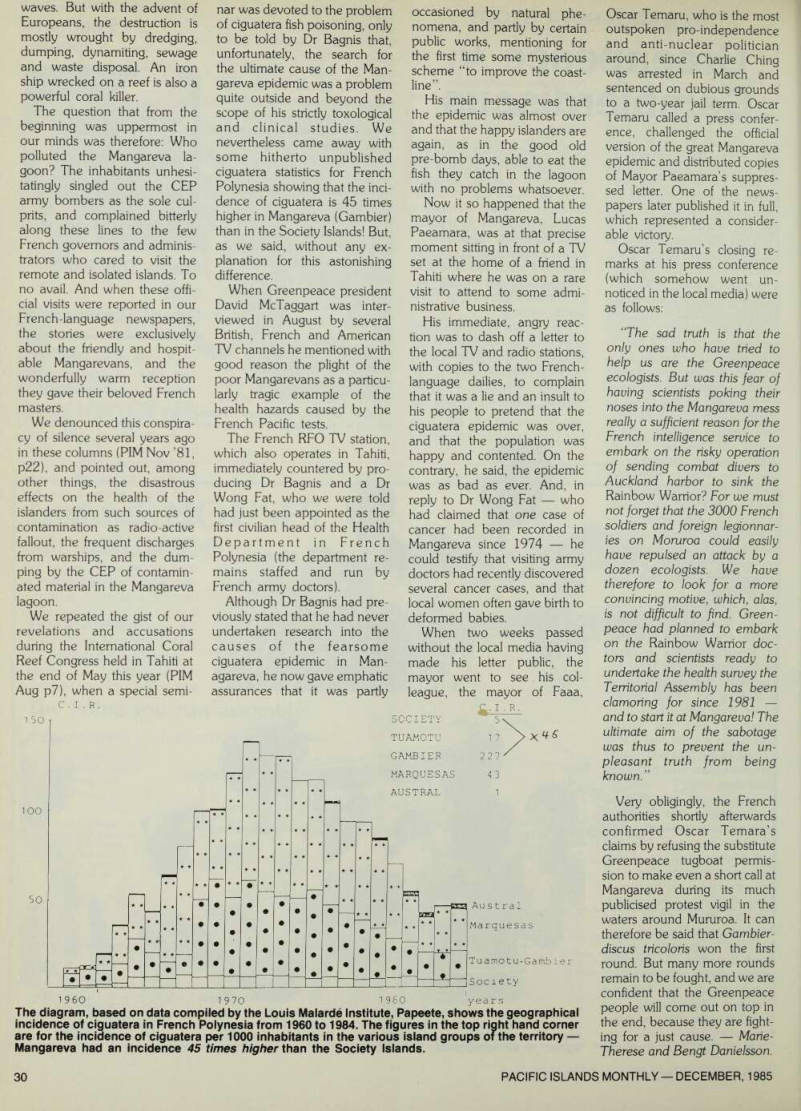
nar was devoted to the problem of ciguatera fish poisoning, only to be told by Dr Bagnis that, unfortunately, the search for the ultimate cause of the Man gareva epidemic was a problem quite outside and beyond the scope of his strictly toxological and clinical studies. We nevertheless came away with some hitherto unpublished ciguatera statistics for French Polynesia showing that the inci dence of ciguatera is 45 times higher in Mangareva (Gambier) than in the Society Islands! But, as we said, without any ex planation for this astonishing difference.
When Greenpeace president David McTaggart was inter viewed in August by several British, French and American TV channels he mentioned with good reason the plight of the poor Mangarevans as a particu larly tragic example of the health hazards caused by the French Pacific tests.
The French RFO TV station, which also operates in Tahiti, immediately countered by pro ducing Dr Bagnis and a Dr Wong Fat, who we were told had just been appointed as the first civilian head of the Health Department in French Polynesia (the department re mains staffed and run by French army doctors).
Although Dr Bagnis had pre viously stated that he had never undertaken research into the causes of the fearsome ciguatera epidemic in Man agareva, he now gave emphatic assurances that it was partly
occasioned by natural phe nomena, and partly by certain public works, mentioning for the first time some mysterious scheme “to improve the coast line”.
His main message was that the epidemic was almost over and that the happy islanders are again, as in the good old pre-bomb days, able to eat the fish they catch in the lagoon with no problems whatsoever.
Now it so happened that the mayor of Mangareva, Lucas Paeamara, was at that precise moment sitting in front of a TV set at the home of a friend in Tahiti where he was on a rare visit to attend to some admi nistrative business.
His immediate, angry reac tion was to dash off a letter to the local TV and radio stations, with copies to the two French language dailies, to complain that it was a lie and an insult to his people to pretend that the ciguatera epidemic was over, and that the population was happy and contented. On the contrary, he said, the epidemic was as bad as ever. And, in reply to Dr Wong Fat who had claimed that one case of cancer had been recorded in Mangareva since 1974 he could testify that visiting army doctors had recently discovered several cancer cases, and that local women often gave birth to deformed babies.
When two weeks passed without the local media having made his letter public, the mayor went to see his col league, the mayor of Faaa,
Oscar Temaru, who is the most outspoken pro-independence and anti-nuclear politician around, since Charlie Ching was arrested in March and sentenced on dubious grounds to a two-year jail term. Oscar Temaru called a press confer ence, challenged the official version of the great Mangareva epidemic and distributed copies of Mayor Paeamara’s suppres sed letter. One of the news papers later published it in full, which represented a consider able victory.
Oscar Temaru’s closing re marks at his press conference (which somehow went un noticed in the local media) were as follows: ‘The sad truth is that the on/y ones who have tried to help us are the Greenpeace ecologists. But was this fear of having scientists poking their noses into the Mangareva mess really a sufficient reason for the French intelligence service to embark on the risky operation of sending combat divers to Auckland harbor to sink the Rainbow Warrior? For we must not forget that the 3000 French soldiers and foreign legionnar ies on Moruroa could easily hove repulsed an attack by a dozen ecologists. I Me have therefore to look for a more convincing motive, which, alas, is not difficult to find. Green peace had planned to embark on the Rainbow Warrior doc tors and scientists ready to undertake the health survey the Territorial Assembly has been clamoring for since 1981 and to start it at Mangareva! The ultimate aim of the sabotage was thus to prevent the un pleasant truth from being known.”
Very obligingly, the French authorities shortly afterwards confirmed Oscar Temara’s claims by refusing the substitute Greenpeace tugboat permis sion to make even a short call at Mangareva during its much publicised protest vigil in the waters around Mururoa. It can therefore be said that Gambier discus tricoloris won the first round. But many more rounds remain to be fought, and we are confident that the Greenpeace people will come out on top in the end, because they are fight ing for a just cause. Marie- Therese and Bengt Danielsson.
The diagram, based on data compiled by the Louis Malardé Institute, Papeete, shows the geographical incidence of ciguatera in French Polynesia from 1960 to 1984. The figures in the top right hand corner are for the incidence of ciguatera per 1000 inhabitants in the various island groups of the territory- Mangareva had an incidence 45 times higher than the Society Islands.