Aust's Ansett
pp. 31-33 · Read in the full issue

trade winds
New Airline Venture
Cook Is. links with Aust's Ansett
Ansett Transport Indus tries of Australia has added a third Pacific Island country, the Cook Islands, to the list of those with which it has agreements to operate regional, international airlines.
Prime Minister Sir Thomas Davis announced in October that Cabinet had approved the deal and expected the first service to take place in March or April, 1986. Ansett’s man agement in Melbourne has similarly announced that it had been approached by the Cook Islands government and that it had offered a management arrangement similar to that undertaken for Western Samoa with Polynesian Airlines.
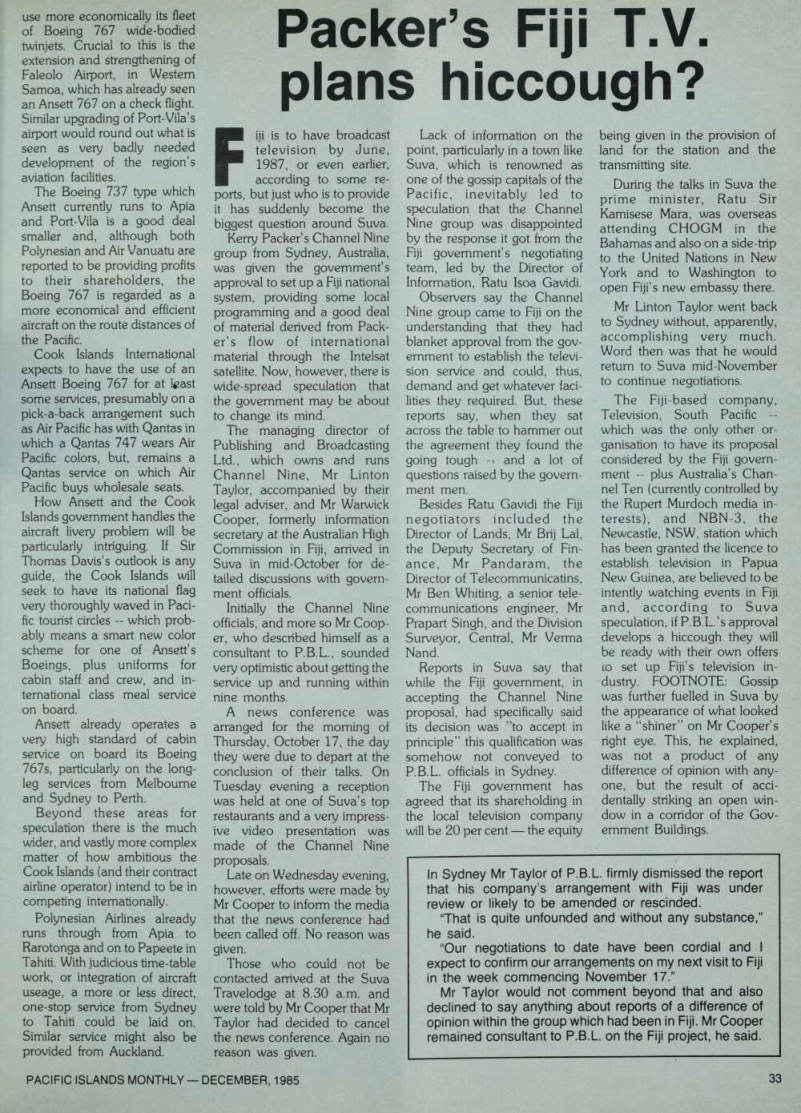
No other details of the con tract have been announced but it appears to involve Ansett in providing aircraft (most likely a Boeing 767 wide-bodied twin jet), plus crews and manage ment expertise. Provision of know-how may even extend to ground facility management, at Rarotonga and Aitutaki.
Ansett’s experts are therefore expected to provide senior staff for the new Cook Islands Air port Authority at both ports, replacing New Zealand Civil Aviation Department personnel due to leave in the wake of the recent hand-over by the New Zealand government of such responsibilities to the Cook Is lands government.
No name has yet been publicly aired for the new com pany but a good bet is consi dered to be Cook Islands In ternational Airlines C.1.1.A.
Announcements so far indi cate opening of direct, non-stop
services between Sydney and Rarotonga, aiming at boosting Cook Islands burgeoning tourist trade but, presumably, they would also operate between Rarotonga and New Zealand.
This would take them into direct competition with Air New Zealand, a matter to which prime minister Davis referred somewhat obliquely in his Cabinet statement when he ex pressed the hope that the New Zealand line would cooperate fullly with the Cook Islands newcomer.
While Ansett is being very reticent about its plans, the company’s interest in the Paci fic is well-established and, with
the contract to the Cooks com pleted, will be significantly boosted.
Ansett owns 49 per cent of Air Vanuatu in partnership with the national government, and operates Polynesian Airlines on a contract with the government of Western Samoa.
One of the more intriguing questions now being asked by aviation industry observers is how far Ansett will be able to link-up or integrate its network of Pacific regional flights. In dustry observers say this is possible, and even desirable, in the interests of rationalising the present rather untidy and very
expensive airline system in the south-west Pacific.
Ansett has always shown very keen interest in the con cept of an integrated airline service for the Pacific and was a major, and very aggressive, contender for the right to oper ate Fiji’s Air Pacific, biggest of the islands region’s national flag-carriers. Losing that race to Qantas, which signed a three year management contract with the Fiji government, was a bitter pill for Ansett, the taste of which still lingers, but which the con tract with the Cook Islands will help remove.
Sir Thomas said it was “en visaged that as far as possible the present Ministry of Trans port staff will be as they are now, and it is hoped that there will be as little staff disruption as possible as a result of the change-over.”
He said Air New Zealand was expected to maintain its present frequency of services with both Boeing 747 Jumbo and 737 twinjet aircraft. He hoped that Air New Zealand could cooper ate with the Cook Islands airline when the agreement came into force in April. ”1 am sure that the tourism boom which is taking place in the Pacific will allow us all to share in the market profitably , especially if we cooperate with one another in all aspects of the trade,” he said. The arrange ment with Ansett would give the Cook Islands opportunities in a wide range of ventures.
Aviation industry observers suggest that one of the ele ments in Ansett’s continued interest in the region is the chance to widen its base and
Reaching for the Pacific skies: When Cook Islands International Airlines takes off it will likely be with one of these Ansett-owned Boeing 767 wide-bodied twin jets.
use more economically its fleet of Boeing 767 wide-bodied twinjets. Crucial to this is the extension and strengthening of Faleolo Airport, in Western Samoa, which has already seen an Ansett 767 on a check flight.
Similar upgrading of Port-Vila’s airport would round out what is seen as very badly needed development of the region’s aviation facilities.
The Boeing 737 type which Ansett currently runs to Apia and Port-Vila is a good deal smaller and, although both Polynesian and Air Vanuatu are reported to be providing profits to their shareholders, the Boeing 767 is regarded as a more economical and efficient aircraft on the route distances of the Pacific.
Cook Islands International expects to have the use of an Ansett Boeing 767 for at least some services, presumably on a pick-a-back arrangement such as Air Pacific has with Qantas in which a Qantas 747 wears Air Pacific colors, but, remains a Qantas service on which Air Pacific buys wholesale seats.
How Ansett and the Cook Islands government handles the aircraft livery problem will be particularly intriguing. If Sir Thomas Davis’s outlook is any guide, the Cook Islands will seek to have its national flag very thoroughly waved in Paci fic tourist circles which prob ably means a smart new color scheme for one of Ansett’s Boeings, plus uniforms for cabin staff and crew, and in ternational class meal service on board.
Ansett already operates a very high standard of cabin service on board its Boeing 7675, particularly on the long leg services from Melbourne and Sydney to Perth.
Beyond these areas for speculation there is the much wider, and vastly more complex matter of how ambitious the Cook Islands (and their contract airline operator) intend to be in competing internationally.
Polynesian Airlines already runs through from Apia to Rarotonga and on to Papeete in Tahiti. With judicious time-table work, or integration of aircraft useage, a more or less direct, one-stop service from Sydney to Tahiti could be laid on.
Similar service might also be provided from Auckland.