Pacific Conference?
pp. 27-28 · Read in the full issue

the month
What ails the South Pacific Conference?
My feeling is that the South Pacific Com mission is certainly becoming a more set tled organisation. This is clear its work programs are of high value, and are generally re garded as being very com petently done.
However, in a way it has become a victim of its own past.
In its time it has generated a great deal of excitement, going back to Ratu Mara’s remarks, at Lae in 1965, about the need to reform the organisation.There fore, there has been a certain expectation that it will continue to provide a kind of stimulation which I don’t think that people necessarily want. In other words, the kind of development issues addressed by the SPC probably will not be the object of the kind of agitation stirred up over the last 20, or especial ly 10, years, as the debate has developed with regard to the SPC’s continuance or rele vance.
Having said that, it is also a matter of concern for the secre tariat and the member countries to ensure that the conference does not settle into being a rubber-stamp for merely techni cal programs. I say that for several reasons. The first reason is that development-related issues remain a very high, if not the first, priority in the South Pacific region. These, therefore, should be subjected to the careful and considered scrutiny of member countries.
Second, the conference does involve an entire region in a way which no other body has done, and so it is perhaps regrettable that those territories that are excluded from other regional associations lose out
The annual South Pacific Conference held in Honiara, Solomon Islands, in September-October, produced negative reactions in some quarters, notably from Fiji’s Deputy Prime Minister, Ratu David Toganivalu. In this article Dr RICHARD HERR, of the University of Tasmania, who has made a special study of the conference and its parent, the South Pacific Commission, describes what he thinks has gone wrong, and the grounds for hoping it can be put right.
on the cut and thrust of regional debate by virtue of this having been lost at the conference. In other words, If the territories that do not have access to discussions of regional priorities in the South Pacific Forum, the South Pacific Bureau for Eco nomic Co-operation (SPEC), the Forum Fisheries Agency (FFA), and the Committee for Co-ordination of Joint Prospec ting for Mineral Resources in South Pacific Offshore Areas (CCOP/SOPAC), miss out en tirely, this will not be good for
them, nor for the other states involved, because, apart from anything else, they lose some of the fratneral links they have forged in the past through the conference.
A third consideration is that the conference involves large numbers of observers, who are again assembled from a wider group than other meetings pro vide. They have greater range and diversity in focusing on development issues in the South Pacific. The conference has offered members of the
South Pacific area the opportunity to offer comment, and to some extent pass judg ment, on the work done by bodies represented by these observers, or sometimes on the work they are not doing. Not always on the floor of the conference, but in private, it allows these representatives to explain the position of their organisations, or that of their governments, so that a better understanding emerges on both sides.
For these and other reasons it is important that the conference enjoys a senior level of political representation from its member governments. In the past, the conference has sought and facilitated the attendance of senior government representa tives by shortening the working period of the conference. (In 1976 Dr Herr and Josua Cavalevu formed a two-man panel to review the functions of the SPC. At that time the conference working period was cut from two weeks to one.
There was a demand to reduce the amount of technical material coming before the con ference by treating more of the technical matters in the commit tees, and the panel developed a special period within the confer ence for discussion around identified themes PIM.) It appears to me that the weakness that has emerged centres primarily on the use of themes in the conference. One result of this is that the themes have often not served as a catalyst for general discussion, as was originally hoped. It may be also that too much work has been identified as technical, and referred to committees.
I think in looking at the most
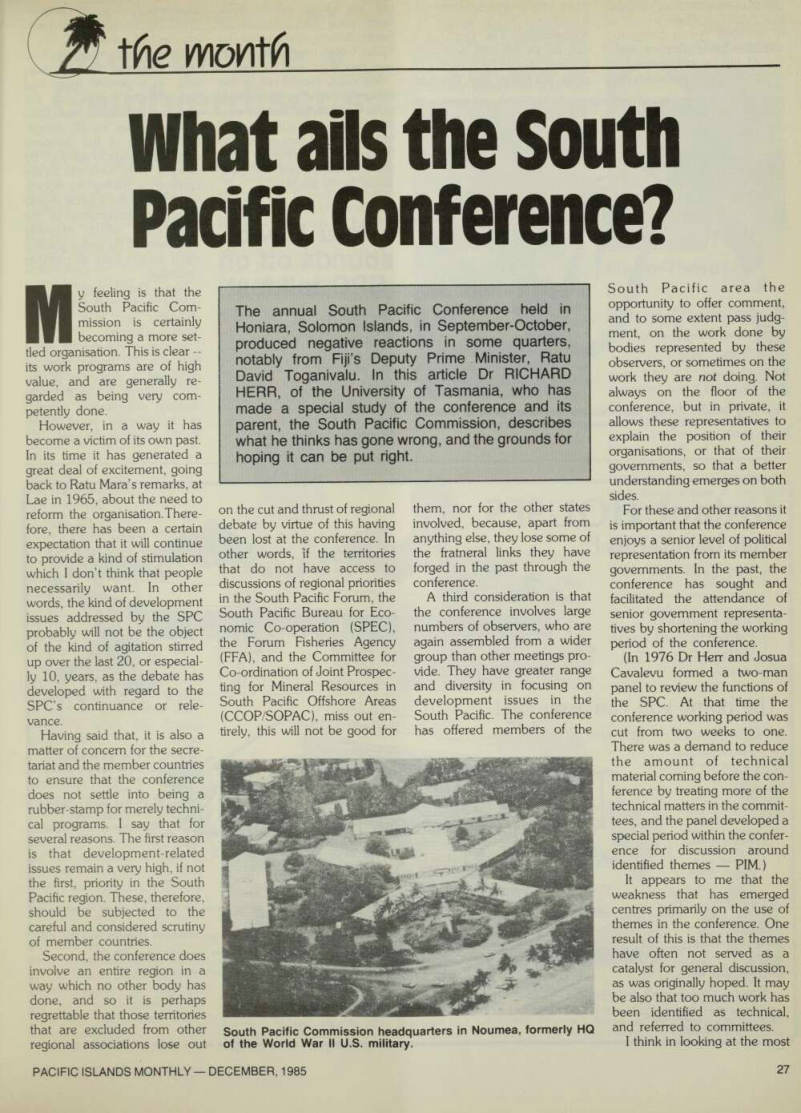
South Pacific Commission headquarters in Noumea, formerly HQ of the World War II U.S. military.
recent conference, however, one should recognise a number of features before being too critical. The conference really should not be embarrassed by its own success in establishing a
more regular and accepted ad ministration of its serious re sponsibilities. The fact that it can do its job with less con troversy should be a matter of pride, not regret. Also, through-
out the history of the SPC, there have been periods of hectic activity, succeeded by cycles where much less energy was expended.
We really should not be too concerned sbout one relatively quiet and straightforward con ference although quite clearly if too many conferences were to become too somnolent both the conference and the SPC would be in trouble.
Ratu David
sounds off on
SPC talkfest
Dissatisfaction in the region with the performance of the South Pacific Commission was sharply marked by the deputy prime minister of Fiji, Ratu David Toganivalu, upon his return from the Honiara confer ence. He said the annual con ference had become simply an
expensive ’’rubber stamp exer cise”. The agenda for the meet ing “lacked substance.”
The annual talkfest had lasted only two days this year, and ”in a general sense had only limited value for the people of the Pacific,” said Ratu David who led the Fiji delega tion. “Many of the decisions had been made in advance by officials. They were put to the conference merely for appro val. ”He said the agenda should reflect the importance of the conference, which normally was attended by senior govern ment leaders from all member countries.
Ratu David said he had voiced his dissatisfaction among delegates and had received “strong support.”
However, despite his critic ism, the Fiji leader said he remained a supporter of the SPC concept. It was the only regional organisation catering to the interests of all South Pacific countries, he said.
Incoming South Pacific Commission secretary-general Palauni Tuiasosopo ... dangers in “too somnolent” conferences. - Stuart Inder photo.