AUSSAT ingredient thickens
pp. 31-33 · Read in the full issue

trade winds
AUSSAT ingredient thickens the communications broth
Australia’s domestic
satellite system, AU SSAT, may also be used to improve domestic and regional com munications services in the Pacific islands by the end of 1986.
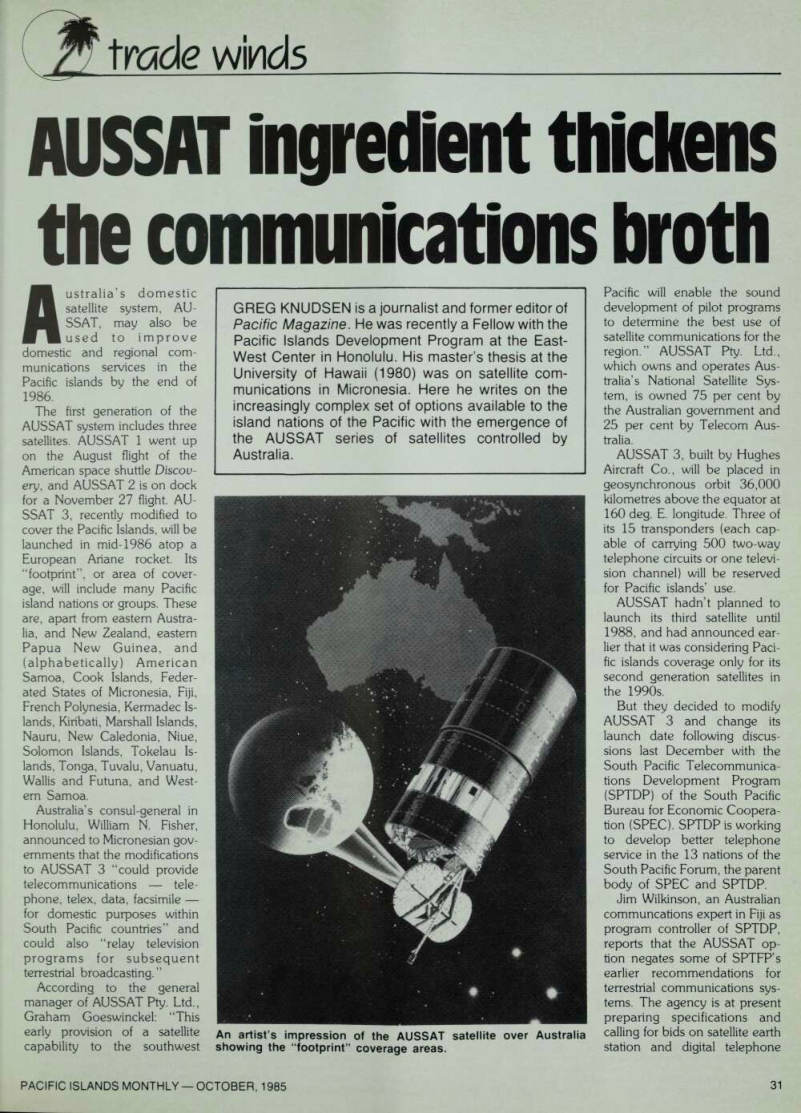
The first generation of the AUSSAT system includes three satellites. AUSSAT 1 went up on the August flight of the American space shuttle Discov ery, and AUSSAT 2 is on dock for a November 27 flight. AU SSAT 3, recently modified to cover the Pacific Islands, will be launched in mid-1986 atop a European Ariane rocket. Its “footprint”, or area of cover age, will include many Pacific island nations or groups. These are, apart from eastern Austra lia, and New Zealand, eastern Papua New Guinea, and (alphabetically) American Samoa, Cook Islands, Feder ated States of Micronesia, Fiji, French Polynesia, Kermadec Is lands, Kiribati, Marshall Islands, Nauru, New Caledonia, Niue, Solomon Islands, Tokelau Is lands, Tonga, Tuvalu, Vanuatu, Wallis and Futuna, and West ern Samoa.
Australia’s consul-general in Honolulu, William N. Fisher, announced to Micronesian gov ernments that the modifications to AUSSAT 3 “could provide telecommunications tele phone, telex, data, facsimile for domestic purposes within South Pacific countries” and could also “relay television programs for subsequent terrestrial broadcasting. ”
According to the general manager of AUSSAT Pty. Ltd., Graham Goeswinckel: “This early provision of a satellite capability to the southwest
GREG KNUDSEN is a journalist and former editor of Pacific Magazine. He was recently a Fellow with the Pacific Islands Development Program at the East- West Center in Honolulu. His master’s thesis at the University of Hawaii (1980) was on satellite com munications in Micronesia. Here he writes on the increasingly complex set of options available to the island nations of the Pacific with the emergence of the AUSSAT series of satellites controlled by Australia.
Pacific will enable the sound development of pilot programs to determine the best use of satellite communications for the region.” AUSSAT Pty. Ltd., which owns and operates Aus tralia’s National Satellite Sys tem, is owned 75 per cent by the Australian government and 25 per cent by Telecom Aus tralia.
AUSSAT 3, built by Hughes Aircraft Co., will be placed in geosynchronous orbit 36,000 kilometres above the equator at 160 deg. E. longitude. Three of its 15 transponders (each cap able of carrying 500 two-way telephone circuits or one televi sion channel) will be reserved for Pacific islands’ use.
AUSSAT hadn’t planned to launch its third satellite until 1988, and had announced ear lier that it was considering Paci fic islands coverage only for its second generation satellites in the 19905.
But they decided to modify AUSSAT 3 and change its launch date following discus sions last December with the South Pacific Telecommunica tions Development Program (SPTDP) of the South Pacific Bureau for Economic Coopera tion (SPEC). SPTDP is working to develop better telephone service in the 13 nations of the South Pacific Forum, the parent body of SPEC and SPTDP.
Jim Wilkinson, an Australian communcations expert in Fiji as program controller of SPTDP, reports that the AUSSAT op tion negates some of SPTFP’s earlier recommendations for terrestrial communications sys tems. The agency is at present preparing specifications and calling for bids on satellite earth station and digital telephone
An artist’s impression of the AUSSAT satellite over Australia showing the “footprint” coverage areas.
exchange equipment. SPTDP has also begun negotiations with AUSSAT on satellite leas ing charges. Regular commer cial rates are based on SA2.I million per year for non-pre emptible use of a 12-watt trans ponder with national or south east Australia spot beam cover age. Hourly rates range from $4OO-$ 1000. But Mr Wilkinson hopes to win considerable con cessions for Pacific island users.
PNG plans own
satellite system
Papua New Guinea and an American company plan to launch three satellites for domestic and regional com munications in 1988 or 1989.
The former Australian de pendency was originally co vered by a spot beam in the AUSSAT system, but the PNG Government declined the service in favor of this venture.
TRT Communications of Washington, DC, and PNG have formed Pacific Satellites Inc. Using PNG’s national satel lite waveband rights, the com pany has filed with the In ternational Frequency Registra tion Board of the International Telecommunication Union to establish a Pacific Basin satellite system called PACSTAR.
Using two Hughes satellites in operation and one orbiting spare, PACSTAR plans to cov er PNG, Fiji, Solomon Islands, Japan, and Southeast Asia with one satellite, and Hawaii, Cali fornia, and French Polynesia with another.
The hybrid satellites will use both C-band and Ku-band fre quencies. The 4/6 GHz C-band operates with less interference from heavy rainfall and will primarily serve the island na tions. The Pacific Rim users will primarily use the 11/12/14 GHz Ku-band (AUSSAT uses Ku band only).
Can television
be far behind?
The new satellite options have enlivened debate on television services in several island na
tions. If one of the islands’ three transponders on AUSSAT is used to relay television prog rams, an unprecedented degree of inter-governmental co operation will be needed to co-ordinate a single regional televison network.
The question of whether or not to even allow television is practically moot as video-cas sette recorders have infiltrated the islands. In Fiji, with an estimated 50-60,000 VCRs and 650,000 people, the govern ment is particularly concerned with the quality of the programs
available on cassettes and their inability to control the trade.
In addition, several Austra lian and U.S. companies, not ably Channel Nine of Sydney (PIM May 1985), are trying to sell satellite-delivered packages of bulk television programs in countries such as Fiji, Tonga, Cook Islands, Western Samoa, Solomon Islands, Vanuatu, and Papua New Guinea. The PNG government had promised to begin such a television service during 1985 as one way to mark their 10th anniversary of independence.
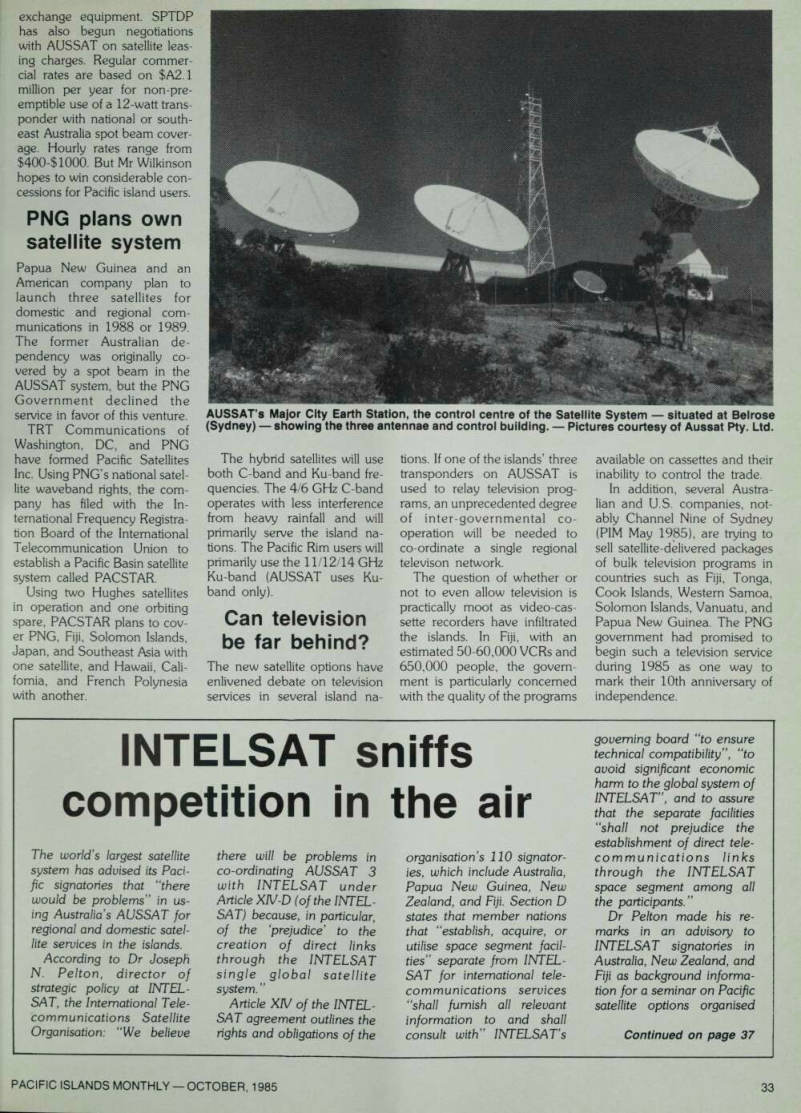
AUSSAT’s Major City Earth Station, the control centre of the Satellite System - situated at Belrose (Sydney) - showing the three antennae and control building. - Pictures courtesy of Aussat Pty. Ltd.