Jeff Heath, crusader
pp. 29-30 · Read in the full issue
in a wheelchair
Very little is known about what is happening in the Pacific region regarding help for handi capped people at least this is what Jeff Heath and his wife Heather found when they de cided to come to the Pacific.
Jeff, a paraplegic resulting from a bone tumor he suffered when he was seven, was naturally interested to know what the situation was in this part of the world. Professionals had told him there were no formal pro grams and organisations.
Jeff is 29 and has been married for only five months.
From South Australia, he has a BA degree in recreation, and has been employed by the South Australian Government for five years advising them on the employment of disabled people. He was the Australian delegate to the Disabled People’s International Confer ence during the Year Of The Disabled, and returned to form a state branch in South Austra lia where he serves as vice president. In 1984 he worked
Apia Calling
to organise an international convention for the disabled for Asia and the Pacific. At the convention it was apparent that there was a lot of material for the Asian and Latin American areas, but virtually nothing on the Pacific.
The aim of Jeffs trip to 10 different Pacific countries is to document the range of services for the handicapped available to local people. The report will be widely circulated over the next two to three years, and can then be used as a cross-refer ence within the area.
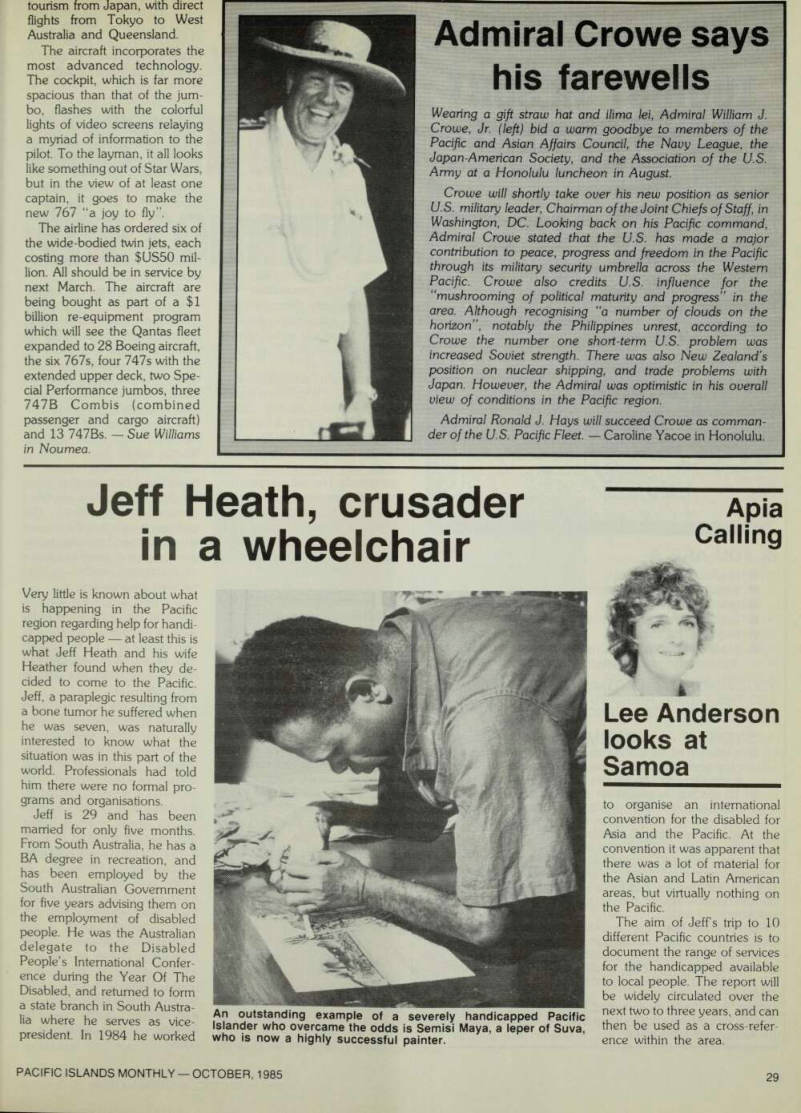
An outstanding example of a severely handicapped Pacific Islander who overcame the odds is Semisi Maya, a leper of Suva, who is now a highly successful painter.
Lee Anderson looks at Samoa
WVll Ul A !VULI IVI 1 lUVO the bulk of their expenses, and estimate the final cost of the trip to them at around $15,000.
However, Jeff says the result to date has been rewarding. Many disabled people in the region have been amazed to see him, a disabled person, travelling around in a wheelchair, married and with a job, and this has raised many questions as to the role of the disabled in society.
Jeff hopes the experience will help to change the attitude of disabled people towards them selves, as well as the attitudes of their families and the public.
When Jeff arrives in a new country he makes contact with the disabled association. He then gives talks illustrated with slides to encourage disabled people to get out and about, as well as introducing fresh ideas and alternatives.
Associations are interested in just how Jeff copes with travel ling. He has a special wheel chair with clips for a rucksack and wide rear wheels for travel on loose surfaces. The wheel chair can also be used as a commode. He said that psycho logically one must not mind being manhandled into aircraft and up stairs. All medicines required by him are mailed ahead. This was pre-arranged in Australia.
During Jeff s travels he has found that there are hardly any government programs for the disabled, and that most pro grams are run by the private sector. He plans to present his findings at the World Confer ence for the Disabled to be held in the Bahamas later this year.
The Western Samoan So ciety for the Intellectually Handicapped was keenly in terested in what Jeff had to say when he visited them in August.
This organisation is an example of just what can be done by the private sector. Marita Wendt, president of the association, said that the group had started five years ago and was only one of two such groups dealing with intellectually handicapped chil dren in Western Samoa. The group started without govern ment aid, but did get help from the Asia/Pacific Action Commit tee who paid a teacher’s salary for three years. The association applied to the Samoan Govern ment for land but nothing suit able was offered. Despite early setbacks the association today
IIQO dliu owns its own three-bedroom house on half an acre of land.
The home is used as a centre for the Association, and will also provide accommodation for people coming for training as well as providing room for older handicapped members to learn cooking, sewing, etc.
The association covers its costs by fund-raising activities and usually plans two main functions each year, netting around 5000 tala at each func tion. This money is tax-free.
Their next aim is to generate income by raising chickens, growing vegetables, and pro ducing handicrafts.
Marita said the aim of the association is to show that the children are teachable and can be productive, a new idea for Western Samoa. One problem, she added, is that there are many handicapped children hidden away in villages, espec ially in Savai’i, the larger but less developed of Western Samoa’s two main islands.
Marita would like to see a similar association started in Savai’i and believes that many handicapped children are often removed to this island. The problem here is that the villages are remote, and the association does not have adequate funds or volunteers needed to start such an organisation.
The next aim of the associa tion is to buy a car so as to be able to provide a pick-up and delivery service, as many par ents of handicapped children cannot afford daily bus fares to the centre.
Marita is now helping to plan the first Pacific Islands Confer ence for Non-Governmental Organisations for the Handi capped to be held in Western Samoa in early October. The conference is being funded by the Asia-Pacific Action Commit tee. Its aim is to bring Pacific organisations together to leam from each other and to organise teacher training programs.
Fiji and Tonga have had more aid for the handicapped than other Pacific island na tions, whereas Tuvalu is just starting such a program. Rather than waste money on mistakes already made in earlier pro grams, Marita feels that it is vital to start sharing information and experiences across national borders. Lee Anderson in Apia.