in the Greenpeace affair
pp. 19-21 · Read in the full issue
Shades of a Greene piece in the Greenpeace affair
We have always felt that Graham Greene’s hilarious novel, Our Man in Havana, about a British vacuum cleaner sales man who was mistaken for a master spy, strains the reader’s credulity with some of its more improbable episodes. How ever, having recently been caught up in a completely for tuitous manner in the fancy spy net being woven around the bombed Greenpeace ship, Rainbow Warrior, we feel in clined to apologise to Mr Greene for our scepticism.
As this short account will show, it is indeed possible, in the real world, to be allotted a key role in a grotesque adven ture fantasy properly belonging in the realm of political fiction.
As we sit here at our desk in our Tahitian home, we have in front of us the freshly released report of the official French investigator of the affair, Ber nard Tricot, which surely rep resents the biggest job of politi cal whitewashing since the Watergate scandal. To all people in their right minds (and to judge from the newspaper
reports on our desk, they are happily in the majority), it is obvious that the French intelli gence service did not send a squad of husky army frogmen and expert bomb handlers with only a rudimentary knowledge of English to New Zealand simply to observe and make notes, as the French defence ministry pretends. The big question, still unanswered at the time of writing, is therefore not who did it, but why French agents committed this act of sabotage which can only stiffen opposition in the Pacific region to the nuclear tests at Moruroa.
After the many revelations, both intentional and otherwise, made in the French media this last month, there is no doubt in our minds that the explanation can be found in the alarm felt in government and military circles in Paris at the announcement, at the beginning of the year, of the new twist the Greenpeace directors planned to give their 1985 anti-nuclear cruises in the Pacific. To begin with, the crew was to include not only the usual bunch of “long-haired pacifists”, deemed harmless, but also several medical doctors
with the necessary equipment to examine the Marshall and Tuamotu islanders likely to have been contaminated.
Moreover, several wellknown Tahitian independence fighters and and-nuclear church leaders were ready and willing to join the Rainbow Warrior in Auckland to take part in the protest cruise in the direction of Moruroa. Since they were French citizens it would not have been legally possible to deny them access and toss them out of French Polynesia which had been the usual fate of foreign anti-nuclear intruders in the past. So any attempt to stop the Rainbow Warrior from reaching Moruroa had to be made in Auckland.
Although the undercover agents of the French DGSE intelligence service are widely known as barbouzes. due to their theatrical habit of growing beards, or hiding behind false ones, the advance scout dispatched to Auckland in April was a quite beardless woman in her early 30s, posing as a geographer, and armed with a false passport in the name of
Frederique Bonlieu. Her main tasks were to infiltrate the NZ Greenpeace movement, map the harbor area, and find suit able 1 , 0d 9 in 9 s for the more masculine and muscular beav ers who were to follow, On her way back to France, Frederique stopped over in Tahiti in the last week of May to do a little snooping among us local opponents of the French tests. To give credence to her disguise as a scientist, she regis tered at the Coral Reef Con gress which was then being held here (PIM Aug., p 7), although it soon became clear to us and to other participants that she knew next to nothing about the scientific problems under discussion. She must have . been particularly dis apP°mted wlth ‘he most compromising documents we handed over to her ’ when she , Came D to , see , us ' w f e co P'“ of our Postm3rk 3rt,cles ,n PIM On the other hand, there is every reason to believe that she was more cordially received by the numerous local barbouzes, and the snoopers from the Thought Police (Renseigne-
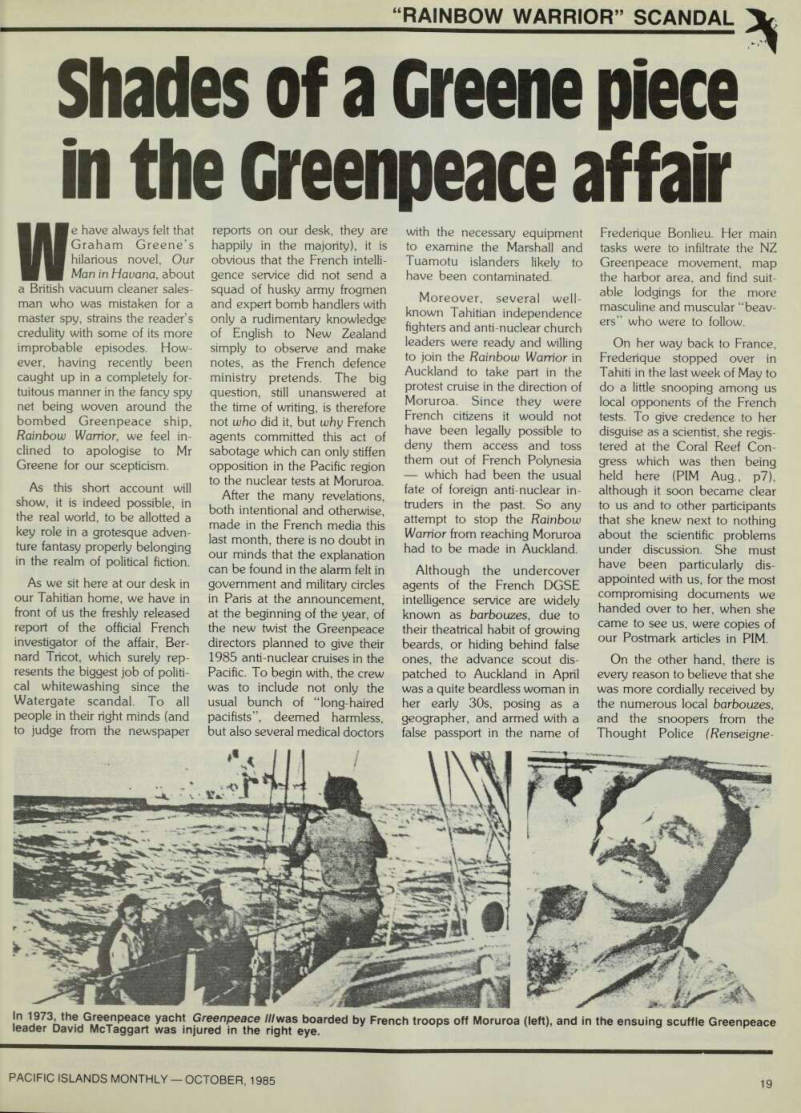
In 1973, the Greenpeace yacht Greenpeace /// was boarded by French troops off Moruroa (left), and in the ensuing scuffle Greenpeace leader David McTaggart was injured in the right eye.
ments Generaux) who keep a close watch and a file on all residents who dare to exercise their constitutional right to criti cise government policies for instance, the nuclear tests, and colonial rule.
We had already almost for gotten the visit of “Frederique” when we heard on July 10 the incredible news of the bombing of the Rainbow Warrior, which immediately sent shock waves around the world. The promin ent part played by “Frederi que” as mole and co-ordinator of the sabotage was confirmed by her sudden disappearance.
Gone also were her DGSE frogmen colleagues, who had sailed to New Zealand from Noumea on the chartered yacht Ouvea. This officially announced “disappearance” meant only, of course, that they had been told by their superiors to go into smoke. While “Frederique” had flown straight home to her headquarters in Paris from Tahiti, the yachts-
men were probably picked up at sea by the French nuclear powered submarine Rubis, taken to Moruroa, and flown from there by military aircraft to France.
At any rate this is where they were interviewed by the special investigator, General de Gaul le’s old offsider, Bernard Tricot, who was so struck by their honest air that he completely exonerated them in his short, 29-page, report on the affair. As for poor “Frederique”, whose
real name turned out to be Christine Cabon, all Monsieur Tricot has to say about her is that she was still so shaken and fearful following all her danger ous undercover activities that, out of compassion, he decided not to interrogate her at all.
By this time the French mass media were full of the wildest spy stories, most of them con cocted in Paris on the basis of the flimsiest imaginable data.
The most popular one “re vealed” that the real culprits
were British agents-pro vocateurs, who had cleverly strewn the beaches around Au ckland with all sorts of in criminating stuff marked
“Made In France”. Their
motive: to get even with the French for their sale of Exocet rockets to Argentina during the Falklands war!
But we were still somewhat taken aback when the widely read weekly Le Point let out the long-kept secret that the great est foreign pirate of all was “the Swedish ecologist and longtime resident of Tahiti, Bengt Danielsson, who had organised an invasion of Moruroa, to be carried out by the inhabitants of neighboring atolls with the help of small paddle canoes and dinghies. ” How had the not so intelligent French secret service, which had never been able to discover what its own agents were doing, managed to unveil this terrific plot? Very simple, said the author of this sensatio
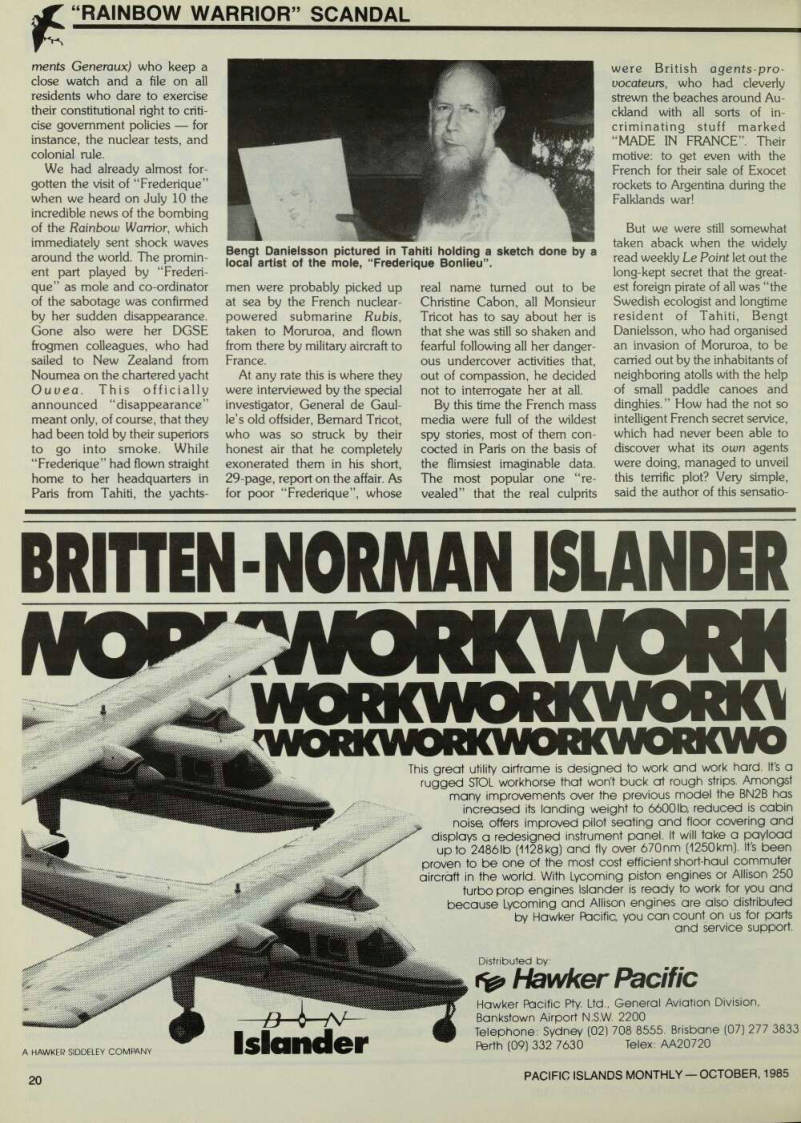
Bengt Danielsson pictured in Tahiti holding a sketch done by a local artist of the mole, “Frederique Bonlieu”.
nal story. “Frederique’s” bar bouze colleagues in Tahiti had been opening our mail, a very common and praiseworthy practice when national security is at stake. The obvious conclu sion was that they had also leaked the story to the gullible journalist who wrote the story.
A few days later the local TV channel provided additional evidence of how fear of Polyne sian participation in the Green peace protest cruises had grown to obsessive proportions among French officials. It screened a film which, accor ding to the commentary, showed “Polynesians from the atolls around Moruroa embar king on the Rainbow Warrior to take part in an invasion of the nuclear base”.
Although we realised how impossible it is to destroy a legend in the grand Arthurian tradition, we sent a spirited rebuttal of the whole story to Le Point, in which we pointed out: 1) that the “documentary” film shown on TV had been shot in May in the Marshall Islands by a French cameraman who had (perhaps unwisely) been allowed to participate in the first leg of the Rainbow Warrior cruise; 2) that consequently the islanders involved were not Polynesians from the atolls sur rounding Moruroa, but Micronesians from Rongelap; 3) that the only Polynesians who had been planning to embark on the Rainbow War rior cruise to Moruroa, which came to nothing because of the sabotage, had all been locked up in a Tahitian jail since March 2; 4) that there are 3000 men on Moruroa, among them 1000 well-armed foreign legion naires, spoiling for a fight, plus numerous warships, aircraft and helicopters, all of which made it highly unlikely that an invasion by a handful of Polynesians, trying to land from paddle canoes and dinghies, would ever succeed.
However, intermingled with the numerous Graham Greene style political fiction pieces, we also find in the French news papers and magazines which keep piling up on our desk
many serious, not to say severe, pieces of writing. The theme common to them all is the absolute necessity for France to maintain and strengthen her nuclear strike force which is supposedly making her a world power and acting as a deterrent to nuclear war. Consequently, France’s tests must go on fore ver in her Pacific Islands, which are an integral part of France.
As often as not, New Zealand and Australia come in for sca thing attacks and are told not to meddle in “the internal affairs” of France i.e., what is happening in New Caledonia and Tahiti. Instead of hypocri tically assuming an anti-nuclear and anti-colonial stance, when their true aim is economic domination of the whole area, Australia and New Zealand should be grateful to France for defending the Pacific region against Russian encroach ments. Now and then it is also hinted that the Greenpeace movement is being manipu lated by the communists, or at least serves communist causes.
True enough, some French politicians have strongly criti cised their intelligence service, but only because the undercov er agents dispatched to New Zealand have been so inept.
They rallied behind Mitterrand to a man, however, when the president and supreme com mander, in true Napoleonic style, declared the armed forces would repulse any attempt by the remaining Greenpeace ves sels to get closer to Moruroa than 72 miles. Why this unusual extent of the forbidden zone?
Because the French Govern ment, of its sovereign will, had decided to add a new security zone extending in a 60-mile radius beyond the 12-mile territorial waters limit.
Coupled with Monsieur Tri cot’s attempt to hide the truth, this firm determination to con tinue to use violent means will, of course, only lead to in creased difficulties for the pre sent and future French govern ments, and eventually make France’s position in the Pacific untenable. The wisest course for Paris to follow would there fore be at long last to listen to the friendly advice offered by a
succession of Polynesian politi cal, civic and church leaders to transfer the whole nuclear tes ting program to French soil.
Yes, we are very well aware of the objections usually raised by French Government officials and ambassadors that, alas, it is impossible to find a site in France where the tests could be staged without destroying some immensely valuable old historic buildings . . .
We are happy to report that we have made a serious topographical survey of this matter, and that we have disco vered dozens of suitable, unin habited regions, where the sub soil is infinitely more solid than the porous sub-stratum of Moruroa and Fangataufa.
Even better, 13 of these tracts of land are already tank or artillery training grounds belonging to the ministry for
defence. Whichever is chosen, it can thus be handed over right away to the bomb technicians, without any red tape and at no cost. We especially recommend the following five which are all much larger in area than the Polynesian atolls actually being used; Canjuers 34,600 hectares Suippes 14,800 hectares Mailly 12,000 hectares Mourmelon 11,700 hectares Larzac 10,000 hectares Last but not least, there is the 35,000-hectare Albion plateau in southern France, where only a small fraction 18 of the originally planned missile silos have been or ever will be dug, and where there is consequent ly plenty of room for drilling atomic test pits. Marie-There se and Bengt Danielsson