Top brass in the wings
p. 17 · Read in the full issue
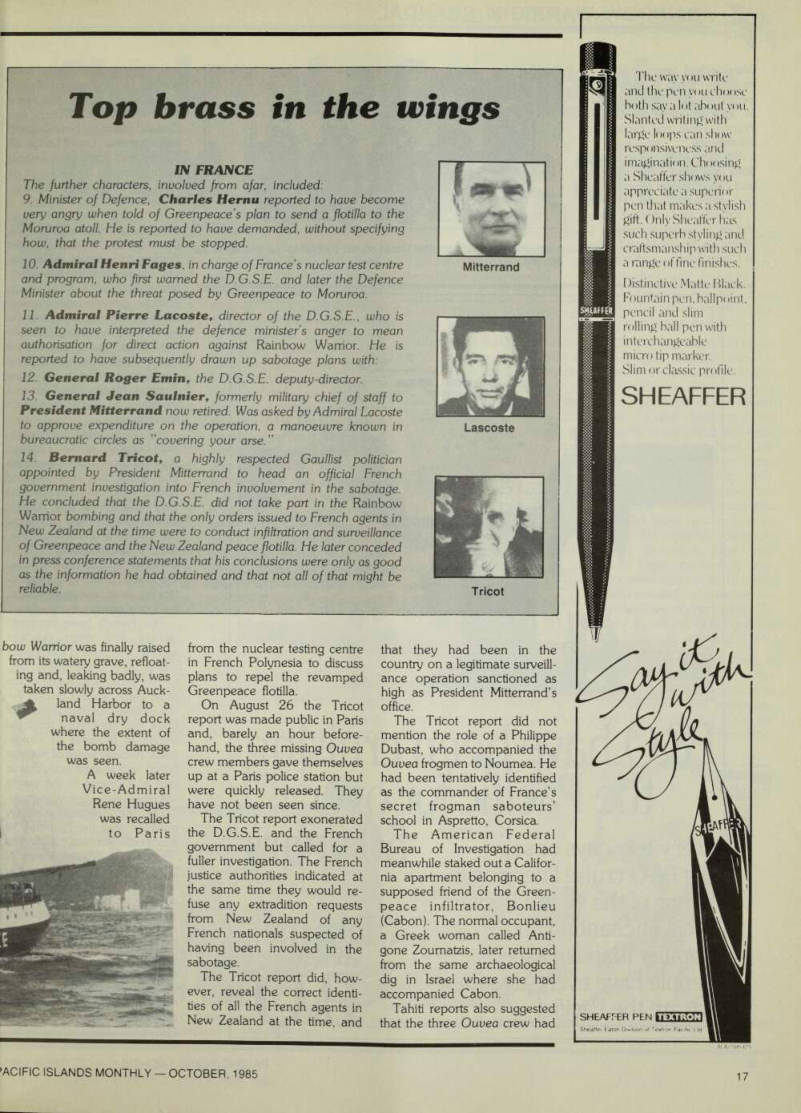
In France
The further characters, involved from afar, included: 9. Minister of Defence, Charles Hemu reported to have become very angry when told of Greenpeace's plan to send a flotilla to the Moruroa atoll. He is reported to have demanded, without specifying how, that the protest must be stopped. 10. Admiral Henri Pages, in charge of France’s nuclear test centre and program, who first warned the D.G.S.E. and later the Defence Minister about the threat posed by Greenpeace to Moruroa. 11. Admiral Pierre Lacoste , director of the D.G.S.E., who is seen to have interpreted the defence minister’s anger to mean authorisation for direct action against Rainbow Warrior. He is reported to have subsequently drawn up sabotage plans with: 12. General Roger Emin, the D.G.S.E. deputy-director. 13. General Jean Saulnier f formerly military chief of staff to President Mitterrand now retired. Was asked by Admiral Lacoste to approve expenditure on the operation, a manoeuvre known in bureaucratic circles as ”covering your arse.” 14. Bernard Tricot, a highly respected Gaullist politician appointed by President Mitterrand to head an official French government investigation into French involvement in the sabotage.
He concluded that the D.G.S.E. did not take part in the Rainbow Warrior bombing and that the only orders issued to French agents in Hew Zealand at the time were to conduct infiltration and surveillance of Greenpeace and the Hew Zealand peace flotilla. He later conceded in press conference statements that his conclusions were only as good as the information he had obtained and that not all of that might be reliable.
Mitterrand
Lascoste
Tricot