worm-wide shame
pp. 12-18 · Read in the full issue

“Rainbow Warrior” Scandal
Saboteurs hoist France worm-wide shame
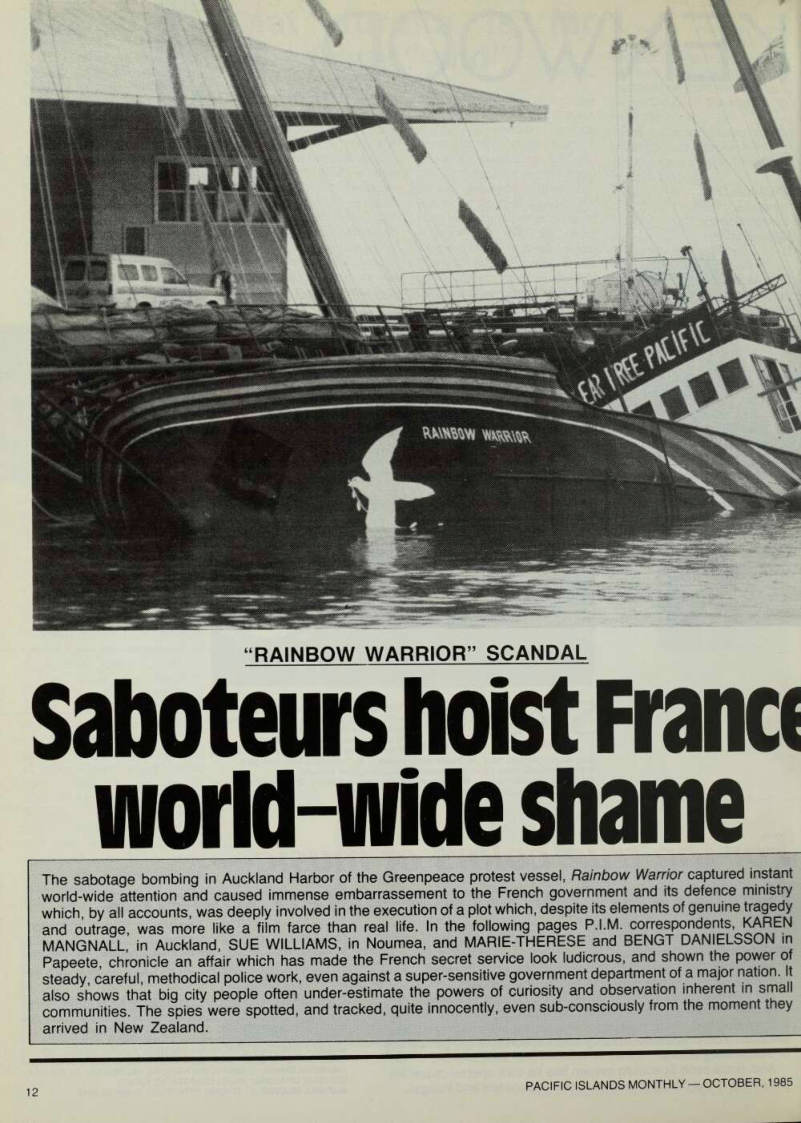
The sabotage bombing in Auckland Harbor of the Greenpeace protest vessel, Rainbow Warrior captured instant world-wide attention and caused immense embarrassement to the French government and its defence ministry which, by all accounts, was deeply involved in the execution of a plot which, despite its elements of genuine tragedy and outrage, was more like a film farce than real life. In the following pages P.I.M. correspondents, KAREN MANGNALL, in Auckland, SUE WILLIAMS, in Noumea, and MARIE-THERESE and BENGT DANIELSSON in Papeete, chronicle an affair which has made the French secret service look ludicrous, and shown the power of steady, careful, methodical police work, even against a super-sensitive government department of a major nation. It also shows that big city people often under-estimate the powers of curiosity and observation inherent in small communities. The spies were spotted, and tracked, quite innocently, even sub-consciously from the moment they arrived in New Zealand.
On November 4, the doors of Auckland’s District Court will open on New Zealand’s most celebrated espionage trial. Its ripples have spread to France, implicating the French overseas secret service, the Direction Generale de la Securite Ex terieure (D.G.S.E.), Defence Minister, Charles Hernu, and the wavelets have begun lap ping at the door of President Mitterrand’s office in the Elysee Palace.
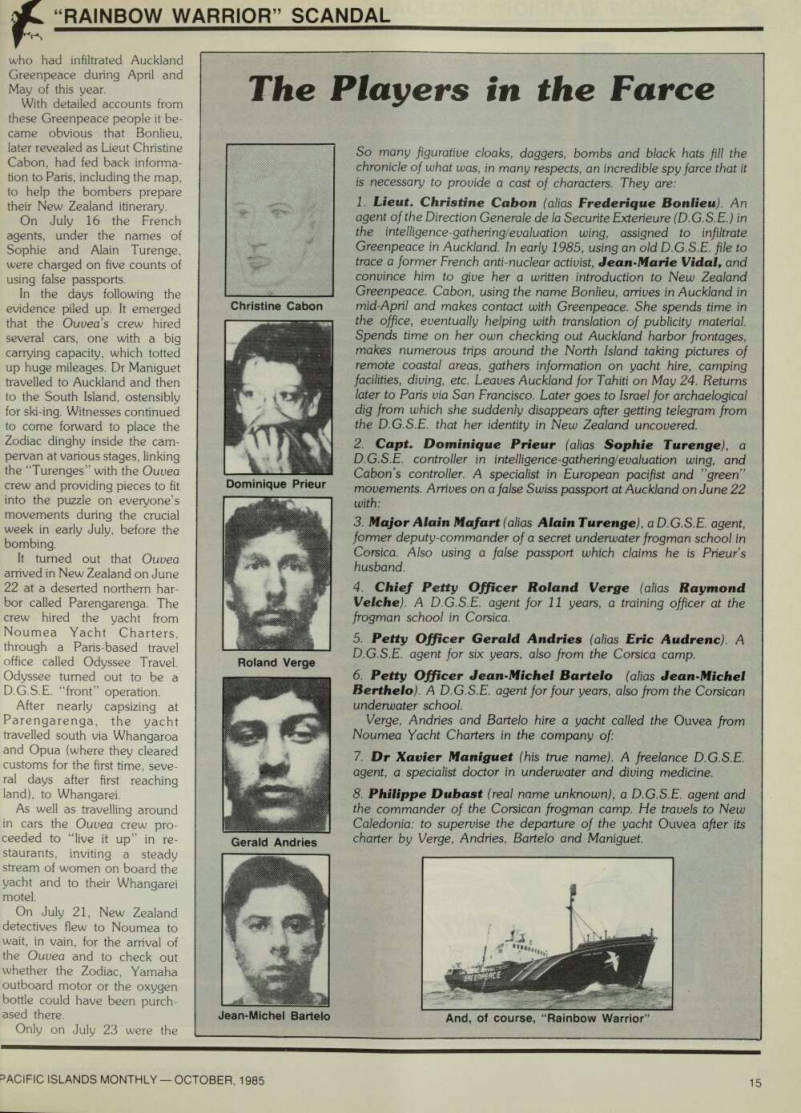
In the dock will be two D.G.S.E. agents, Alain Mafart and Dominique Prieur. They are charged with murder, arson by use of explosives, and con spiracy to commit arson. Also charged with the same crimes, but in absentia, are three other D.G.S.E. agents, all highly skilled underwater sabotage frogmen: Roland Verge, Gerald Andries and Jean-Michel Barte lo.
Also on trial will be French nuclear tests at Moruroa and France’s conduct of its foreign and defence policies.
The first police witness is expected to be Greenpeace New Zealand anti-nuclear cam paign coordinator, Elaine Shaw, who will set the scene of the Greenpeace protest cam paign which brought the 40metre Rainbow Warrior into Auckland harbor on July 7, 1985.
At ten minutes to midnight on July 10 two huge explosions ripped through the Greenpeace flagship as it was moored at Marsden wharf. The Rainbow Warrior’s inhabitants jumped for the wharf or dived into the water as the ship sank in less than four minutes.
But Greenpeace photo grapher, Fernando Pereira, ducked below after the first blast to collect his beloved camera gear. He was trapped in his cabin by the second explo sion and later discovered to have drowned.
Within minutes of the blasts the largest police (and press) investigation in New Zealand’s history had been launched and was in the weeks following to reveal a sabotage operation flawed by French arrogance towards New Zealanders’ pow ers of observation and deduc tion.
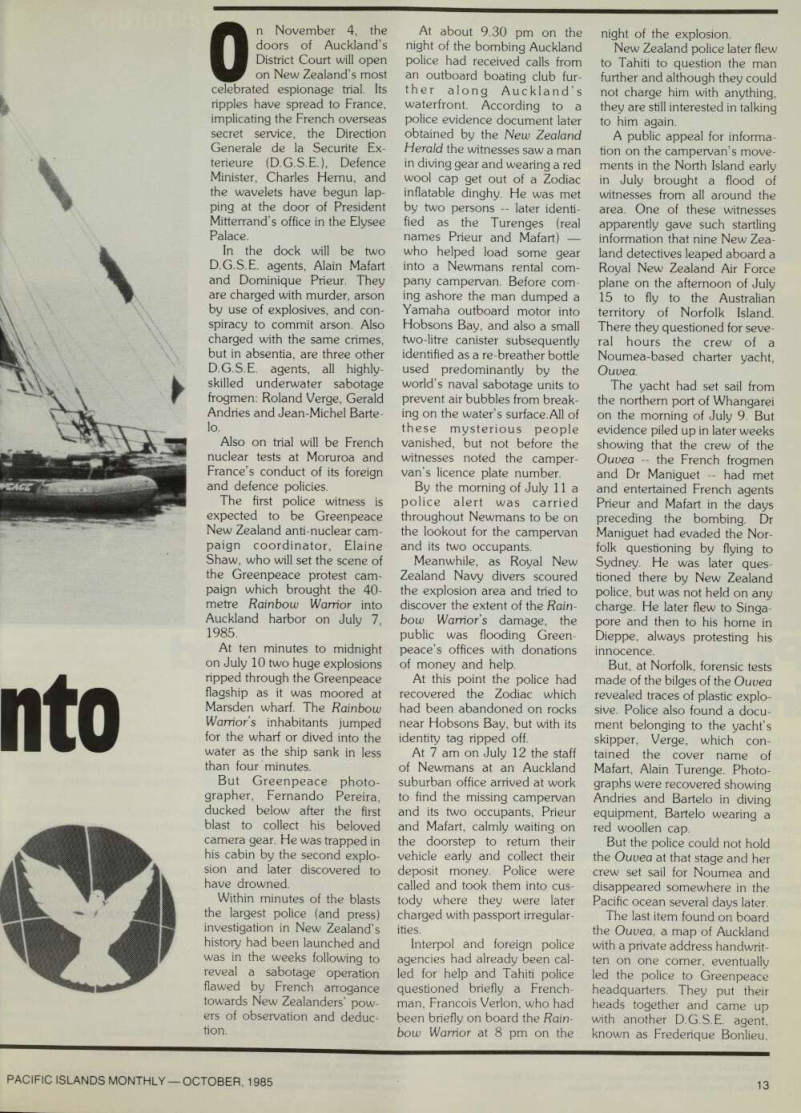
At about 9.30 pm on the night of the bombing Auckland police had received calls from an outboard boating club fur ther along Auckland’s waterfront. According to a police evidence document later obtained by the New Zealand Herald the witnesses saw a man in diving gear and wearing a red wool cap get out of a Zodiac inflatable dinghy. He was met by two persons - later identi fied as the Turenges (real names Prieur and Mafart) who helped load some gear into a Newmans rental com pany campervan. Before com ing ashore the man dumped a Yamaha outboard motor into Hobsons Bay, and also a small two-litre canister subsequently identified as a re-breather bottle used predominantly by the world’s naval sabotage units to prevent air bubbles from break ing on the water’s surface. All of these mysterious people vanished, but not before the witnesses noted the camper van’s licence plate number.
By the morning of July 11a police alert was carried throughout Newmans to be on the lookout for the campervan and its two occupants.
Meanwhile, as Royal New Zealand Navy divers scoured the explosion area and tried to discover the extent of the Rain bow Warriors damage, the public was flooding Green peace’s offices with donations of money and help.
At this point the police had recovered the Zodiac which had been abandoned on rocks near Hobsons Bay, but with its identity tag ripped off.
At 7 am on July 12 the staff of Newmans at an Auckland suburban office arrived at work to find the missing campervan and its two occupants, Prieur and Mafart, calmly waiting on the doorstep to return their vehicle early and collect their deposit money. Police were called and took them into cus tody where they were later charged with passport irregular ities.
Interpol and foreign police agencies had already been cal led for help and Tahiti police questioned briefly a French man, Francois Verlon, who had been briefly on board the Rain bow Warrior at 8 pm on the
night of the explosion.
New Zealand police later flew to Tahiti to question the man further and although they could not charge him with anything, they are still interested in talking to him again.
A public appeal for informa tion on the campervan’s move ments in the North Island early in July brought a flood of witnesses from all around the area. One of these witnesses apparently gave such startling information that nine New Zea land detectives leaped aboard a Royal New Zealand Air Force plane on the afternoon of July 15 to fly to the Australian territory of Norfolk Island.
There they questioned for seve ral hours the crew of a Noumea-based charter yacht, Ouuea.
The yacht had set sail from the northern port of Whangarei on the morning of July 9. But evidence piled up in later weeks showing that the crew of the Ouuea the French frogmen and Dr Maniguet - had met and entertained French agents Prieur and Mafart in the days preceding the bombing. Dr Maniguet had evaded the Nor folk questioning by flying to Sydney. He was later ques tioned there by New Zealand police, but was not held on any charge. He later flew to Singa pore and then to his home in Dieppe, always protesting his innocence.
But, at Norfolk, forensic tests made of the bilges of the Ouuea revealed traces of plastic explo sive. Police also found a docu ment belonging to the yacht’s skipper, Verge, which con tained the cover name of Mafart, Alain Turenge. Photo graphs were recovered showing Andries and Bartelo in diving equipment, Bartelo wearing a red woollen cap.
But the police could not hold the Ouuea at that stage and her crew set sail for Noumea and disappeared somewhere in the Pacific ocean several days later.
The last item found on board the Ouuea, a map of Auckland with a private address handwrit ten on one corner, eventually led the police to Greenpeace headquarters. They put their heads together and came up with another D.G.S.E. agent, known as Frederique Bonlieu,
who had infiltrated Auckland Greenpeace during April and May of this year.
With detailed accounts from these Greenpeace people it be came obvious that Bonlieu, later revealed as Lieut Christine Gabon, had fed back informa tion to Paris, including the map, to help the bombers prepare their New Zealand itinerary.
On July 16 the French agents, under the names of Sophie and Alain Turenge, were charged on five counts of using false passports.
In the days following the evidence piled up. It emerged that the Ouvea’s crew hired several cars, one with a big carrying capacity, which totted up huge mileages. Dr Maniguet travelled to Auckland and then to the South Island, ostensibly for ski-ing. Witnesses continued to come forward to place the Zodiac dinghy inside the cam pervan at various stages, linking the “Turenges” with the Ouvea crew and providing pieces to fit into the puzzle on everyone’s movements during the crucial week in early July, before the bombing.
It turned out that Ouvea arrived in New Zealand on June 22 at a deserted northern har bor called Parengarenga. The crew hired the yacht from Noumea Yacht Charters, through a Paris-based travel office called Odyssee Travel.
Odyssee turned out to be a D.G.S.E. “front” operation.
After nearly capsizing at Parengarenga, the yacht travelled south via Whangaroa and Opua (where they cleared customs for the first time, seve ral days after first reaching land), to Whangarei.
As well as travelling around in cars the Ouvea crew pro ceeded to “live it up” in re staurants, inviting a steady stream of women on board the yacht and to their Whangarei motel.
On July 21, New Zealand detectives flew to Noumea to wait, in vain, for the arrival of the Ouvea and to check out whether the Zodiac, Yamaha outboard motor or the oxygen bottle could have been purch ased there.
Only on July 23 were the
Turenges arrested again and faced with the major charges of murder, arson and conspiracy.
On July 26 arrest warrants were issued for the same charges against three of the Ouuea crew, excluding Dr Man iguet whose role could not be identified.
On July 27, in Israel, the Greenpeace infiltrator, Gabon, received an urgent telegram saying, in effect, “father sick, come home.” Bonlieu left im mediately, catching a T.W.A. flight from Tel Aviv to Paris. It later emerged that her father had died many years ago. On the day she disappeared Auck land newspapers published for
the first time details of her involvement in the sabotage.
During this time the police had begun collecting records of internal and overseas telephone calls placed by all the French agents now identified as being involved in the investigation into the Rainbow Warrior bom bing. A second oxygen re breather bottle was found, quite a distance away from the first one, apparently carried there by tides.
Police started talks with their French counterparts to enable New Zealand detectives to go into France to further investi gate the background of the suspects. Other detectives went to Switzerland to trace the background of the false pass ports used by the couple calling themselves Turenge.
Suddenly information began leaking from the D.G.S.E. in Paris that some of the saboteurs were French agents. Almost simultaneously President Mit terrand went public and or dered a full inquiry to be headed by a counsellor of state, Bernard Tricot.
By August 13, French and Auckland newspapers had be gun revealing a D.G.S.E. plot to blow up the Rainbow Warrior, but the story was sidetracked by claims that the dirty work was actually done by right-wing mercenaries financed on “mate’s rates” by New Caledo nian Caldoches helping out the
D.G.S.E. Then the Zodiac and the Yamaha outboard engine were traced to a London shop, Barnet Marine. The shop manager identified the purchas er as a Frenchman, perhaps Mafart.
Later information revealed that five D.G.S.E. agents, in cluding the crew of the Ouuea, were in London at the time.
The French government had by then begun to strike back against the news revelations by claiming that the sabotage was done by Greenpeace itself, or by “an enemy of France” such as Great Britain, or the Soviet Union.
Inquiries made by the New Zealand Herald suggested that what could have panicked the French into the sabotage was the possibility that the Rainbow Warrior crew could have ad vanced close enough into Moruroa to see large scale destruction of the atoll and also do anecdotal health sur veys of nearby islands. The newspaper also said that this information was prob ably gained by intercep ting Greenpeace correspondence discus sing the possibilities with anti-nuclear activ ist in Tahiti, Bengt Danielsson, and from Gabon’s searching of files in Green peace’s Auckland office.
A joint scien tific report by Auckland geothermal experts and Greenpeace shows that, based on the recent Tazieff and - *
Atkinson reports on Moruroa, the atoll is substantially dam aged and probably beginning to leak increasing amounts ol radio-active nucleides into the surrounding ocean. (This claim was subsequently rejected bv, other New Zealand scientists and a brisk academic argumenl was stirred alongside the majoi story). Simultaneously Neu Zealand newspaper articles alsc recorded the fairly widely-re ported belief that the French will shift their nuclear tests tc Fangataufa.
By August 14 the New Zea land police had asked the French to arrest anc detain all those sus iyt pects wanted in Neu Jp Zealand for the JR Rainbow Warrioi sabotage. Then the I trial of th e Turenges was se for November 4 By this stage press report; all around the world had re vealed theii true identi ties, Mafar and
I Prieur.
I On . Augus 22 the 1 Rain-
Detective-Superintendent Allan Galbraith ... heading New Zea land police inquries in France.
Defence Minister Charles Hernu registers his amazement at reading in the Tricot report that he wasn’t involved at all in the Rainbow Warrior affair. Cartoon by Plantu in Le Monde.
bow Warrior was finally raised from its watery grave, refloat ing and, leaking badly, was taken slowly across Auck #land Harbor to a naval dry dock where the extent of the bomb damage was seen.
A week later Vice-Admiral Rene Hugues was recalled to Paris
from the nuclear testing centre in French Polynesia to discuss plans to repel the revamped Greenpeace flotilla.
On August 26 the Tricot report was made public in Paris and, barely an hour before hand, the three missing Ouvea crew members gave themselves up at a Paris police station but were quickly released. They have not been seen since.
The Tricot report exonerated the D.G.S.E. and the French government but called for a fuller investigation. The French justice authorities indicated at the same time they would re fuse any extradition requests from New Zealand of any French nationals suspected of having been involved in the sabotage.
The Tricot report did, how ever, reveal the correct identi ties of all the French agents in New Zealand at the time, and
that they had been in the country on a legitimate surveill ance operation sanctioned as high as President Mitterrand’s office.
The Tricot report did not mention the role of a Philippe Dubast, who accompanied the Ouvea frogmen to Noumea. He had been tentatively identified as the commander of France’s secret frogman saboteurs’ school in Aspretto, Corsica.
The American Federal Bureau of Investigation had meanwhile staked out a Califor nia apartment belonging to a supposed friend of the Green peace infiltrator, Bonlieu (Gabon). The normal occupant, a Greek woman called Anti gone Zoumatzis, later returned from the same archaeological dig in Israel where she had accompanied Gabon.
Tahiti reports also suggested that the three Ouvea crew had
been picked up in mid-ocean by the French nuclear sub marine, Rubis and dropped off in Papeete on July 22. The French Navy has denied this consistently.
By late August the revela tions had tailed off. The French and New Zealand governments had settled into a war of nerves.
Prieur and Mafart were shifted to separate prisons Mafart in Auckland and Prieur in Christchurch after reports
that French mercenaries were going to break them out of gaol.
The whole episode had cast a black pall over French-New Zealand relations. New Zealand prime minister, David Lange, all but ordered the French ambas sador, Jacques Bourgoin, to go back to Paris in the tense days following the Tricot report.
Mr Lange displayed anger over the assertions in the re port, which he claimed was derisory in some of its aspects.
He made clear he was con vinced of D.G.S.E. and perhaps French government involve ment in the bombing and he reacted with outrage to the report’s admission that France had five agents on a sanctioned intelligence mission in New Zealand. He described this as a violation of New Zealand’s sovereignty.
No doubt more information will become public between now and November 4 when the trial opens, but New Zealand police, while careful in anything they have so far said, appear confident that they can show the depth of French involve ment in the bombing.
French officials have accused the New Zealand police of lacking, or of having fabricated, evidence aganist the couple.
The French have promised instant and stern reaction against the new Greenpeace vessel, the ocean-going tug, Greenpeace and any of the other New Zealand protest flo tilla vessels if they poke their bows into the French territorial waters of Moruroa or Fanga taufa. Another series of neutron bomb tests is apparently due to start at Moruroa in the weeks ahead.
For the French the irony must be that the bombing of Rainbow Warrior, and the “Pink Panther” style farce of the D.G.S.E. operation, has focused wider international attention upon Greenpeace’s protests, and upon their own nuclear test program, than if they had simply ignored the protesters. World-wide cover age of the trial of their agents can only compound that embarrassment. Karen Man gnall in Auckland.
A caustic comment on the Tricot report by cartoonist Plantu in Le Monde.