That duruka is far
p. 10 · Read in the full issue
from “wild”
Pacific vegetables and fruits aren’t mentioned often in the press or in popular publications, and when they are, the reader often gets the impression that they are either “wild” or were introduced into the Pacific fully domesticated from Southeast Asia. A “wild” case concerns your Tradewinds re port (June 1985) on the cook book, A Taste of the Tropics and its associated promotion of fresh tropical products into Aus tralia and New Zealand. Com menting on the book and its “complete guide to tropical fruits and vegetables,” your re porter is impressed by the inclu sion of duruka (Fiji asparagus) “which is, in fact, a wild sugar cane species.”
The reporter perhaps cannot be faulted, for this misinforma tion appears right in the cook book. But the authors of the book should know better. This plant is actually Saccharum edule, related to the sugar canes. The edible part is the
undeveloped flower (the reader should not surmise that it tastes sugary it doesn’t). The point I want to make is that that the flower never develops fully and the plant itself is therefore com pletely dependent upon hu mans for its propagation. It’s hard to find another example of a plant less wild. Its deve lopment is due to careful selec tion of one or more sterile sports by tens of generations of careful, observant Melanesian farmers. In pre-European times it had been spread as far west as the Malay peninsula.
Duruka is just one of the large roster of plants, including breadfruit and sugar-cane, ori ginally developed by Melane sians.
Nevertheless 1 wish well to all involved in the promotion of fresh Pacific foods in Australia and New Zealand especially to the growers! Your Tradewinds reporter added the useful information that duruka (known as pitpit in Papua New
Guinea) is “delicious when braised in coconut milk.” I would also add that it’s excel lent for a barbecue. Best to put the stems on, with leaves intact, before the fire is hot enough to cook the meat.
But we may have to wait a while to taste duruka here. In Fiji, the main crop is harvested in April and May.
N. Bowers
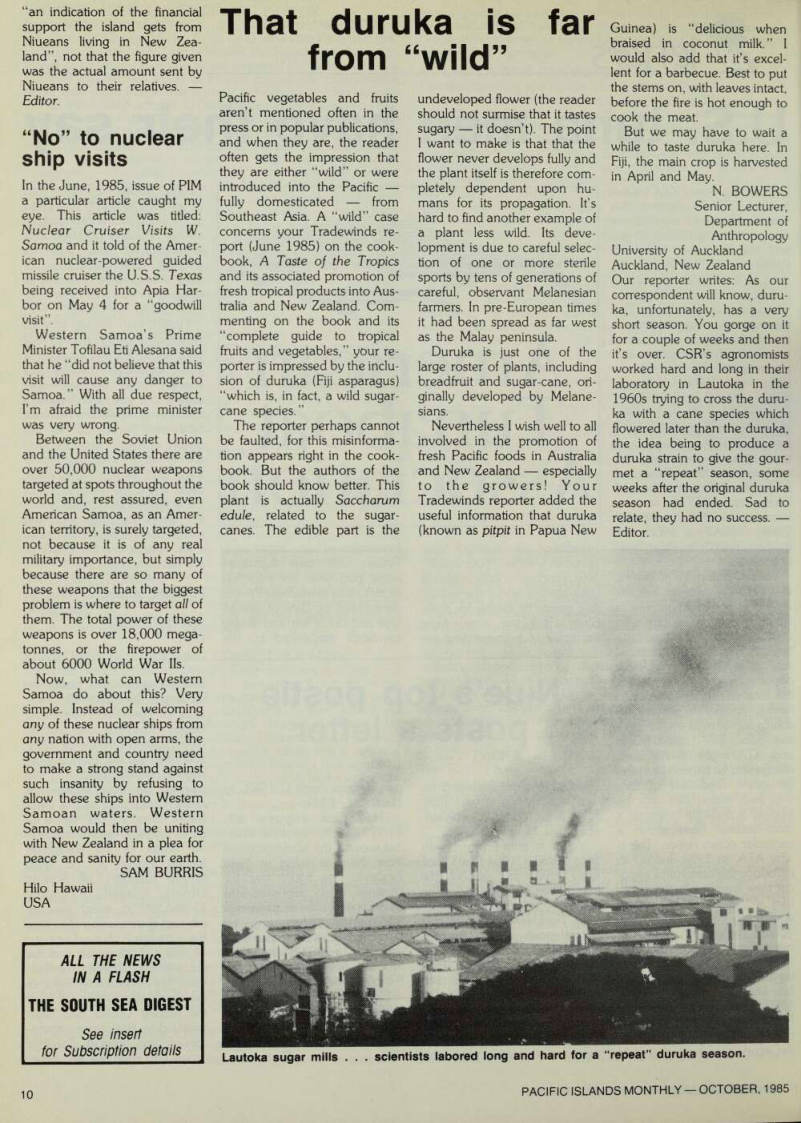
Senior Lecturer, Department of Anthropology University of Auckland Auckland, New Zealand Our reporter writes: As our correspondent will know, duru ka, unfortunately, has a very short season. You gorge on it for a couple of weeks and then it’s over. CSR’s agronomists worked hard and long in their laboratory in Lautoka in the 1960 s trying to cross the duru ka with a cane species which flowered later than the duruka, the idea being to produce a duruka strain to give the gour met a “repeat” season, some weeks after the original duruka season had ended. Sad to relate, they had no success.
Editor.
Lautoka sugar mills . . . scientists labored long and hard for a “repeat” duruka season.