Australia “needs clear
p. 51 · Read in the full issue
political currents
The Png Border Issue
Australia “needs clear policy" on Irina Jaya
By the measure of most regional pundits the re lationship between Papua New Guinea and Indonesia over their land bor der, and the multitude of com plications it involves, is the Pacific region’s most delicate political problem. Papua New Guinea seems, to Pacific eyes, much put-upon and trapped in a situation with very few op tions, and little chance of win ning a point. But Australia is also involved by association and regional necessities, and, according to some, is in need of a coherent policy.
According to some recent reports, Indonesian police and military units have stepped up their activity west of the border, which has led to a renewed influx of refugees into PNG (and some from the south of Irian Jaya who have come on to Australian territory in the Torres Strait area).
The matter is given further emotional voltage by the fact that most Melanesians, and a high proportion of others in terested in the Pacific, consider the Indonesian presence in West Irian to be an example of neo-colonialism. Given that the United Nations is not in the least likely to do anything about that, having been responsible for it in the first place, the border problem is likely to remain for the foreseeable fu ture at least as fragile as it now is.
Noting all of this, the highly influential Australian Financial Review of Sydney, recently suggested in an editorial that it was about time Australia con cocted a clearly defined policy on the security problem on the
border. It was, they said, “an increasingly glaring weakness in Australian foreign policy.”
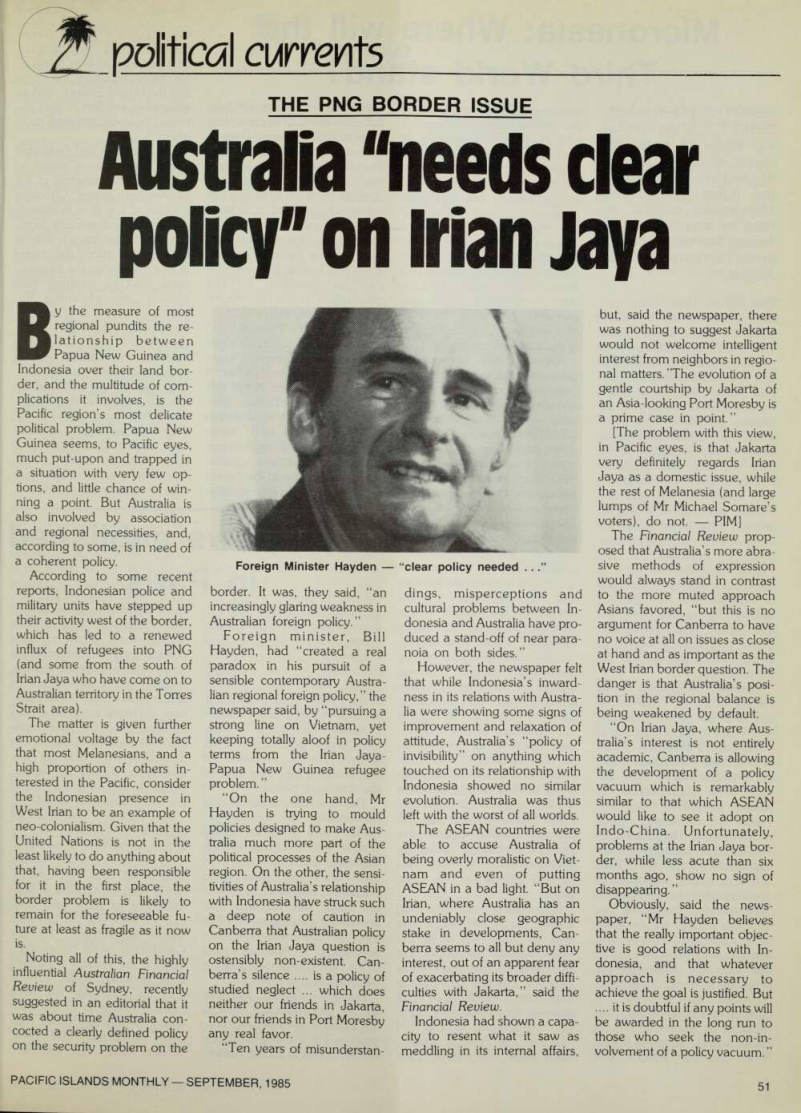
Foreign minister, Bill Hayden, had “created a real paradox in his pursuit of a sensible contemporary Austra lian regional foreign policy,” the newspaper said, by “pursuing a strong line on Vietnam, yet keeping totally aloof in policy terms from the Irian Jaya- Papua New Guinea refugee problem.”
“On the one hand, Mr Hayden is trying to mould policies designed to make Aus tralia much more part of the political processes of the Asian region. On the other, the sensi tivities of Australia’s relationship with Indonesia have struck such a deep note of caution in Canberra that Australian policy on the Irian Jaya question is ostensibly non-existent. Can berra’s silence ... is a policy of studied neglect ... which does neither our friends in Jakarta, nor our friends in Port Moresby any real favor.
“Ten years of misunderstan
dings, misperceptions and cultural problems between In donesia and Australia have pro duced a stand-off of near para noia on both sides.”
However, the newspaper felt that while Indonesia’s inward ness in its relations with Austra lia were showing some signs of improvement and relaxation of attitude, Australia’s “policy of invisibility” on anything which touched on its relationship with Indonesia showed no similar evolution. Australia was thus left with the worst of all worlds.
The ASEAN countries were able to accuse Australia of being overly moralistic on Viet nam and even of putting ASEAN in a bad light. “But on Irian, where Australia has an undeniably close geographic stake in developments, Can berra seems to all but deny any interest, out of an apparent fear of exacerbating its broader diffi culties with Jakarta,” said the Financial Review.
Indonesia had shown a capa city to resent what it saw as meddling in its internal affairs,
but, said the newspaper, there was nothing to suggest Jakarta would not welcome intelligent interest from neighbors in regio nal matters. ’The evolution of a gentle courtship by Jakarta of an Asia-looking Port Moresby is a prime case in point.” [The problem with this view, in Pacific eyes, is that Jakarta very definitely regards Irian Jaya as a domestic issue, while the rest of Melanesia (and large lumps of Mr Michael Somare’s voters), do not. PIM] The Financial Review prop osed that Australia’s more abra sive methods of expression would always stand in contrast to the more muted approach Asians favored, “but this is no argument for Canberra to have no voice at all on issues as close at hand and as important as the West Irian border question. The danger is that Australia’s posi tion in the regional balance is being weakened by default.
“On Irian Jaya, where Aus tralia’s interest is not entirely academic, Canberra is allowing the development of a policy vacuum which is remarkably similar to that which ASEAN would like to see it adopt on Indo-China. Unfortunately, problems at the Irian Jaya bor der, while less acute than six months ago, show no sign of disappearing.”
Obviously, said the news paper, “Mr Hayden believes that the really important objec tive is good relations with In donesia, and that whatever approach is necessary to achieve the goal is justified. But ... it is doubtful if any points will be awarded in the long run to those who seek the non-in volvement of a policy vacuum. ”
Foreign Minister Hayden “clear policy needed ..