air route hub
pp. 49-50 · Read in the full issue

Pacific Air Service
J.A.L. makes Japan an air route hub
More than any other national carrier, Japan Airlines seems to hold high the flag of its country, conveying to its passengers from the moment they cross the threshold of a scrupulously clean J.A.L. jum bo, the atmosphere, and the ethic, of their country.
Flight crews are expert; cabin staff is courteous and attentive to a fault. They are, as W.S. Gil bert might have written, the very model of a modern major miracle of efficiency and, in that, are doing no more than their country expects of them.
In short, J.A.L. is a leading element of that great manufac turing and marketing machine, Japan, Incorporated.
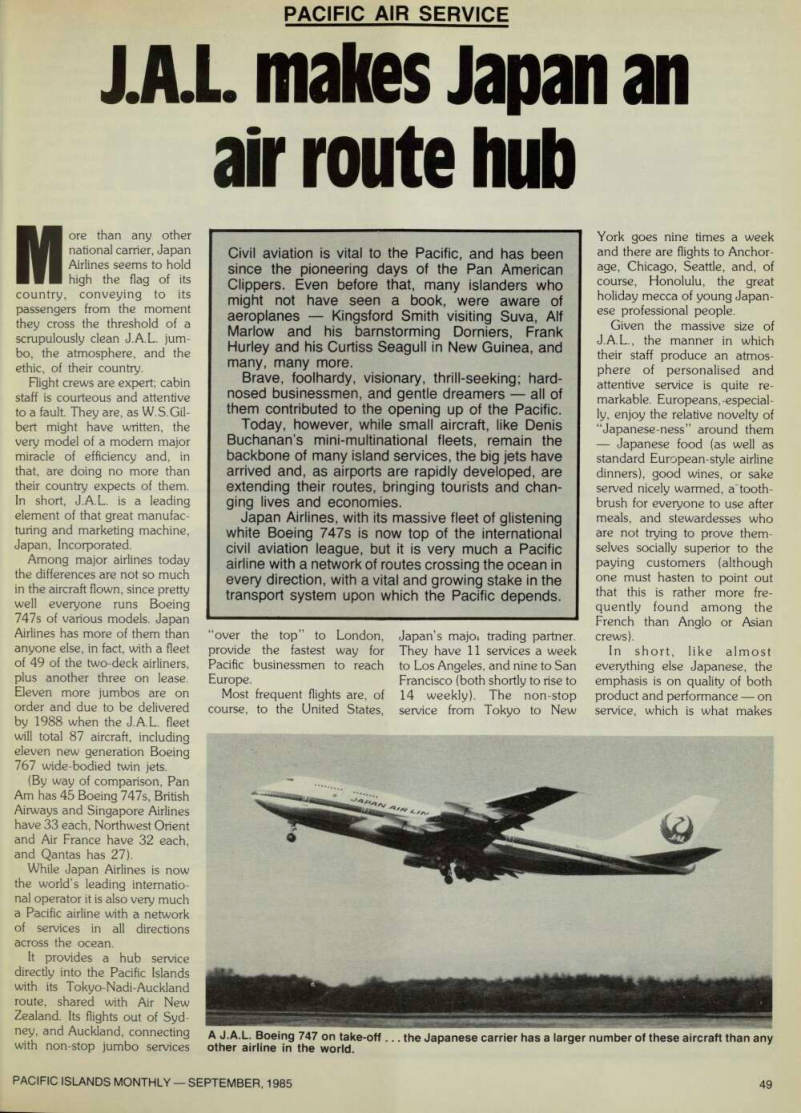
Among major airlines today the differences are not so much in the aircraft flown, since pretty well everyone runs Boeing 747 s of various models. Japan Airlines has more of them than anyone else, in fact, with a fleet of 49 of the two-deck airliners, plus another three on lease.
Eleven more jumbos are on order and due to be delivered by 1988 when the J.A.L. fleet will total 87 aircraft, including eleven new generation Boeing 767 wide-bodied twin jets. (By way of comparison, Pan Am has 45 Boeing 7475, British Airways and Singapore Airlines have 33 each, Northwest Orient and Air France have 32 each, and Qantas has 27).
While Japan Airlines is now the world’s leading internatio nal operator it is also very much a Pacific airline with a network of services in all directions across the ocean.
It provides a hub service directly into the Pacific Islands with its Tokyo-Nadi-Auckland route, shared with Air New Zealand. Its flights out of Syd ney, and Auckland, connecting with non-stop jumbo services
Civil aviation is vital to the Pacific, and has been since the pioneering days of the Pan American Clippers. Even before that, many islanders who might not have seen a book, were aware of aeroplanes Kingsford Smith visiting Suva, Alf Marlow and his barnstorming Dorniers, Frank Hurley and his Curtiss Seagull in New Guinea, and many, many more.
Brave, foolhardy, visionary, thrill-seeking; hard nosed businessmen, and gentle dreamers all of them contributed to the opening up of the Pacific.
Today, however, while small aircraft, like Denis Buchanan’s mini-multinational fleets, remain the backbone of many island services, the big jets have arrived and, as airports are rapidly developed, are extending their routes, bringing tourists and chan ging lives and economies.
Japan Airlines, with its massive fleet of glistening white Boeing 747 s is now top of the international civil aviation league, but it is very much a Pacific airline with a network of routes crossing the ocean in every direction, with a vital and growing stake in the transport system upon which the Pacific depends.
“over the top” to London, provide the fastest way for Pacific businessmen to reach Europe.
Most frequent flights are, of course, to the United States,
Japan’s majoi trading partner.
They have 11 services a week to Los Angeles, and nine to San Francisco (both shortly to rise to 14 weekly). The non-stop service from Tokyo to New
York goes nine times a week and there are flights to Anchor age, Chicago, Seattle, and, of course, Honolulu, the great holiday mecca of young Japan ese professional people.
Given the massive size of J.A.L., the manner in which their staff produce an atmos phere of personalised and attentive service is quite re markable. Europeans,-especial ly, enjoy the relative novelty of “Japanese-ness” around them Japanese food (as well as standard European-style airline dinners), good wines, or sake served nicely warmed, a' tooth brush for everyone to use after meals, and stewardesses who are not trying to prove them selves socially superior to the paying customers (although one must hasten to point out that this is rather more fre quently found among the French than Anglo or Asian crews).
In short, like almost everything else Japanese, the emphasis is on quality of both product and performance on service, which is what makes
A J.A.L. Boeing 747 on take-off... the Japanese carrier has a larger number of these aircraft than any other airline in the world.
the difference among airlines.
More casual Pacific and Au stralasian passengers some times chafe when super-correct J.A.L. captains order the seat belt signs switched on for turbu lence so mild that most folk would scarcely notice it. On the other hand, it is nice to know they really care.
They manage to achieve the close attention to each passen ger’s comfort for which the best of the smaller airlines, Air New Zealand notably among them, have become known. Yet, they don’t turn a hair, and probably don’t have to go outside their own services, if someone rings up wanting to fly a dozen bulldozers to Brazil, or 100 yeti-tamers to Outer Mongolia.
Today Japan Airlines is rank ed first among the 129 mem bers of the International Air Transport Association (lATA) with the top total of internatio nal scheduled passenger and cargo revenue. The figures are slightly mind-boggling.
In the year to March 31, 1984, J.A.L. flew
5,448,280,000 revenue ton kilometres, a rise of 6.7 per cent on the previous year. The line carried 4,917,481 international and 8,294,622 domestic passengers. International cargo totalled 284,740 tons, a rise of nearly 18 per cent, and domes tic cargo, up 6 per cent, was 145,936 tons. In the first half of the 1984-5 financial year all categories were showing in creases, best of all being in ternational passenger traffic, up nearly 12 per cent.
Operating revenues in creased by 1.6 per cent, to 756,199 million yen (about Auss4422 million) while operating costs went down 2.4 per cent to 735,030 million yen (Auss429B million). Operating profit was 21,169 million yen (Aussl23 million), compared with a loss of 8319 million yen (Auss4B million) in the year to March 31, 1983, a rise of 354.5 per cent. Pre-tax profit was 2610 million yen (Aussls.26 million), compared with the previous year’s loss of 3815 million yen (Auss22.3 million),
and that, after tax of 9035 million yen (Ausss2.B million) made a net loss for the year of 6424 million yen (Auss 37.5 million). There was an add back from a depreciation re serve which took the figures just back into the black but no dividend was paid.
However, projections for the year to March 31, 1985, were indicating a good profit and prospects of an eight per cent dividend.J.A.L. serves 55 cities in 33 countries, (it was 57 cities in 35 countries, but services to Teheran and Baghdad have been suspended for the dura tion of the war between Iran and Iraq). Five Japanese cities are on the route map of domes tic services, which makes their domestic traffic volume remark able indeed, not least in the smooth organisation of their handling of massive numbers in very small geographical areas.
In addition to all this airborne enterprise J.A.L. operates Nik ko Hotels International through the JAL Development Corpora tion, in which it has a 67 per
cent interest.
J.A.L. was founded on Aug ust 1, 1951, as a private com pany but in 1953 this was absorbed into a new corpora tion with government capital.
The government remains the largest single shareholder with about 36 per cent. Other major shareholders include five fire and marine insurance com panies, two banks and a Mr Kenji Osano whose holding of 2.43 per cent represents, at current share valuations, a stock market paper fortune of Auss97 million.
Passenger loadings are in creasingly rapidly, as is Japan ese involvement in resort hotel development, into Micronesia parts of which, by some projec tions, will become in the next decade or so a sort of “Miami Beach” for holidaymakers from the major Japanese cities.
Guam already is highly deve loped by Japanese hotel inves tors; Palau has opened a major resort, built for Pan Pacific Hotel Corporation, an arm of the huge Tokyu organisation.